Last Updated on September 16, 2026 by Wisnu Arista H.
Invisible Tech Smart Home Bali: Automation You Cannot See
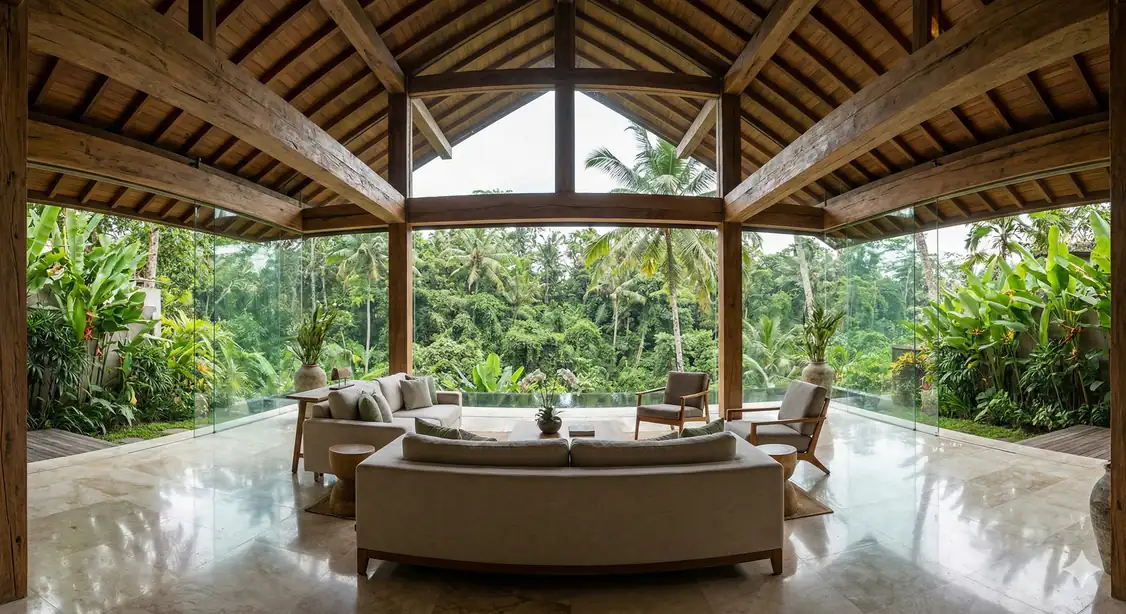
Let’s be honest about building luxury properties in Bali right now. The people buying or renting these villas—whether they’re foreign investors, tech executives, or digital nomads—want the exact same smart-home perks they’d get in a Manhattan penthouse. But here is the catch: they came to the Island of the Gods to escape all that digital noise. They want raw nature, organic textures, and quiet. That is exactly what invisible tech smart home Bali design is for.
So, how do you give them high-tech convenience without ruining the tropical vibe?
You hide it.
This is exactly why the Invisible Tech Smart Home Bali movement has reshaped the luxury market in 2026. At Bali Best Design, we realized a long time ago that slapping a glowing plastic touchscreen onto a beautifully aged, reclaimed teak wall is practically an architectural crime. If you want to dominate the high-end market, your tech needs to act like a silent butler. It should anticipate your needs, but you should rarely ever see it. This is the core philosophy of invisible tech smart home Bali design — technology that serves without intruding.
If you’re planning a project and want to get the Bali Interior Designer Service right, here is how good design makes the technology disappear.
1. The Golden Rule: Tech as a Silent Butler
Think back to a few years ago. Having a massive TV screen and a wall filled with smart switches was a huge status symbol. Not anymore. In 2026, real luxury is “Quiet Luxury.” People are paying top dollar for visual silence.
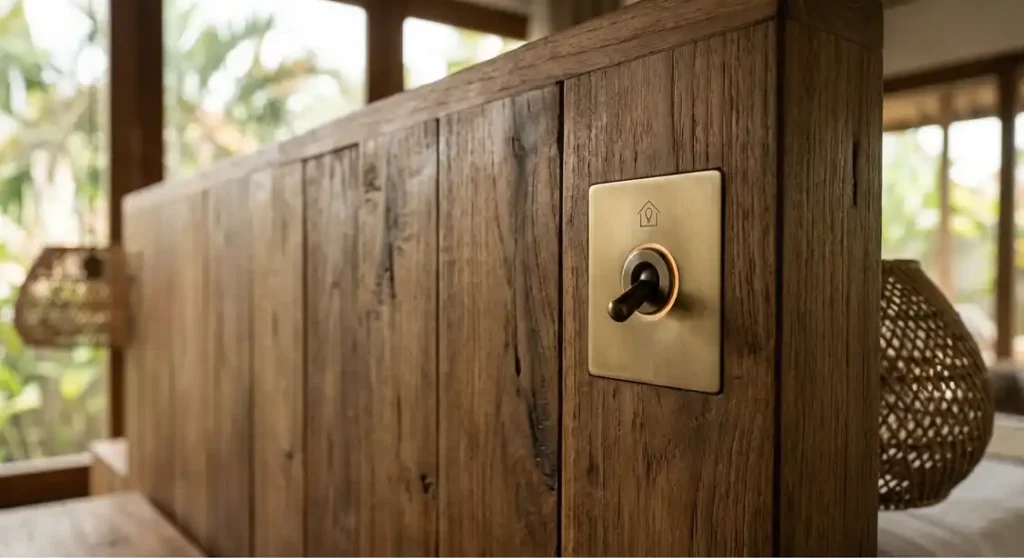
When we design a space, the goal is to make the infrastructure completely unseen. Instead of lining a wall with plastic dimmers, the design hides the control panels behind custom, push-to-open wooden panels. The drawings also mark where your electrical contractor and AV integrator run the CAT6 cabling, so it is in place long before the walls are closed. For the switches that absolutely must be accessible, ditch the plastic and specify solid brass micro-switches or custom-carved natural stone toggles that actually feel like they belong in a jungle sanctuary.
It takes a lot more planning, but the result is a living room that feels like a serene temple, not a spaceship.
If you are still gathering ideas, our guide to Sustainable Interior Design Trends Bali 2026.
2. Hacking the Sunrise: Circadian Rhythm Lighting
If you’re building a wellness-focused villa, you can’t ignore how light affects the human body. This is where invisible tech really shines.
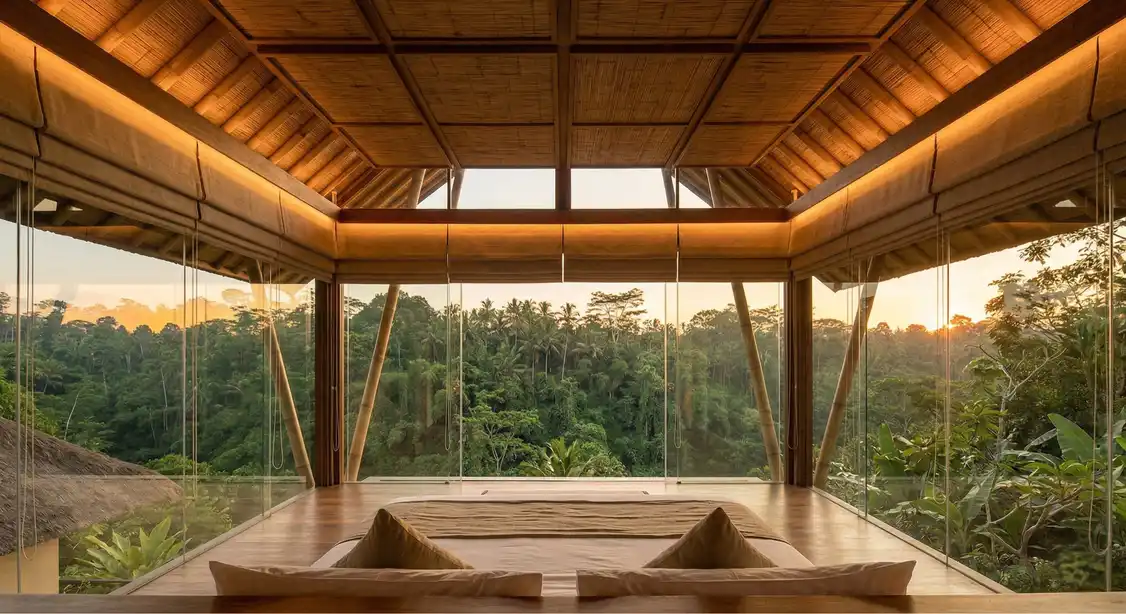
Instead of just turning lights on and off, modern eco-luxury villas use circadian rhythm automation. The house literally tracks the Balinese sun. In the morning, as the sun comes up over the rice paddies, your bedroom lights don’t just click on. They slowly fade up using cool, blue-white tones to naturally suppress melatonin and wake you up gently.
When the midday heat hits, sensors on the roof pick up the glare. The house automatically drops motorized blackout blinds (which roll down from hidden ceiling pockets) and dims the interior lights to keep the house cool. Then, right around sunset, the lighting shifts entirely to warm, amber tones—mimicking a campfire. You don’t have to press a single button or open an app. The house just takes care of your biological clock.
3. Smart Climate Control That Respects the Climate
Air conditioning in the tropics is non-negotiable. But let’s face it: split AC units hanging on the wall are ugly. Good design reduces how hard it has to work in the first place — see our guide to passive cooling techniques for what to get right before automation takes over.
In a well-designed villa, you won’t see them. Your MEP engineer specifies a Variable Refrigerant Volume (VRV) system, and the interior design tucks it entirely out of sight inside woven bamboo drop-ceilings. The cold air falls through ultra-slim, linear diffusers that just look like a natural shadow line in the architecture.
But the smartest part isn’t the cooling—it’s the energy management. Your integrator can embed tiny, invisible magnetic sensors inside the frames of those massive glass sliding doors. If a guest slides the doors open to let in the ocean breeze, the smart home system notices immediately. It quietly shuts off the AC in that specific zone so you aren’t air-conditioning the whole neighborhood. It’s a massive win for sustainability, and your monthly energy bill will thank you. This kind of zone-responsive climate logic is what separates a genuine invisible tech smart home Bali build from a villa that merely has a smart thermostat.
4. Speakers in the Walls? The New Era of Entertainment
Entertainment systems have always been the enemy of minimalist design. You spend weeks picking out the perfect volcanic stone for an accent wall, only to cover it up with a giant black TV and chunky floor speakers.
That approach is out.
For audio, specify invisible speaker technology. These transducers are literally installed into the drywall or ceiling, and then plastered and painted completely over. The wall itself vibrates to create exceptionally rich, room-filling sound. You look around the room trying to find where the music is coming from, and there’s nothing there.
For visuals, ultra-short-throw 4K laser projectors can hide inside custom teak credenzas. When it’s movie night, a motorized screen drops down from a hidden ceiling slit. When the movie is over, the screen rolls up, the projector turns off, and you have your beautiful living room back.
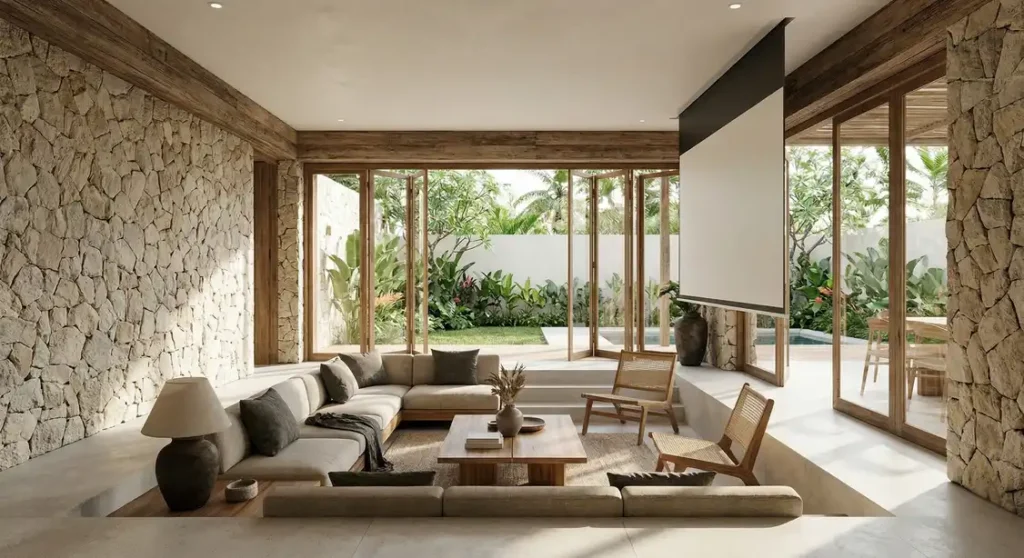
5. Security That Doesn’t Feel Like a Fortress
High-net-worth expats want serious security, but they definitely don’t want their tropical getaway to feel like a maximum-security prison.
Bulky cameras and massive digital deadbolts kill the vibe. Instead, your security installer can flush-mount camera lenses directly into the eaves of the roofline, color-matching them so they disappear into the dark wood. At the front door, sleek biometric fingerprint scanners can be built straight into custom brass handles. It’s effortless, it’s highly secure, and it looks flawless.
6. The Real Question: Does Invisible Tech Smart Home Boost ROI?
Look, I’ll be completely straight with you: integrating invisible tech requires meticulous architectural planning, and yes, it costs more upfront than buying off-the-shelf smart gadgets. But does it pay off? Absolutely.
What we are seeing across the Bali market in 2026 is that villas with seamless, invisible automation sit at the top of the luxury listings rather than competing on price. Wealthy renters actively seek out properties that offer friction-free living without the visual clutter. Plus, the automated energy savings from smart blinds and door-sensor climate control will meaningfully cut your operational costs over time, the same goal our guide to net zero villa design approaches from the building envelope down.
Planning the tech into a villa is a drawing-stage job, not a shopping list you deal with at the end. Our Bali interior design studio can plan the concealment, joinery and lighting with your integrator before the walls close. Send us your plans.
Invisible Tech Smart Home Bali: FAQ
Invisible tech refers to smart home automation systems that are fully integrated and concealed within a villa’s architecture — no visible cables, plastic panels, or wall-mounted screens. Control panels hide behind custom wooden facades, speakers are plastered into walls, and climate systems are tucked inside woven bamboo ceilings, making the technology indistinguishable from the design itself.
Generally, yes. Villas with seamlessly integrated automation tend to command higher Average Daily Rates on luxury platforms because high-net-worth guests expect friction-free living without visual clutter. The key is invisible integration — off-the-shelf smart gadgets mounted visibly on walls have the opposite effect on perceived luxury.
Costs vary by scope, but invisible tech integration costs more than standard visible smart systems. The premium comes from pre-construction cable routing, custom concealment joinery, and higher-grade components. The ROI comes from higher ADR, lower energy bills from automated climate zoning, and reduced maintenance from built-to-last infrastructure.
Partial retrofits are possible — motorized blinds, smart locks, and climate zoning can be added to existing builds. However, full invisible integration (in-wall speakers, fully concealed control panels, structured cabling) is significantly easier and cheaper to achieve during construction or a major renovation, before walls are closed up.