Last Updated on September 18, 2026 by Wisnu Arista H.
How to Hire an Interior Designer in Bali — Without Getting Burned
Let’s be brutally honest. Bali is full of incredibly talented designers, but the island is also full of construction horror stories, ballooning budgets, and abandoned projects. The difference between a profitable tropical oasis and a financial disaster almost always happens before the project even starts. If you are figuring out how to hire an interior designer in Bali, you are not just looking for someone to pick out pretty paint colors and rattan chairs. You are looking for a strategic partner to manage your CapEx (Capital Expenditure). In this highly competitive market, hiring the wrong person costs you in ruined materials and delayed openings.
Here is the uncompromising, insider guide on how to navigate the Bali design industry, ask the hard questions, and protect your investment before you sign a single contract.
If you are still early in your research, start with our overview of interior design in Bali to understand the full scope of what a professional engagement looks like before diving into the hiring process.
What Does an Interior Designer in Bali Actually Do?
An interior designer in Bali is responsible for spatial planning, coordination with the MEP (Mechanical, Electrical, and Plumbing) layout, custom furniture design, and material sourcing suited for high humidity. They act as the bridge between your aesthetic vision and the structural reality, ensuring the property is both beautiful and highly functional.
Key responsibilities of a Bali interior designer:
- Space Planning: Optimizing layouts for natural airflow and indoor-outdoor living.
- Material Specification: Selecting woods and fabrics that survive tropical moisture.
- Custom Millwork: Designing built-in cabinetry and bespoke furniture.
- Project Coordination: Liaising with local contractors and artisans.
- Procurement: Managing the purchasing and delivery of all interior FF&E.
The Difference Between an Interior Designer, a Decorator, and a Contractor in Bali
Many foreign investors make the fatal mistake of hiring the wrong professional for the job.
- The Interior Designer: Handles the technical planning, lighting architecture, and spatial flow. They are the “brains” of the interior operation.
- The Decorator: Focuses purely on the surface—cushions, art, and loose furniture. They do not handle structural or MEP changes.
- The Contractor: The team that physically swings the hammers. Some studios offer “Turnkey” design-and-build services, acting as your single point of accountability. Others design the interiors and supervise the fit-out while a licensed contractor builds. Know which model you are signing.
Do You Need an Architect AND an Interior Designer?
If you are building a new luxury villa from the ground up, the answer is almost always yes. An architect focuses on the exterior structural shell and securing local building permits (PBG). The interior designer focuses on how the space is actually lived in, ensuring the internal flow makes sense for a luxury lifestyle. We break that split down in detail in our guide to interior designer vs architect in Bali.
For commercial builds — hotels, restaurants, beach clubs, and retail spaces — the coordination between architect, designer, and MEP engineer becomes even more critical. Our commercial interior design in Bali playbook covers that process in full.
How to Find the Right Interior Designer in Bali
Do not hire a designer based solely on a beautiful Instagram feed.
Where to Look — and Where Not To
Avoid generic expat Facebook groups where anyone with a laptop claims to be a designer. Instead, look at high-performing luxury villas on Airbnb or Booking.com in areas like Canggu or Uluwatu. If you love the space, contact the villa management and ask who designed it. Alternatively, seek out established studios that have a physical office presence on the island.
How to Verify a Designer’s Track Record in Bali
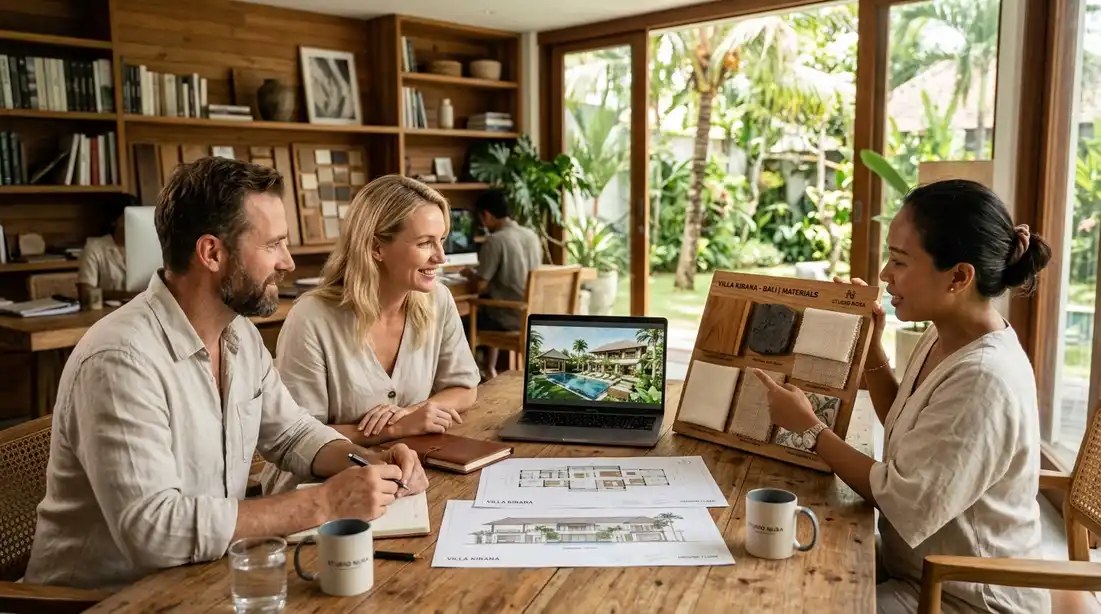
Before you request a portfolio, ask one simple question: can I speak to two past clients directly? Not read their testimonials. Not browse their Google reviews. Actually call or message someone who has been through a full project with this studio. A legitimate designer with a real track record will make those introductions without hesitation. One who deflects, delays, or offers written references instead — that deflection is your answer.
How to Read a Design Portfolio Like a Professional
When reviewing a portfolio, you need to look past the aesthetics. Ask these specific questions:
- “Are these 3D renders or real photos?” Many amateur designers only show computer-generated images because they lack the experience to actually execute a build.
- “How is this teak wood holding up today?” Ask to see projects that were completed 2 or 3 years ago to see how their material choices withstand Bali’s harsh elements.
- “Who was your main contractor for this?” A great designer has a vetted network of reliable local builders.
The Questions You Must Ask Before You Sign Anything
Never sign a contract based on good vibes alone. You must be deeply critical during the consultation phase.
Questions About Process and Timeline
Before committing, understand how the designer handles real-world challenges on a Bali project:
- How do you handle supply chain delays when importing materials from Java?
- Will you provide weekly site inspections, or only technical drawings?
- What happens if the construction timeline shifts?
- How do you coordinate with contractors and local artisans during execution?
Questions About Fees, Contracts, and Scope
Clarity here protects your budget:
- Does your design fee include revisions? What is the limit before extra charges apply?
- Are 3D photorealistic renders included or billed separately?
- How are procurement markups handled?
- What exactly is included in your scope — and what is not?
Never rely on assumptions. If something is not clearly written, it is not guaranteed.
The Red Flags That Should Make You Walk Away
Treat the following as serious warning signs. One issue may not disqualify a designer, but it should prompt deeper verification before you move forward.
- Recommends standard MDF wood or non-treated fabrics for semi-outdoor spaces. If a designer cannot speak confidently about material performance in tropical climates, they are not ready for a Bali project. For a deeper understanding of what responsible material selection looks like, read our guide on sustainable interior trends in Bali
- Offers a price that seems “too good to be true” (they will likely make up the difference by taking massive, hidden commissions from low-quality suppliers).
- Hesitates to show you a detailed, itemized contract.
At this stage, you should have a clear picture of how the designer works, how they structure their fees, and how transparent they are during the consultation phase.
If you still feel unsure, that uncertainty is important. Most costly mistakes happen when decisions are rushed without full clarity.
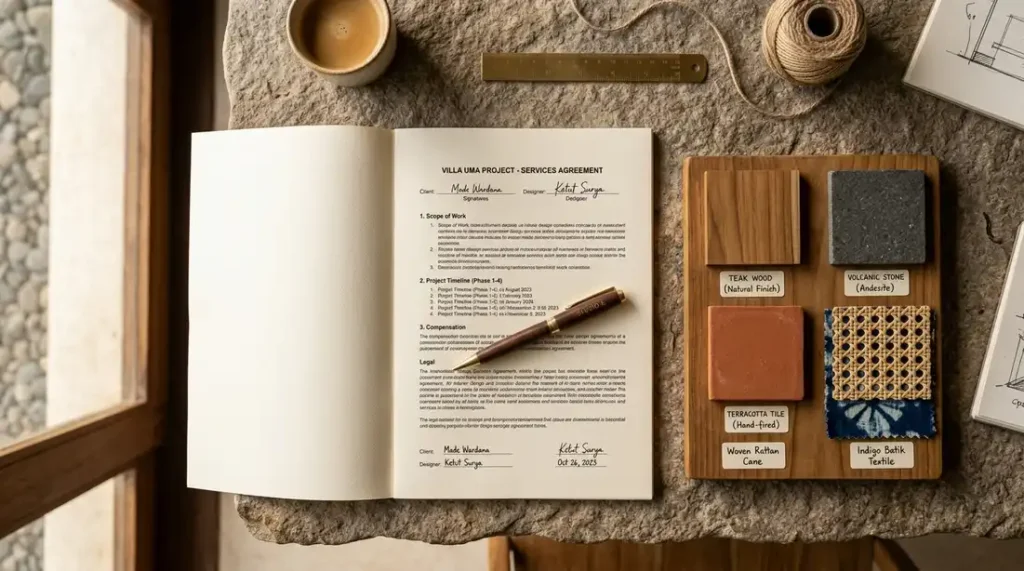
What a Legitimate Interior Design Contract in Bali Must Include
A professional contract should clearly define the full scope of the project. At a minimum, it must include:
- Itemized scope of work per room
What exactly is being designed and delivered - Deliverables per project phase
Concept, 3D renders, technical drawings, execution support - Payment schedule tied to milestones
Payments should follow progress — not arbitrary dates - Revision limits and overage terms
How many revisions are included before extra fees apply - Termination clause and ownership rights
Who owns the drawings, renders, and work if the project stops - Registered legal entity (PT or PT PMA)
Proof the studio is a legitimate business in Indonesia
If any of these are unclear or missing, the contract is not protecting you.
Interior Designer Hiring Checklist for Bali
Before signing any contract, make sure you can confidently check every item below:
Legal & Credibility
- □ The studio operates under a registered Indonesian entity (PT or PT PMA)
- □ You have spoken directly with at least 1–2 past clients
- □ You have seen real completed project photos, not only 3D renders
Scope & Deliverables
- □ You received a clear, itemized scope of work per room
- □ Deliverables are defined for each phase (concept, 3D, drawings, execution)
- □ The number of revisions is clearly stated
Contract & Payment
- □ Payment schedule is tied to milestones, not dates
- □ Ownership of drawings and renders is clearly defined
- □ Termination terms are clearly written
Materials & Execution
- □ Materials are specified for tropical conditions (humidity, salt air)
- □ Designer can explain why each material is chosen
- □ You understand where furniture and materials are sourced
Budget & Hidden Costs
- □ Procurement markup (if any) is clearly disclosed
- □ Additional fees (coordination, revisions, site visits) are explained
- □ No vague or “to be confirmed” pricing in critical areas
Communication & Project Management
- □ Weekly reporting format is clearly defined (PDF + video walkthrough)
- □ Site visit frequency is agreed
- □ Decision timeline is clear
Final Decision Check
- □ You feel comfortable asking difficult questions
- □ The designer answers clearly, not vaguely
- □ Nothing important is “left for later discussion”
How to Hire an Interior Designer in Bali Remotely
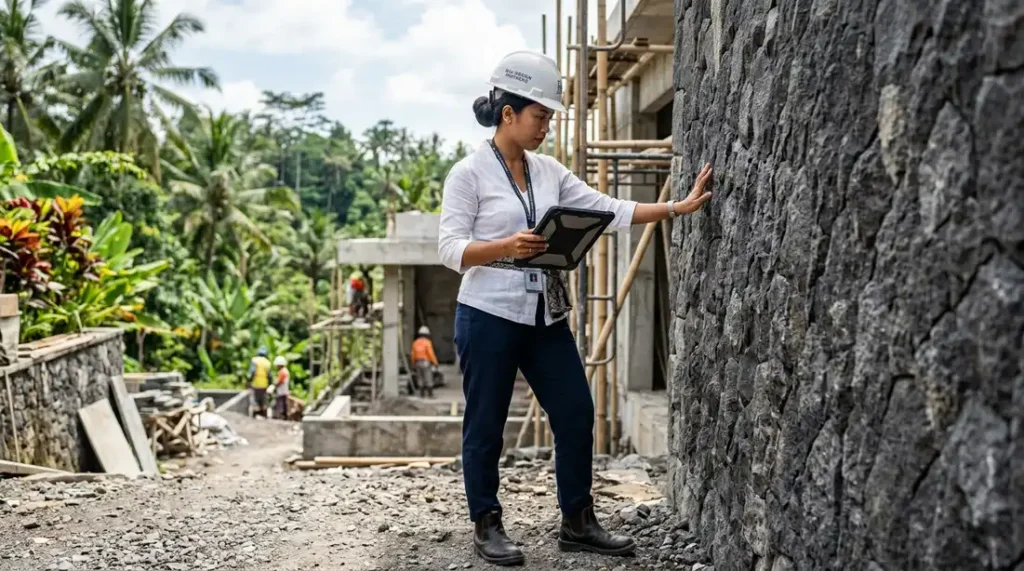
The vast majority of property investors are living in Australia, Europe, or Singapore while their Bali villa is being built. Managing a project remotely requires an elite level of communication. You can also brief a designer entirely online through our online interior design service.
How Weekly Reporting Should Work on a Remote Project
You cannot rely on sporadic WhatsApp messages. Your designer must commit to a structured reporting system. Expect a weekly PDF progress report combined with a video walkthrough of the site. You need to see the progress with your own eyes, not just read about it.
What Decisions You Must Make In-Person vs. Remotely
You can approve floor plans and 3D renders over Zoom. However, you should try to fly to Bali for the “Touch and Feel” phase. Testing the comfort of a custom sofa, approving the stain color on teak wood, and feeling the texture of natural stone are decisions that are incredibly risky to make through a computer screen.
Understanding Interior Design Fees in Bali
How do designers actually charge in Indonesia? There are three standard models:
1. Price Per Square Meter (SQM)
This is the most common and transparent system in Bali. You pay a fixed rate based on the total square meterage of the property being designed.
2. Fixed Fee
Great for strict budgets. The designer quotes a single, flat rate for the entire scope of work, regardless of the square meterage.
3. Percentage of Project Cost
Commonly quoted at 10% to 20% of the total build cost, which is the usual industry range. This is highly common for “Turnkey” services where the designer is also managing the contractors and the entire procurement process.
Hiring the right interior designer in Bali is the single most important decision you make before breaking ground. Get it right and everything else follows. Get it wrong and you spend the next six months managing someone else’s mistakes with your own money.
If you want a studio that designs your interiors, produces the custom furniture and supervises the interior fit-out alongside your builder — get in touch with our Bali interior design team. We’ll walk you through our process, our contract structure, and our portfolio before you commit to anything.
What Hidden Costs to Watch for in a Bali Design Project
The fee model is only part of the picture. Watch for procurement markups — markups commonly run 15% to 35% over trade cost, and some studios go higher, without disclosing it upfront. Watch for revision fees that kick in after a single round of changes. And watch for “coordination fees” billed separately from both the design fee and the project management fee. None of these are illegitimate, but all of them should be declared in writing before you sign anything.
Once you have chosen your designer, here is the interior design process in Bali step by step.
FAQ — Hiring an Interior Designer in Bali
For a standard 3-bedroom luxury villa, the design phase (concept, 3D renders, and technical drawings) typically takes 4 to 8 weeks. However, the procurement, custom furniture production, and final installation can add an additional 3 to 5 months depending on the complexity of the materials.
Yes, but it requires hiring a highly professional agency. You must ensure your contract guarantees weekly video walkthroughs and detailed PDF progress reports. A remote build fails when communication breaks down, so establishing a strict reporting cadence is mandatory.
A design fee strictly covers the intellectual property: mood boards, spatial planning, 3D renders, and technical CAD drawings. A project management fee (often an additional percentage) pays for the designer to physically visit the construction site weekly to ensure the local contractors are actually following those drawings accurately.
Always verify their legal standing. They should operate under a registered Indonesian entity (PT or PT PMA) and have a physical studio you can visit. Furthermore, demand to speak with two of their past clients and physically visit one of their completed projects.