Last Updated on October 1, 2026 by Wisnu Arista H.
Coworking Space Design Bali: Zones, Acoustics and Power
Let’s stop pretending that adding a few extra power outlets and a fast router to a coffee shop makes it a legitimate workspace. Good coworking space design in Bali isn’t like that.
The digital nomad market in Bali has evolved aggressively. Ten years ago, expats were happy to work from a hammock in Ubud. Today, many of them run companies, manage remote teams in Europe, and take client calls across time zones. They do not want a bohemian cafe. They want a high-performance productivity hub.
If you are planning a coworking space in Bali, your aesthetic is secondary to your engineering. You are selling focus, reliability, and professional networking. Cheap chairs give members backaches. A blender drowns out their client calls. Either way, they will cancel their $200/month memberships immediately.
As an interior design studio in Bali, here is our blueprint for planning high-retention workspaces that drive consistent monthly recurring revenue.
The Ergonomics of Prolonged Member Retention
In a restaurant, you design chairs to turn tables over quickly. In a coworking space, you are playing the exact opposite game. You want your members to sit at their desks for eight hours straight without realizing how much time has passed.
Your entire business model relies on physical comfort. If you cheap out on ergonomics, you lose. In coworking design, ergonomics is not a premium upgrade: it is the core product you are selling.
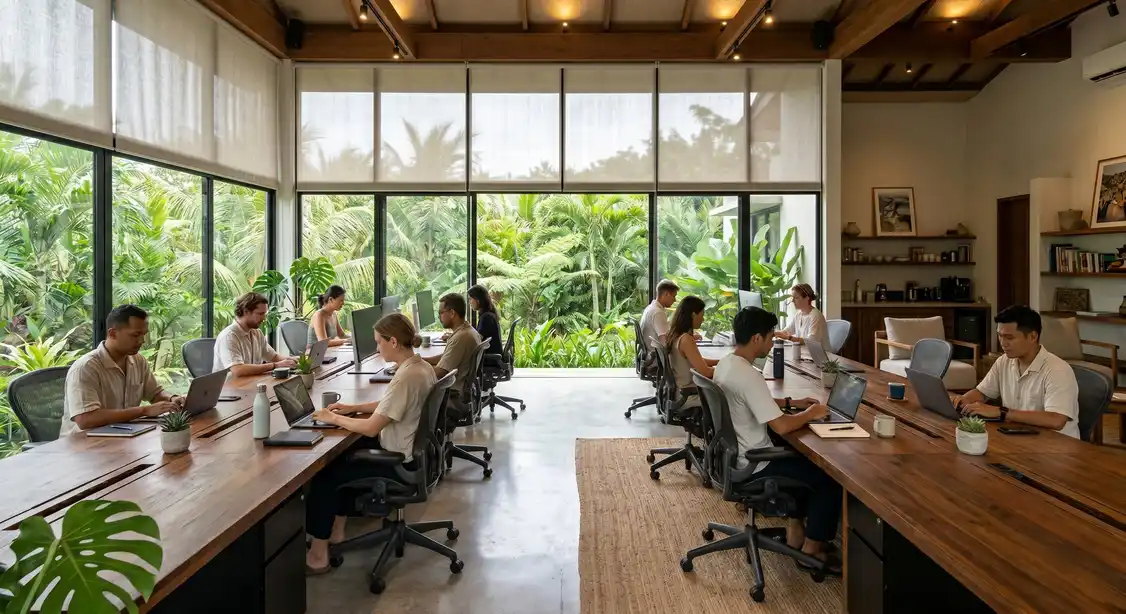
- The Desk Depth Dictator: A standard cafe table and most basic office desks are around 60cm deep. That is workable for a laptop-only setup. However, it becomes an ergonomic problem once you add an external monitor, keyboard, and wrist space. A proper coworking desk must be at least 70cm to 80cm deep. This allows correct monitor distance, reduces eye strain, and provides ample surface area for full-day work.
- The “Herman Miller” Standard: Do not buy aesthetic wooden chairs or trendy rattan stools for the focused work zones. It is a common and costly mistake. You must invest heavily in high-end, adjustable, ergonomic mesh task chairs with lumbar support. It is a significant upfront capital expense. Even so, ergonomic seating is one of the first things members judge a space by.
- Stand-Up Infrastructure: You must integrate motorized standing desks into the floor plan. Modern workers demand the ability to shift postures. However, these require flawless cable management underneath to prevent massive tangles of laptop chargers when the desks move up and down.
We are applying this in our current fit-out for Alpha Prime Office in Berawa. Consultation desks were planned as paired stations with dedicated power at each desk before construction began.
The same thinking shaped the property management office we designed for Lokalé in Kayu Tulang, Canggu: three floors on a narrow plot, with fleet parking, offices and a rooftop staff terrace.
The “Screen Glare” Dilemma (Tropical Lighting)
Bali is famous for its incredible, aggressive natural sunlight. Architecturally, you want massive glass windows to show off the rice paddy or ocean views. But practically? Direct sunlight is the primary enemy of a laptop screen.
If a member has to squint to see their spreadsheet, they will pack up and leave.
- The North-South Orientation: Smart commercial architects design the building so the primary glass facades face North or South. This allows for massive amounts of ambient natural light without the blinding, direct horizontal rays of the morning East or afternoon West sun hitting the screens.
- Automated Solar Diffusers: If you have West-facing windows, you cannot just use blackout curtains (that kills the vibe). Install semi-translucent motorized roller blinds that track the sun. These diffuse harsh glare while keeping the workspace naturally bright.
- Lux Levels and Task Lighting: Ambient lighting should sit between 300 and 500 Lux. This provides comfortable illumination for navigation and casual work without feeling harsh or clinical. However, ambient light alone is not enough for sustained computer work. Every desk should also have access to an individual, adjustable task light capable of boosting the specific work surface to 500 Lux or higher. This two-layer approach (lower ambient paired with higher task lighting) follows the IES (Illuminating Engineering Society) standard for productive office environments.
Acoustic Engineering and Spatial Zoning for the Video Call Era
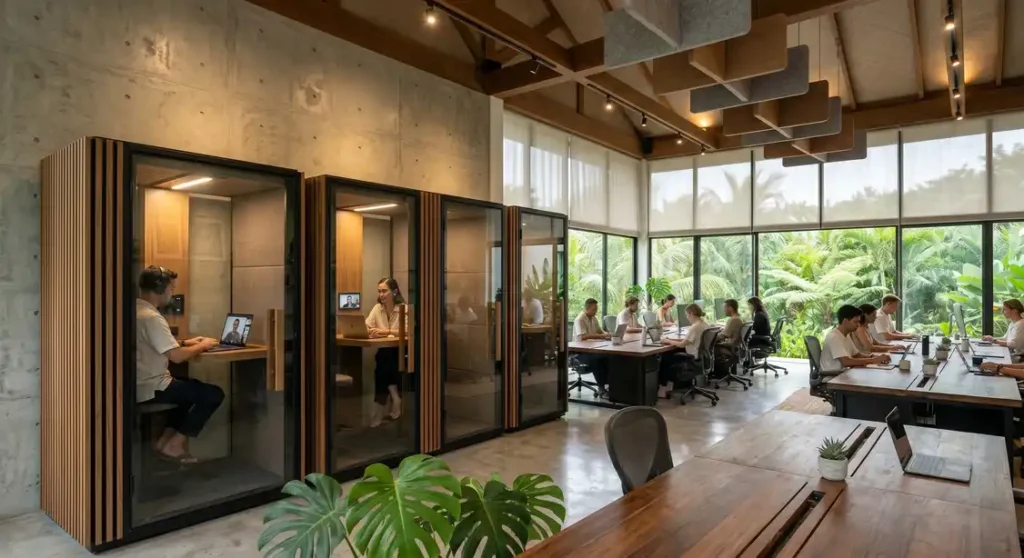
We live in the era of perpetual video calls. If your coworking space is just one giant open room, it will fail.
You will have one person trying to write code in absolute silence while the person next to them is yelling on a sales call. This creates extreme friction between members. You have to aggressively zone the space based on acoustic intent. This is why acoustic zoning is central to any commercial interior design Bali.
- The Silent Zone: A heavily policed, library-style room. You must use acoustic ceiling baffles, thick carpets (rare in Bali, but necessary here), and sound-absorbing wall panels. No calls. No talking. Just pure, uninterrupted focus.
- The Collaboration Floor: This is the energetic hub where mild background noise is encouraged. Think low-fi music, coffee machines, and casual networking.
- The Soundproof Pods: You must purchase or custom-build acoustically sealed phone booths (like Framery pods). These use multi-layered sound-dampening walls to block open-plan noise. Because they are sealed, they require independent, silent ventilation fans to circulate fresh air continuously. Without this, a member inside will feel stuffy within minutes. If someone cannot jump into a pod at a moment’s notice to take a confidential call, your space is useless to them.
High-Density MEP (Power & Cooling)
This is where the Pinterest dream crashes into reality. A high-performance coworking facility functions like a localized data center supporting continuous high-density computing.
- Extreme Cable Management: You cannot have extension cords running across the floor. It is a serious safety hazard and looks terrible. Workstation joinery should incorporate dedicated vertical cable channels. This routes heavy-duty power and data cabling directly into desks without loose cords crossing floors.
- Thermal Load Management: 100 people working on 100 laptops generates a significant amount of physical heat. A standard AC unit meant for a cafe will choke and die. Plan commercial HVAC systems capable of handling high electronic heat loads. Air distribution must be balanced so vents do not blow directly onto seated members.
- The Uninterruptible Power Supply (UPS): Bali’s power grid fluctuates. If the power drops for even 10 seconds, your members will drop from their video calls and lose unsaved work. You need an industrial-grade UPS battery system that keeps the internet and outlets live for the 30 seconds it takes for your heavy-duty diesel generators to kick in.
| Workplace Zone | Primary Design Function | Interior & Material Specification |
|---|---|---|
| Focus & Dedicated Desks | Sustained individual computer work | 70–80cm desk depth, ergonomic mesh task seating, individual adjustable task lighting paired with soft diffused ambient lighting. |
| Quiet / Library Rooms | High-concentration solo work | Acoustic ceiling baffles, fabric sound-dampening wall panels, dense area rugs over hard flooring, soft upholstery. |
| Phone & Video Call Booths | Confidential calls without open-plan distraction | Acoustically lined enclosures, perimeter door gaskets, independent low-noise airflow ventilation. |
| Meeting & Workshop Rooms | Group presentations and client pitches | Glass partitions with acoustic laminated interlayers, solid timber conference tables, integrated surface power modules. |
The Community Layout: Designing for Serendipity
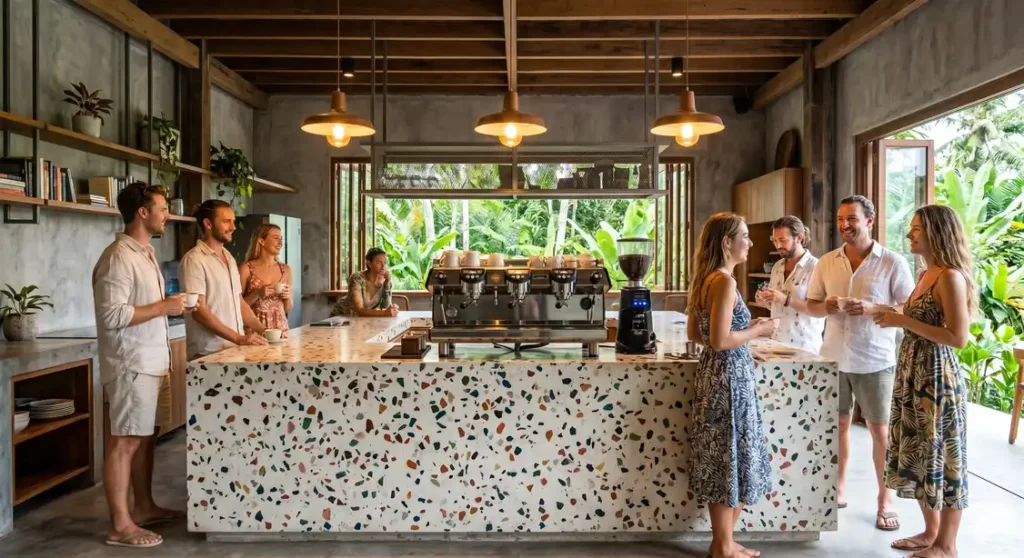
People come for the fast internet, but they stay for the network. Your layout has to subtly force people to interact without being annoying.
We call this designing for “serendipity.” In a coworking space, the layout itself is the product. If the space does not facilitate organic connections, no amount of fast internet will save your retention numbers.
- The Kitchen Island Anchor: Do not hide the coffee machine in a corner. Build a massive, beautiful, oversized kitchen island right in the center of the collaboration zone. This forces members to stand next to each other while pouring coffee, naturally sparking conversations and networking.
- The Amphitheater: If you want to be the premium hub in Canggu or Ubud, you need to host pitch nights, crypto meetups, and workshops. A tiered wooden amphitheater provides casual seating during daytime work. In the evening, the same structure converts easily into an event space for workshops.
A coworking hub shares operational DNA with other commercial spaces. Planning a public espresso bar or social lounge? Our guide to cafe interior design in Bali covers customer flow alongside high dwell times.
Reception sets professional credibility the moment prospective members walk in. For entrances and lounges, see our principles on boutique hotel lobby design in Bali.
Planning a Coworking Space in Bali?
If you are developing or refitting a coworking hub or commercial workspace in Bali, getting the acoustic zoning, circulation flow, and ergonomic layouts right before opening determines member retention. Book a design consultation with our studio. We will help you plan your floor plate, select durable commercial materials, and coordinate power and cooling needs with your MEP engineers before construction begins.
Frequently Asked Questions About Coworking Space Design
Direct sunlight destroys laptop visibility. Smart architectural layouts orient primary glass facades to the North or South to capture ambient light without direct horizontal rays. For West-facing windows, you must install automated, semi-translucent motorized solar blinds that track the sun to diffuse harsh light while maintaining a bright atmosphere.
In the era of perpetual video calls, mixing focused coders with loud sales teams creates severe member friction. A premium coworking space must physically separate “Silent Library Zones” from “Active Collaboration Floors,” and most importantly, invest heavily in soundproof, acoustically treated phone pods with independent ventilation for confidential calls.
A coworking hub acts like a localized data center. It requires heavy-duty UPS (Uninterruptible Power Supply) battery systems to keep internet routers and laptops alive during Bali’s frequent grid fluctuations. It also requires oversized commercial HVAC systems designed specifically to handle the massive thermal load generated by hundreds of laptops and human bodies.