Last Updated on September 17, 2026 by Wisnu Arista H.
Home Interior Design Bali: The Complete Guide for Permanent Residences
There is a massive, unspoken difference between building a holiday rental and building a forever home on the Island of the Gods. If you are planning a permanent home in Bali, applying standard “villa aesthetics” to a permanent residential property is a recipe for daily frustration. The island’s humidity, its UV intensity, and its exceptional local material supply chain demand an approach built for this specific environment—not adapted from somewhere else.
Holidaymakers can tolerate a lack of storage, open-air bathrooms, and delicate fabrics for three days. However, when you are moving your entire family to Bali, you need full functionality, climate-resilient materials, and dedicated spaces for real life—not just Instagram photos. The tropical environment is harsh; monsoonal rains and intense coastal salt air will test every inch of your property.
Most homes in Bali look stunning on the day the furniture arrives. By year two, the teak is warping, the fabric on the sofa has gone stiff and mildewed, and the owner is wondering where the budget went wrong. It almost never went wrong at the build stage; it went wrong at the design stage.
This comprehensive guide breaks down exactly how an experienced interior design team in Bali approaches a luxury residential project. The goal: a home that withstands the tropical climate, accommodates daily family life, and remains a peaceful private sanctuary for years to come.
What Makes Home Interior Design Bali Different From Villa Design?
Home interior design Bali focuses on long-term residential functionality rather than short-term rental appeal. Commercial villas prioritize photogenic spaces and maximum guest capacity. Residential home design strictly prioritizes extensive enclosed storage, functional wet/dry kitchens, durable family-friendly materials, and private climate-controlled living spaces.
Key residential design differences include:
- Storage Solutions: Deep wardrobes, pantries, and secure utility rooms.
- The “Messy” Kitchen: A secondary enclosed kitchen for heavy, daily cooking.
- Climate Control: Enclosed, well-insulated living rooms instead of open-plan joglos.
- Acoustic Privacy: Soundproofing bedrooms from heavy tropical rain and street noise.
- Material Physics: Rejecting standard MDF and synthetic foams that fail in 80%+ humidity.
How Bali’s Climate Changes Every Interior Decision
Climate is the single most important variable in a permanent home here. Humidity is not an inconvenience in Bali; it is the governing force behind every interior decision you make. Materials that perform perfectly in Melbourne, Los Angeles, or London begin failing within months of installation in a tropical environment.
It is also the reason a permanent home requires a fundamentally different material specification list than any other tropical market. Wood expands and contracts with moisture content. Fabric absorbs it. Metals oxidize in it. What happens to the wrong materials in Bali’s humidity? Standard MDF swells and delaminates. Standard ceramic tile grout turns black with mold within a season. Untreated iron hardware rusts visibly within months of coastal exposure.
The homes that age beautifully here are designed around this reality from day one, not the ones that discovered it after the fact. To address this, experienced residential designers prioritize cross-ventilation. Even in fully air-conditioned homes, design spaces that allow prevailing breezes to flow through the property when doors are open. This prevents stagnant, moist air from settling into fabrics and cabinetry. For a deeper look at the materials and airflow choices this demands, see our guide to how Bali’s tropical climate shapes interior design.
Core Elements of a Luxury Bali Home Interior
At the core of any residential brief sits a basic question: how do you build something that lasts? When designing a permanent residence, your CapEx (Capital Expenditure) must be directed toward livability and longevity. A beautiful home that requires constant maintenance is not a luxury; it is a burden.
Optimizing Layouts and Spatial Zoning
Interestingly enough, many investors accidentally build homes with zero privacy. In a true luxury residence, spatial zoning is critical. You must clearly separate the “Public Zone” (living room, guest dining, pool) from the “Private Zone” (family bedrooms, kids’ play areas, home office).
For the ultimate residential sanctuary, consider the architectural layout of the primary sleeping quarters. A standard suite that opens directly onto the main pool deck offers no acoustic separation from entertaining spaces. Highly functional family homes use a hidden master bedroom concept instead. Tuck the master suite behind a discreet corridor or a lush internal courtyard. This creates a deeply private, acoustically isolated retreat that remains entirely separated from the home’s entertainment zones.
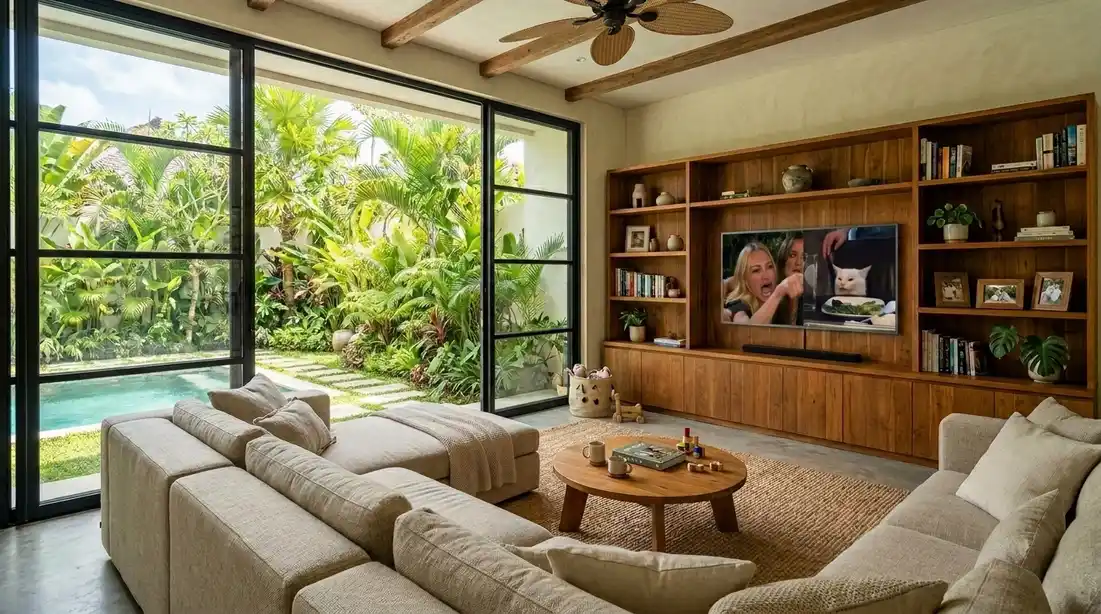
We also highly recommend designing an enclosed, air-conditioned family media room. Open-air living spaces are beautiful in the dry season, but during the monsoon, your family needs a comfortable, dry, and mosquito-free space to relax together.
Privacy Without Walls — The Balinese Landscaping Approach
True privacy in Bali isn’t achieved with high walls and locked gates. The island’s design tradition uses densely planted bamboo, tropical palms, and layered garden screens to create a visual enclosure that feels organic rather than fortified. It also regulates temperature—mature tropical planting shades the building envelope and reduces the heat load on interior spaces significantly.
Room-by-Room Residential Breakdown
Every residential project comes down to how individual rooms function in real daily use, not just how they photograph. To truly understand residential interior design in Bali, we must look at how specific rooms function differently for full-time residents compared to transient tourists.
The Kitchen: The Dual Kitchen Strategy
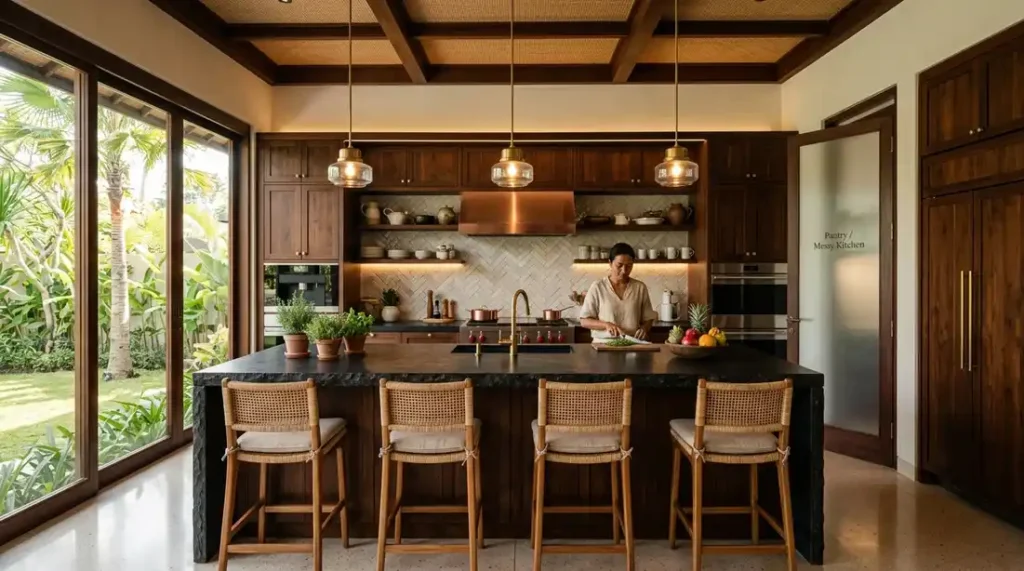
In a standard holiday villa, the kitchen is often just a visually stunning countertop. For a family living in Bali, elite residential homes employ the “Dual Kitchen” strategy:
- The Show Kitchen (Dry Kitchen): Located in the main living space. It features high-end aesthetics, a beautiful stone island, an espresso machine, and a wine fridge. It is used for entertaining and light prep.
- The Messy Kitchen (Wet Kitchen): Tucked away behind closed doors. This is where heavy cooking, deep frying, and extensive meal prep happen. It is equipped with heavy-duty commercial exhaust fans, durable stainless steel sinks, and large pantries. This keeps the smell of cooking oil and spices out of your main living room.
For a deeper breakdown of how to specify materials and layout for both zones, read our guide on Bali kitchen design.
The Living Room: The Indoor-Outdoor Threshold
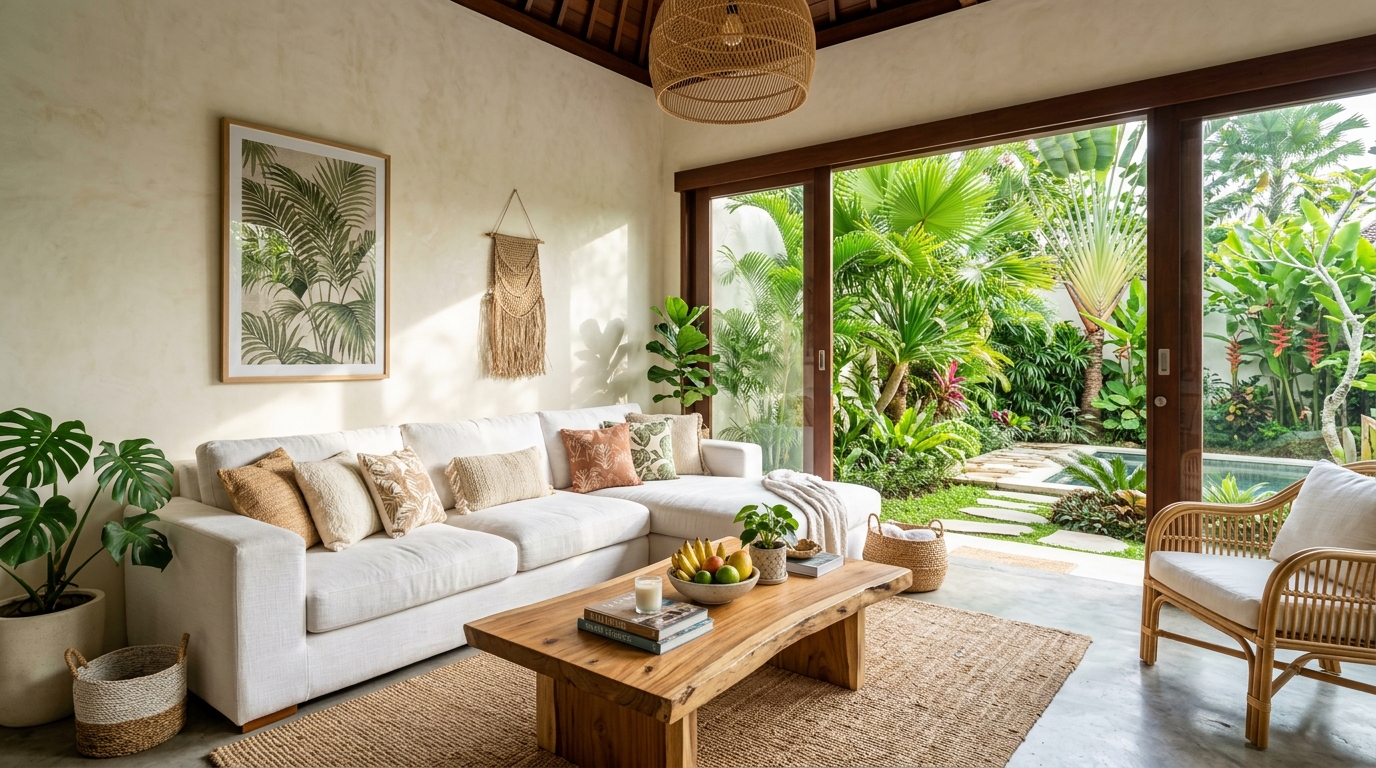
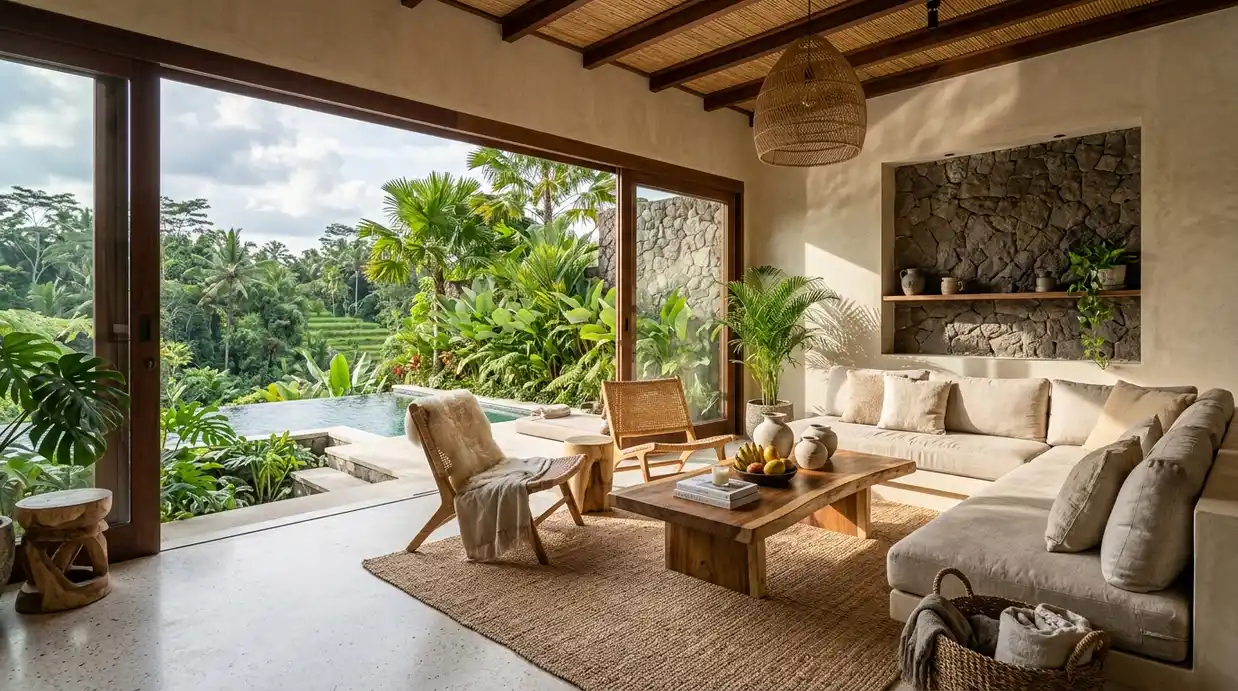
The transition between the indoor living room and the pool terrace is the most technically demanding detail in a permanent Bali home. A poorly designed threshold creates a heat corridor that defeats the air conditioning, or a mosquito entry point that makes evening family use impossible. A recessed track for stacking glass panels allows the space to open fully in the dry season. During the monsoon, it seals completely — something a standard door frame cannot achieve.
For room-specific layout ideas and material breakdowns, see our guide on Bali living room ideas.
The Dining Room: Materials, Placement, and the Wet Kitchen Connection
In a permanent residence, the dining room is one of the most overlooked spaces in the initial brief — yet it becomes the highest-traffic room in a family home. For daily residential use, specify stone or sealed solid timber for the dining table surface — solid teak and marble are both climate-proof choices. Avoid lacquered MDF tabletops; they peel at the edges after a single wet season.
Keep the dining area within reach of the wet kitchen but visually connected to the garden. Avoid enclosing it inside the main living zone — this reduces cooking odours at the table. It also preserves the indoor-outdoor connection that defines Bali residential living.
For layout strategies and material combinations by design style, see our dedicated guide on Bali dining room design ideas.
Master Suites: Combating Humidity and Mold
The biggest threat to your wardrobe in Bali is mold. Walk-in closets must be meticulously designed with built-in dehumidification systems. Install smart-ventilation louvers in the wardrobe doors and low-wattage heating rods inside shoe cabinets. This keeps leather goods dry and mold-free throughout the wet season.
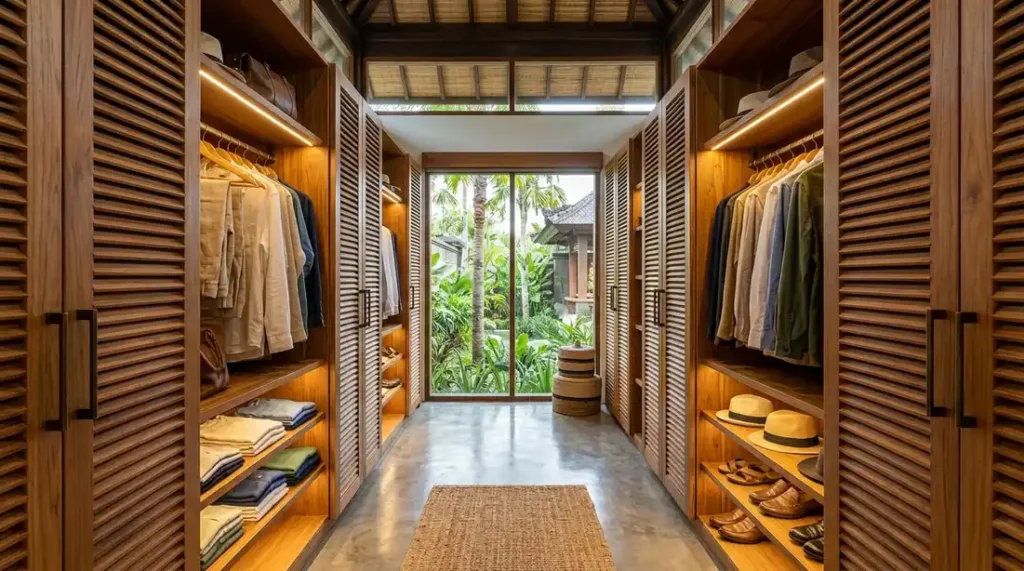
The Bedroom: Orientation, Materials, and Acoustic Design
In a permanent residence, the bedroom is where humidity does its most invisible damage. Synthetic foam mattresses and polyester bedding trap moisture and develop mold inside the core within a single wet season. Short-stay villa guests never notice — they leave before it surfaces. Specify natural latex or pocket-spring mattresses, 100% linen or cotton bedding, and solid teak or powder-coated aluminum bed frames — never MDF carcasses, which delaminate quietly and expensively.
Bed orientation matters more than most designers acknowledge. Position the headboard against an interior wall so the prevailing cross-breeze flows across the sleeping plane rather than hitting the face directly. This single decision reduces dependence on overnight air conditioning significantly.
For a full breakdown of layout strategies and material choices by design style, see our dedicated guide on Bali bedroom design ideas.
The Bathroom: Open-Air Sanctuaries
Bali’s most distinctive residential design contribution to global interior culture is the outdoor bathroom. It is a private, garden-enclosed bathing space that blurs the boundary between bathing and nature entirely. Even in homes where a fully outdoor bathroom isn’t feasible, the design principle holds: maximize connection to natural light, planting, and sky. Natural stone surfaces—river boulders, hand-chiseled volcanic tuff, or Sukabumi stone in the shower—perform better in a wet environment than any ceramic alternative . They also carry a material honesty that elevates the entire bathing experience.
The Home Office: Acoustics and Airflow
If you are moving to Bali, there is a high chance you are working remotely. Designing a home office here requires strict attention to acoustics. The sound of heavy tropical rain on a roof can be deafening, making Zoom calls impossible. Your designer must specify acoustic ceiling baffles and double-glazed glass for the windows. A dedicated split-system AC unit means you cool only the office — not the entire house.
See our full guide on home office design in Bali for acoustic specification details and layout strategies.
Custom Furniture and Local Procurement
Custom furniture is the practical heart of any residential project. A major advantage of building a home in Bali is the island’s access to world-class craftsmanship. However, managing procurement for a residential build requires extreme diligence.
Access can change what is worth commissioning. On a site reached only by boat and cart, see our guide to Gili Islands villa furniture.
Why You Should Avoid Importing Furniture?
The appeal is understandable—a familiar brand, a known quality standard, convenient delivery. The outcome is predictable—swollen drawers, delaminating veneers, rusted hardware, and faded upholstery within eighteen months of installation. Furthermore, importing luxury items carries massive Indonesian import taxes that will instantly inflate your FF&E budget. See our full guide to custom furniture and local procurement in Bali for how to manage sourcing without the risk.
Why Is Local Teak the Best Timber Choice for Bali Homes?
Teak (Kayu Jati) is the most reliable timber choice for tropical furniture and structural elements. It naturally produces its own oils, making it highly resistant to termites, rot, and water damage — a property confirmed by timber science sources including The Wood Database. However, not all teak is created equal. For high-end residential interiors, specify documented reclaimed teak or certified long-rotation heartwood over young, short-rotation plantation teak. Mature heartwood is more stable, so custom dining tables and built-in wardrobes are far less likely to warp.
By having your custom furniture built locally, pieces can be designed to fit the exact millimeter of your home’s layout. This maximizes storage and creates a seamless, architectural look that off-the-shelf retail furniture simply cannot match.
The Invisible Backbone: MEP and Utilities
You cannot see the MEP (Mechanical, Electrical, and Plumbing) design, but it is the most critical aspect of a permanent home. If this fails, your beautiful home becomes unlivable.
Do You Need a Water Filtration System in a Bali Home?
Tap water in Bali is not safe for drinking and can be harsh on your hair and skin. A true luxury home integrates a whole-house Reverse Osmosis (RO) and UV filtration system directly into the plumbing architecture. This allows you to drink safely from any tap in the house and prevents hard-water calcification from destroying your expensive brass bathroom fixtures.
What Type of Air Conditioning Works Best in a Bali Residence?
Residential homes cannot rely on cheap, wall-mounted AC units that rattle and leak. A well-designed home uses ducted, concealed VRV/VRF systems that provide whisper-quiet, highly efficient climate control distributed evenly throughout the living spaces. These systems cost more upfront and use less energy than a wall of split units over a five-year horizon.
Should You Add Solar and Battery Backup to Your Bali Home?
For a permanent home, a dedicated MEP room is no longer optional. Bali’s power grid, while improving, still experiences fluctuations and occasional outages, especially during heavy monsoons. A modern residential home should be designed with a dedicated MEP room to house solar inverters and lithium battery backups. Wiring the home with a centralized kill-switch for non-essential phantom loads protects your battery reserves, ensuring your refrigerators and essential climate controls remain online during grid failures.
Trending Residential Design Styles in Bali
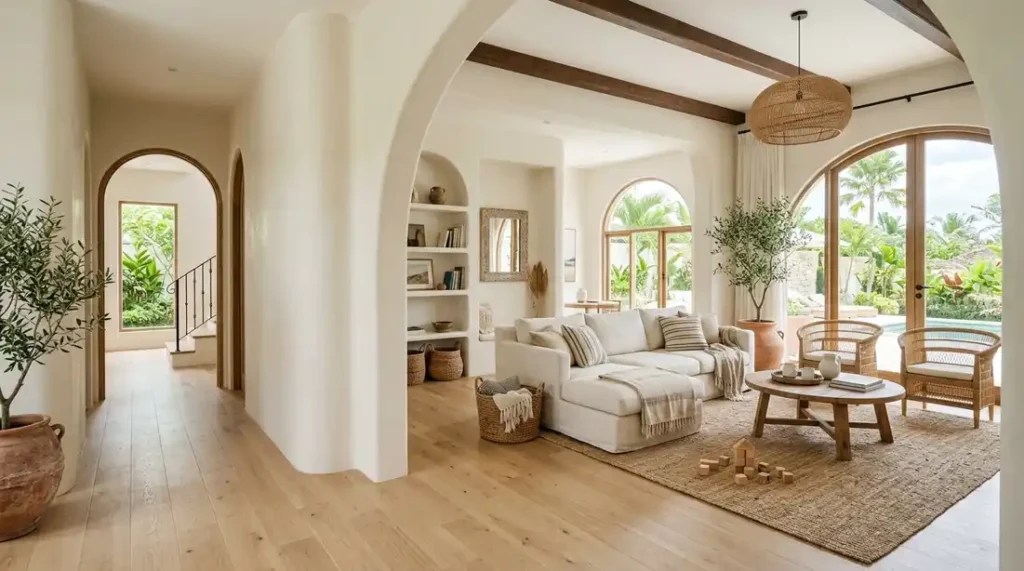
Most permanent homes here today fall into one of four stylistic directions. Building a functional, weather-resistant home does not mean sacrificing your aesthetic vision. Here are the top architectural directions that balance high-end design with the realities of permanent tropical living. For inspiration, browse our Bali home interior design ideas.
Modern Mediterranean Tropical
The current dominant style request across Bali’s residential market. It borrows the curved plaster forms, arched openings, and stark white palette of Mediterranean architecture and grounds them in tropical materiality—teak accents, lava stone floors, and abundant planting. The appeal is highly practical: the Mediterranean palette reflects heat, making spaces feel naturally cooler, while the emphasis on shaded outdoor living translates perfectly to the island’s climate.
Japandi
This merges the warm, minimalist, and highly functional aspects of Japanese design with Scandinavian functionality. For a family home, Japandi is exceptional because it focuses heavily on hidden, built-in storage to maintain visual tranquility. Light oak or teak, creamy neutral tones, and low-profile furniture make the space feel clean and uplifting. The combination is also straightforward to maintain on a daily basis.
Wabi-Sabi — Designing for Imperfection
Wabi-sabi embraces the beauty of materials as they age—limestone that develops a patina, teak that silvers over time, and raw plaster walls that show the texture of their application. Instead of fighting the inevitable aging process that Bali’s climate accelerates, wabi-sabi incorporates it as an intended outcome. For a busy family home, this is incredibly practical. You stop stressing over every little scratch on the floor or water mark on the counter, because it simply adds to the organic character of the home.
Adapting Tropical Brutalism
Brutalism (the heavy use of raw, exposed concrete) is a massive trend. However, too much concrete can make a family home feel like a cold, uninviting bunker. To adapt this for residential living, experienced studios soften the brutalist shell with ‘Organic Luxury’ interiors. Incorporating massive artisanal woven rugs, soft indirect lighting, and rich warm wood paneling on the ceilings brings warmth back into the space. It also provides the acoustic dampening a brutalist shell needs — creating a striking yet comfortable family environment.
Residential Rooms We Have Designed
Two recent residential commissions show how the room-by-room decisions above play out in practice:
- Kids’ Bedroom & Ensuite, Kerobokan — a children’s bedroom and ensuite, rendered in both daylight and evening lighting so the owner could judge the scheme at either time of day.
- Victor House Master Bedroom — a master bedroom for a private residence, now in its finishing phase on site.
Your Next Steps Before Breaking Ground
Choosing a partner for your home is the most important decision you will make. Do not hire a commercial hotel or short-term villa designer to design your permanent family home. The skillsets are entirely different. You need a residential specialist who understands the nuances of daily life, deep storage planning, and long-term maintenance.
Before signing any contracts or finalizing a mood board, vet your prospective design team on three fronts. Ask how they coordinate with your MEP engineer for long-term living, how they source local materials, and what their plan is for combating tropical humidity. If you are preparing to interview agencies, read our detailed guide on how to hire an interior designer in Bali. It will help you avoid the island’s most common contractor traps and protect your CapEx.
When you are ready to brief someone, our Bali interior design studio works on permanent homes as well as villas: storage planning, climate-resilient materials, custom furniture and fit-out supervision on site. Send us the plans and we will tell you what we would change.
FAQ — Home Interior Design Bali
Modern Mediterranean Tropical is currently the most requested style across Bali’s residential market. It combines clean curved plaster forms and a warm neutral palette with local teak, lava stone, and tropical planting. Japandi and Wabi-Sabi are also highly sought after by long-term expat residents who prioritize ease of maintenance alongside natural aesthetics.
Residential interior design costs in Bali vary significantly based on the home’s size, your material choices, whether furniture is imported or locally crafted, and how custom the build-out is. Rather than a fixed per-SQM rate, reputable studios will scope your project specifically and quote based on your actual requirements. Expect a detailed breakdown covering design fees, FF&E, custom millwork, and project management as separate line items.
Mold prevention starts in the design phase. You must ensure excellent cross-ventilation and use marine-grade plywood or aluminum carcasses for all built-in cabinetry. Avoid placing heavy furniture directly against exterior walls, and install dehumidifiers or low-wattage heating rods in enclosed spaces like walk-in closets and pantries.
Yes, if the roles are clear. A home interior design Bali project can run remotely when your architect and a licensed builder run the construction on site, while your interior design team works through 3D renders and technical drawings, reports on furniture production and supervises the interior fit-out in person. Make sure your contracts guarantee weekly video walkthroughs and detailed PDF progress reports, because a remote residential build fails when communication breaks down.