Last Updated on September 18, 2026 by Wisnu Arista H.
Interior Design Budget Bali: How to Plan Your Project Without Getting Blindsided
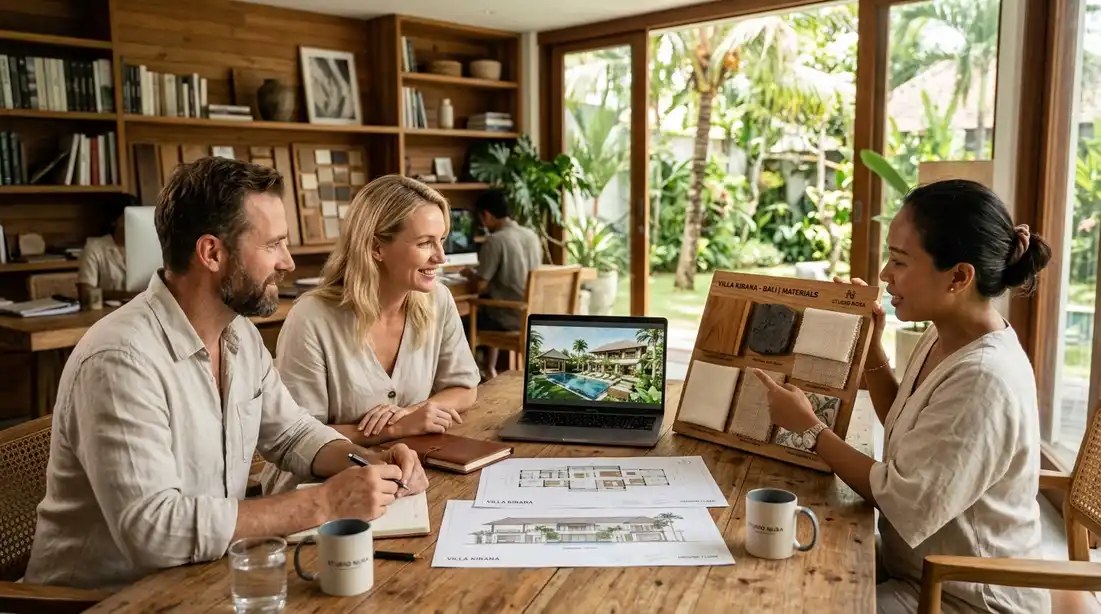
Let’s talk about the number that nobody in Bali’s design industry wants to give you upfront — your actual budget. Planning a realistic interior design budget Bali is the most important financial decision you make before a single contractor is briefed, a single material is selected, or a single contract is signed. Get it wrong and you fall into what experienced developers call the “Bali Black Hole” — hidden import taxes, surprise MEP failures, and procurement markups that drain your entire CapEx before the villa is fully furnished.
This is how you avoid it.
What Is a Realistic Interior Design Budget in Bali?
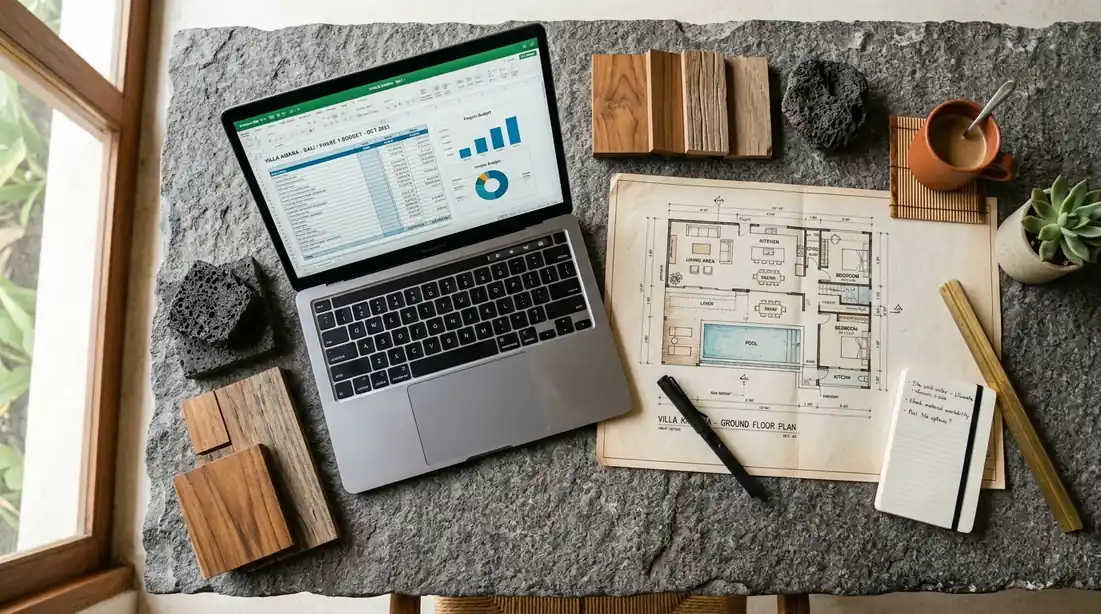
A realistic interior design budget in Bali separates your total CapEx into four non-negotiable categories: structural and MEP work, professional design and project management fees, FF&E (Furniture, Fixtures, and Equipment), and a contingency fund. Every category must be funded independently, with a contingency fund sitting above all three as a financial fortress against the unexpected.
Key steps to structuring your budget before you brief a single designer:
- Define project scope first — cosmetic refresh versus full structural gut are completely different financial conversations
- Isolate your FF&E allocation — movable furniture and decorative lighting must have their own ring-fenced budget line
- Understand the design fee structure — know whether you’re paying per SQM or a percentage of total project cost before signing anything
- Lock in procurement transparency — agree on how materials are sourced and marked up before a single purchase is made
- Build the contingency fund last — it should be the last line you add and the first money you protect
The Four Budget Categories Every Bali Project Must Have
Most investors budget for two things: the build and the furniture. The projects that go over budget are almost always the ones that missed the other two.
Category 1 — Structural and MEP Work: The invisible backbone of the property. Electrical panels, plumbing, waterproofing, HVAC. In older Bali villas this is where the real surprises live — and they are almost never cheap surprises.
Category 2 — Design and Project Management Fees: What you pay the studio for their intellectual output and, where included, on-site supervision of the fit-out. Two separate things that are sometimes bundled and sometimes billed separately.
Category 3 — FF&E: Everything that makes the space livable and photographable. Custom furniture, lighting, appliances, textiles, art. This category consistently consumes more budget than first-time investors expect.
Category 4 — Contingency Fund: Not optional. Not a sign of poor planning. The single most important line in your entire spreadsheet. More on this below.
What Percentage of Your Total Budget Should Go to Each Category?
Resist any designer or developer who gives you a universal percentage breakdown before seeing your specific project. The split varies significantly based on whether you’re doing a cosmetic renovation, a full fit-out of a new build, or a structural overhaul of an aging villa. What holds true across all project types: FF&E will almost always consume more than you originally allocate, and MEP will almost always cost more than the initial quote.
Where Your Interior Design Budget in Bali Actually Goes
Design Fees — What You’re Paying For and What’s Often Hidden
Professional studios in Bali typically structure design fees in one of three ways: a flat fee based on the square meterage of the property, a fixed project fee regardless of size, or a percentage of the total build cost for full turnkey engagements.
The fee covers the intellectual output — spatial planning, mood boards, 3D renders, and technical CAD drawings contractors build from. What it does not automatically cover: site supervision, contractor coordination, procurement management, and the weekly reporting that keeps a remote project on track. Those fall under a separate project management fee, and confusing the two is one of the most expensive misunderstandings in the Bali design industry.
FF&E — Furniture, Fixtures, and Equipment Costs in Bali
FF&E is the line item that surprises almost every first-time investor. Custom teak dining tables, imported rugs, bespoke pendant lights, mattresses, outdoor furniture rated for Bali’s climate — it adds up faster than any spreadsheet initially accounts for.
The good news: Bali’s local artisan network is genuinely world-class. Sourcing custom furniture from workshops in Bali and Java, Gianyar and Jepara among them, gives you superior quality, faster lead times, and significantly lower costs than importing equivalent pieces from Europe. It also eliminates the import duty exposure that turns a beautiful Italian marble countertop into an extremely expensive mistake.
MEP and Infrastructure — The Budget Line Most Investors Forget
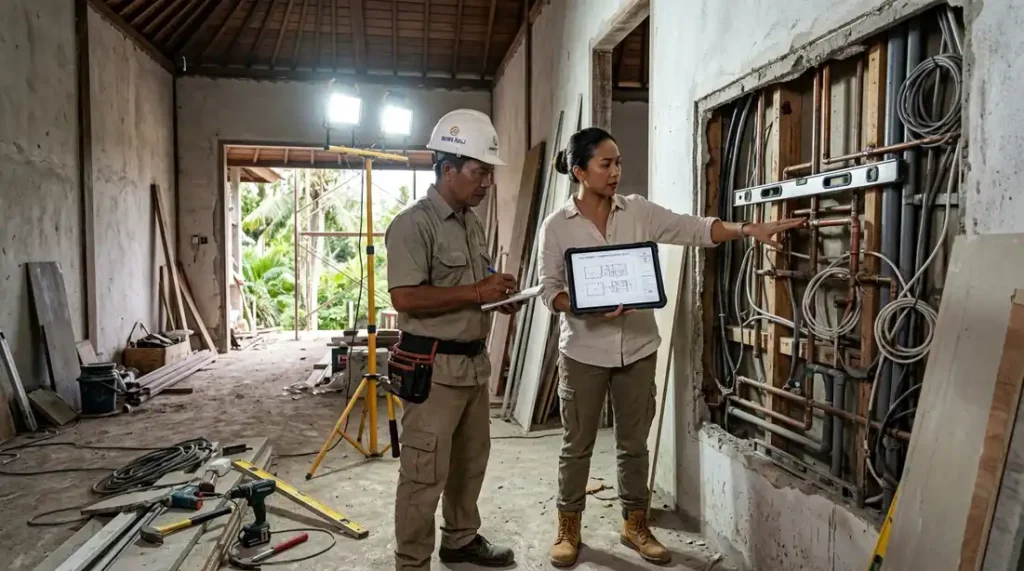
Here’s the brutal truth about renovating older villas in Bali: the walls lie. Everything can look structurally sound from the outside while the electrical wiring inside is decades past its service life and the waterproofing on the roof has been failing quietly for two wet seasons.
MEP failures are the single most common cause of budget catastrophe in Bali renovation projects. Rotting pipes behind newly plastered walls. Electrical panels that can’t handle modern AC loads. Waterproofing failures that don’t reveal themselves until the first heavy rain — after the expensive custom plaster finish has already gone up. Budget for MEP as if you’ll find problems, because in an older Bali villa, you almost certainly will.
The Hidden Costs That Blow Bali Renovation Budgets
The Procurement Markup Trap
Many studios offer aggressively low upfront design fees and recover the margin by marking up every material and furniture purchase, commonly 15% to 35% over trade cost and sometimes more, without disclosing it. By the time you realize it, your FF&E budget is gone and the villa is half-furnished.
The fix is simple but non-negotiable: before signing any contract, get written clarity on how procurement is handled. A transparent studio will either charge a fixed, disclosed sourcing fee or pass their trade discounts directly to you. Any resistance to this conversation is itself a red flag worth paying attention to.
Import Duties and Currency Risk
If your capital is in USD or AUD but you’re paying contractors in IDR while importing materials priced in Euros, you are carrying currency risk across three exchange rates simultaneously. Indonesian import duties on luxury goods compound this — what looks like a reasonable price for European stone or hardware in the showroom becomes significantly more expensive once it clears Benoa Harbor.
The practical solution: source locally wherever the quality is comparable. For understanding how local material sourcing intersects with both cost efficiency and environmental responsibility, our guide on sustainable interior design Bali covers the full material landscape.
Mold Remediation — The Hidden Cost Nobody Budgets For
Bali’s humidity doesn’t forgive poorly ventilated spaces. Mold remediation during a renovation — discovering it behind walls, under floors, inside ceiling cavities — is one of the most budget-destructive surprises a project can encounter. It’s also one of the most common in villas that were built without adequate ventilation planning. Budget for the possibility. Inspect aggressively before you commit to a renovation scope.
Logistics Costs for Remote Locations
A villa in Canggu has fundamentally different logistics costs than a clifftop property in Uluwatu or a project on Nusa Penida. Transporting large custom furniture pieces across a strait or up a steep access road adds real cost that flat logistics estimates don’t capture. If your project is in a remote or difficult-access location, your contractor and designer need to account for this explicitly in the quote — not absorb it as a surprise midway through installation.
Where to Splurge and Where to Save
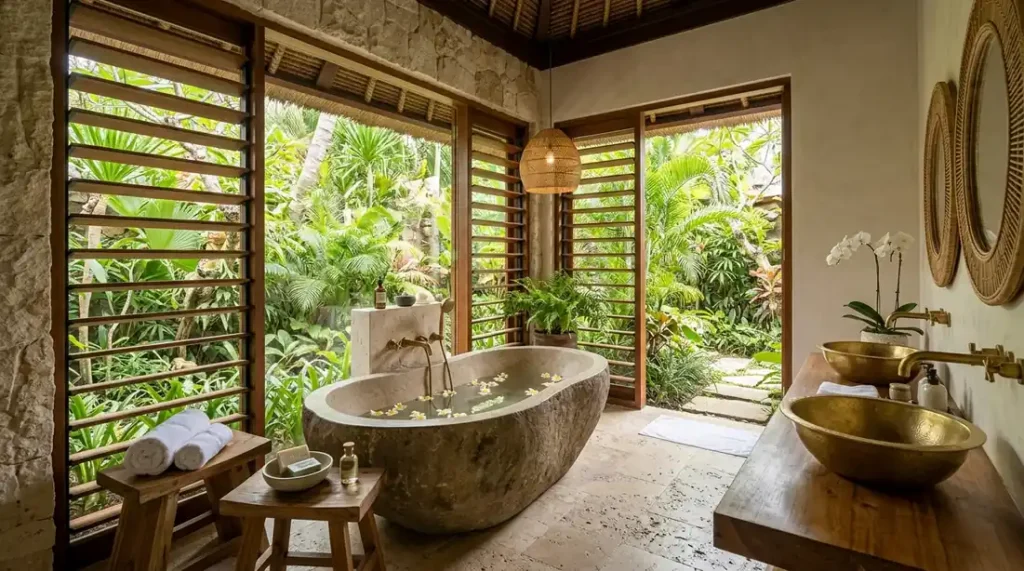
Not every square meter of your villa deserves the same capital allocation. Understanding where luxury investment generates returns — and where it doesn’t — is what separates experienced developers from first-timers.
Where to Splurge
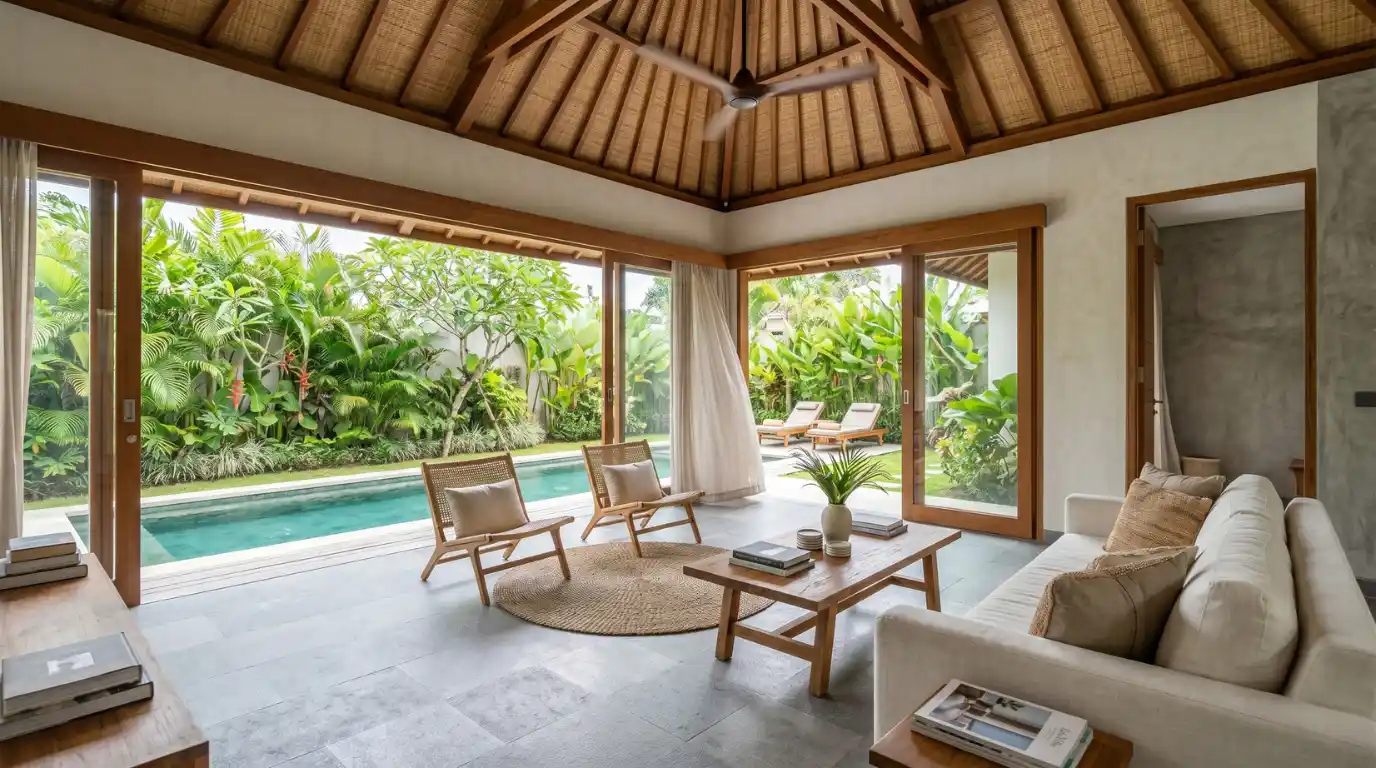
The master bathroom and the living room-to-pool integration. Guests judge luxury by the quality of their shower experience — water pressure, high-end brass fixtures, natural stone surfaces — and by how the main living area connects to the pool. These are the spaces that appear in every Airbnb photo, drive every booking decision, and justify premium nightly rates. Concentrate your heavy FF&E spend here.
Where to Save
Secondary bedrooms. Guests occupying a second or third bedroom for three nights do not need custom-carved teak wardrobes. High-quality modular cabinetry, good quality linens, and a well-designed lighting plan deliver the same guest satisfaction at a fraction of the cost. Redirect those savings to the master suite and communal areas where they generate actual returns.
How to Have the Budget Conversation With Your Designer
Questions to Ask Before You Agree on a Number
- Is your design fee inclusive of revisions, and what is the limit before additional charges apply?
- How to handle the procurement — do you charge a markup, a fixed sourcing fee, or pass trade pricing directly?
- What does your payment schedule look like and what milestones does each payment correspond to?
- Have you built projects in locations similar to mine — and what logistical surprises came up?
- What is the most common reason your projects go over budget, and how do you manage it?
Red Flags in How a Designer Talks About Money
A designer who is vague about their fee structure before the contract is signed will be vague about costs throughout the entire project. Watch for studios that lead with aesthetics and deflect budget questions, that can’t explain the difference between a design fee and a project management fee, or that quote a project without visiting the site first. Clarity about money at the start of a relationship is one of the strongest predictors of project health at the end of it.
If you haven’t secured your studio yet, our guide on how to hire an interior designer in Bali covers the full vetting process — including the contract questions that protect your budget before work begins.
How to Build a Budget That Doesn’t Fall Apart
Why Your Contingency Fund Should Be 15–20%, Not 10%
The standard advice for construction contingencies is 10%. In Bali, that is not enough. Supply chain fluctuations, wet season delays, MEP surprises in older buildings, and mid-project design decisions that seemed small but cascaded into contractor rework — these are not edge cases in Bali. They are the norm. Budget your contingency at 15–20% and treat any portion you don’t spend as a bonus, not a planning failure.
How to Tie Payments to Milestones, Not Dates
A payment schedule tied to calendar dates gives you no leverage when progress stalls. A payment schedule tied to project milestones — concept approval, technical drawing sign-off, furniture production completion, installation handover — means every payment you make is a direct exchange for a verified deliverable. This is the single most important structural protection you can build into your contract. If a studio resists milestone-based payments without a strong explanation, treat that resistance as information.
For a full understanding of how budgeting fits within the broader scope of interior design in Bali — from first brief to final handover — our complete overview covers what a professional engagement looks like at every stage.
Protecting your budget isn’t about spending less. It’s about spending in the right places, with the right protections in place from day one. If you want to work with a studio that puts procurement transparency, milestone payments, and weekly reporting in writing before anything else — get in touch with interior design in Bali. We’ll walk you through our full financial framework before you commit to anything.
Budget is one piece of the bigger picture — see the full interior design process in Bali.
FAQ — Interior Design Budget Bali
There is no honest universal answer before a site assessment and clear scope of work. Costs vary significantly based on property size, finish level, volume of custom furniture, and whether it requires MEP upgrades. What we can tell you: anyone who gives you a firm number before understanding your specific project is estimating, not quoting. Start with a proper brief and get a scope-based figure from there.
FF&E stands for Furniture, Fixtures, and Equipment — everything movable that makes a space livable and luxurious. Custom furniture, lighting, appliances, textiles, and decorative objects all fall under this category. It consistently consumes a larger portion of the total project budget than first-time investors expect, which is why it needs its own ring-fenced budget line from the start rather than being absorbed into a general construction estimate.
A realistic quote is itemized, milestone-based, and separated into design fees, project management fees, and FF&E procurement costs. It accounts for your specific location’s logistics, references comparable completed projects, and includes a clearly defined contingency provision. A quote that is a single round number covering everything with no breakdown is not a quote — it is a placeholder that will be renegotiated mid-project.
Yes, and for larger properties it’s often the smarter approach. Phasing typically works by completing the high-impact communal spaces and master suite in phase one — the areas that drive booking decisions and justify nightly rates — and addressing secondary bedrooms and support spaces in phase two once the property is generating revenue. A good designer will help you sequence phases so the property is photographable and rentable after phase one without looking visibly incomplete.