Last Updated on September 23, 2026 by Wisnu Arista H.
Reclaimed Teak vs. New Teak: What Really Makes Teak Last in Bali
The real question is not Reclaimed Teak vs. New Teak. It is how old the tree was when it was cut. Well-seasoned reclaimed teak and certified long-rotation new teak both keep teak’s natural defences. Timber cut at under 15 years is the weak link, and shortages have pushed much of the market toward it.
While new plantation teak is abundant, reclaimed teak, often called “Heritage Timber”, has become the benchmark for discerning investors. Bali Best Design is the design arm of Bali Best Buy, whose workshop has built furniture in Bali since 2005. This guide breaks down the science, aesthetics and economics from the perspective of our Bali Interior Design Services. It covers the one factor that matters more than whether teak is new or reclaimed.
1. Why Seasoned Teak Outperforms Young Teak in Bali’s Humidity
The primary threat to furniture and structural timber in Indonesia is humidity. Bali’s average relative humidity sits around 80–85% all year. Wood is a hygroscopic material, acting like a sponge that absorbs and releases moisture to match its environment. This state is known as Equilibrium Moisture Content (EMC).
The Reactive Nature of Young Teak
Here is what most sellers skip: the problem is not new teak, it is young teak. Perhutani, Indonesia’s state forest enterprise, grows its teak on long rotations of 40 to 60 years. But shortages of that timber have pushed much of the market toward trees cut at under 15 years. Those logs are mostly sapwood and juvenile wood. Research rates them lower in both dimensional stability and durability (Pratiwi et al., 2019).
Kiln Drying (KD) lowers the moisture, but it cannot change what the wood is made of. Once it leaves the kiln and enters a non-air-conditioned Balinese living room, it begins to “fight” the humidity. Wood fibers expand and contract aggressively. This leads to the warping of tabletops and checking (cracking) of joinery.
The Settled Nature of Reclaimed Teak
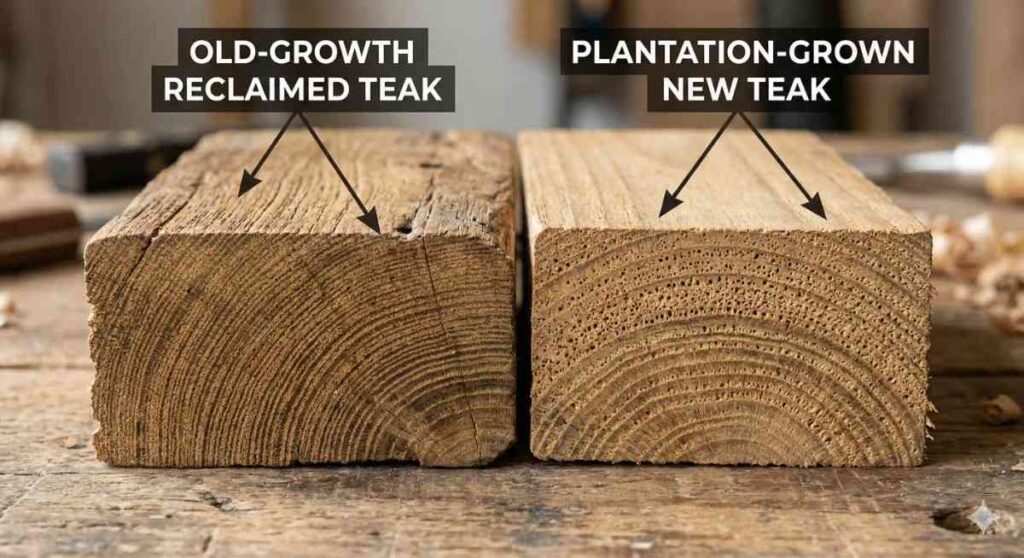
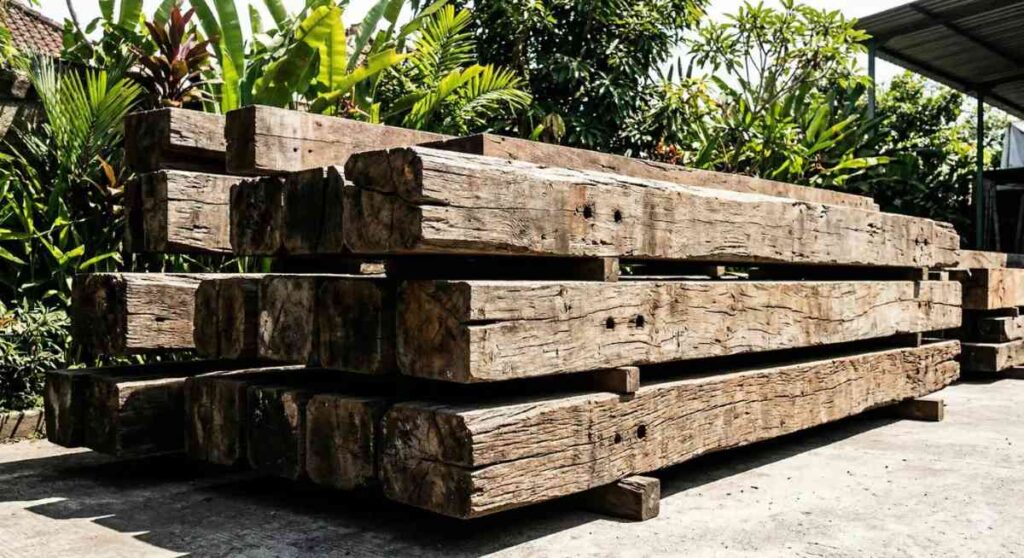
Reclaimed teak is wood that has already lived a full life. Salvaged from old Javanese houses (Joglos and Gladaks) or colonial-era bridges, this timber has spent decades seasoning in the Indonesian climate. Its cellular structure is stable. It has finished the drying shrinkage that splits fresh boards, so it moves far less as humidity swings. That makes it among the most stable options available for tropical climates.
When weighing reclaimed teak vs. new teak for a Bali villa, this stability is a powerful argument, provided the timber’s origin is documented.
2. Natural Defenses: Long-Rotation vs. Short-Rotation Teak
In the choice between Reclaimed Teak vs. New Teak, the age of the tree at the time of harvest determines the long-term durability of the piece.
Older Trees, Stronger Defenses
Teak is not a wild tree in Java. It was introduced centuries ago, and by 1950 Java held the world’s largest area of teak plantation (FAO). So an old Joglo beam is usually well-grown, long-rotation teak rather than wild “old-growth”. What makes it valuable is age: as teak matures, its heartwood builds up more of the natural extractives that protect it.
- Silica Content: Teak contains up to 1.4% silica, which has a pronounced blunting effect on cutting tools (The Wood Database).
- Tectoquinones: The key protective compound in teak’s natural extractives. In one study, it rose from 43% of extractives in 5-year-old teak to 61% at 20 years. Decay resistance climbed from “resistant” to “very resistant” (Silva et al., 2023). That chemistry is why mature teak heartwood holds up against termites and dry rot, two persistent issues in Bali’s climate. It is not a force field, though: teak is only moderately resistant to marine borers and powder post beetles.
The Short-Rotation Problem
The weak link is short-rotation teak. Cut young, it carries more sapwood, less heartwood, and lower extractive content. That is why research rates it lower for durability and stability (Pratiwi et al., 2019). That is not the same as all new teak: long-rotation plantation heartwood keeps much of teak’s natural defense. The rule that follows is simple. New or reclaimed, specify heartwood and ask how old the timber is and where it came from. For new teak, ask for certified long-rotation stock.
| Reclaimed heritage teak | Certified long-rotation new teak | Short-rotation new teak | |
|---|---|---|---|
| Tree age at harvest | Salvaged from old Javanese houses and colonial bridges, so usually well-grown long-rotation timber | Perhutani’s 40 to 60 year rotations | Often under 15 years |
| Dimensional stability | Highest: has already finished its drying shrinkage, so it moves least as humidity swings | Good | Lowest: mostly sapwood and juvenile wood (Pratiwi et al., 2019) |
| Decay resistance | Mature heartwood, high tectoquinone content | Retains much of teak’s natural defence | Lower: less heartwood and lower extractives (Pratiwi et al., 2019) |
| Patina | Honey-brown, with nail holes and iron stains | Golden, darkens with age (The Wood Database) | Golden, darkens with age |
| What to ask for | Documented origin | Certified long-rotation stock, heartwood specified | How old the timber is and where it came from |
| Maintenance | Least movement, so fewest opened joints; oiling is for colour | Close behind reclaimed; oiling is for colour | Most movement: warping and checking |
| Cost driver | Highest: salvaging, de-nailing and re-milling is slow, skilled work, and supply is finite | Mid | Lowest, and abundant |
3. Aesthetic Soul: The “Quiet Luxury” of Patina
In the Sustainable Interior Trends Bali 2026 movement, the “perfectly uniform” look of mass-produced furniture is being replaced by Material Honesty.
Freshly cut teak is golden and can look “raw” and uneven. Like all teak, it darkens with age (The Wood Database), but new teak cannot fake a past.
Reclaimed Teak arrives with a built-in history: a deep, honey-brown patina and the marks of decades of use. At Bali Best Design, we celebrate the markers of heritage timber:
- Historical Markers: Subtle nail holes from its previous life as a house beam.
- Iron Stains: Darker character marks where old handmade bolts once sat.
- Natural Weathering: A texture that feels warm and “organic” to the touch.
In a luxury villa, these elements provide a sense of “Quiet Luxury”—the feeling that the home has a soul and a story, rather than being a “catalog” house.
4. Reclaimed Teak Value: Maintenance and Villa Resale in Bali
From an investment perspective, reclaimed teak costs more up front. Salvaging, de-nailing, and re-milling old beams is slow, skilled work. Whether it pays back depends on what you compare it with.
Maintenance Savings
Movement is what opens joints and cracks tabletops, so settled timber saves you repairs. Against young, sapwood-heavy teak, well-seasoned reclaimed heartwood wins clearly; against certified long-rotation heartwood, the gap is much smaller. Either way, oiling is mostly about keeping the colour. Teak’s own extractives do the protecting.
Property Valuation
Investors and buyers increasingly ask where the timber came from, and documented heritage timber has a story a catalogue villa cannot tell. The supply of old beams is finite, which is part of the scarcity value. Just do not buy it as a financial bet: nobody can promise that furniture appreciates. Reclaimed teak is also part of the Sustainable Interior Trends Bali 2026 movement.
Put together: in the reclaimed teak vs. new teak debate, documented heritage timber is hard to beat, and certified long-rotation teak is the honest runner-up.
5. Ethical Sourcing: The Zero-Logging Movement
Sustainability is no longer a “nice-to-have”; it is a market requirement for Interior Design in Bali.
- Zero Deforestation: Using reclaimed teak means that zero new trees were cut down to furnish a villa. It is the ultimate form of circular manufacturing.
- Carbon Sequestration: Timber is a carbon sink. Using heritage timber keeps carbon locked in the wood as long as the piece is in use. It prevents old structures from rotting or being burned, releasing carbon into the atmosphere.
- Supporting Local Heritage: Sourcing reclaimed wood helps preserve the history of Indonesian architecture. Good reclaimed teak comes from buildings that are genuinely beyond repair, taken down with the community’s consent. A reputable workshop can tell you which one. That same material becomes the raw input for bespoke Balinese craftsmanship.
- It also sits alongside the rest of what we specify in our guide to the best sustainable materials for Bali villas.
Specifying Teak for a Bali Villa?
The grade and the age of the timber are decided at specification, not at delivery. Talk to our interior design team in Bali and we will specify the timber alongside the rest of the fit-out.
FAQ (Reclaimed Teak vs. New Teak)
Often, yes. Salvaging, de-nailing and re-milling old beams is slow, skilled labour, though prices vary by grade and some new Java teak costs more. Whether it pays back depends on the comparison: against young short-rotation teak, settled heartwood saves on repairs; against certified long-rotation teak, the difference is smaller.
Ask your supplier for documentation of the source structure — a reputable studio can provide the provenance of the timber (the village, the structure type, and the year of decommission). FSC certification applies to new plantation wood, not reclaimed — do not accept FSC as proof of reclaimed origin.
No special treatment, just good practice. Well-seasoned reclaimed teak does not need chemical sealants to stay stable, and neither does good long-rotation heartwood. A natural teak oil at the time of manufacture keeps the colour; after that, re-oil when the surface starts to look dry. Outdoors, you can also let it weather to silver. The oil is for looks, not protection.