Last Updated on September 24, 2026 by Wisnu Arista H.
Beach Club Design Bali: Engineering Mega-Venues for Maximum ROI
Let’s be brutally honest about the state of the island’s hospitality industry. If you are diving into beach club design Bali in 2026, you are not just opening a business. You are entering a multi-million dollar architectural arms race.
Designing a project of this staggering magnitude requires disciplined operational precision. If you get the spatial flow wrong, your staff will struggle to keep up with order volume at peak capacity. If you specify the wrong materials, the salt air off the Indian Ocean will start corroding your fit-out within the first few seasons.
Look at the massive beachfront footprints in Berawa, and the sprawling day-clubs of Pererenan. The scale of coastal hospitality on this island has exploded far beyond a simple wooden bar with a swimming pool. You are engineering a venue that has to move thousands of guests safely, withstand some of the harshest weather in the tropics, and earn as much as possible from every square metre.
Here is the operational playbook for beach club design Bali. It covers engineering a coastal venue that survives the elements and extracts maximum ROI from every square meter.
Beach Club Design Bali: The Economy of Tiered VIP Zoning
A beach club is fundamentally a status machine. Your layout has to visually and physically separate the people spending $50 from the people spending $10,000 on a VVIP package, while making both groups feel they are having the best day of their trip.
You achieve this through aggressive, mathematically calculated tiered zoning and line-of-sight.
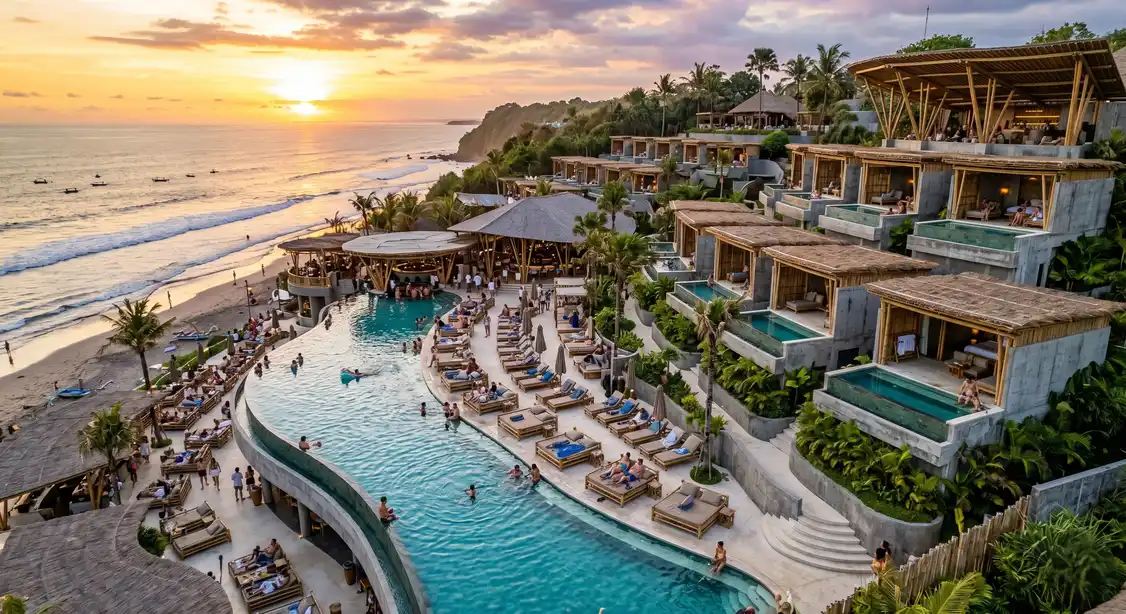
- The GA (General Admission) Trenches: These include sunken pool bars and floating beanbags. They also cover standing areas right next to the DJ booth. This zone is high-energy, high-density, and low minimum spend. The goal here is volume. You want these guests close to the action to create the “party vibe”. So the seating must be inherently temporary to encourage constant movement to the bar.
- The Daybed Mid-Tier: Daybeds sit slightly raised behind or around the pool and carry a solid minimum spend. They give groups of 4 to 6 real comfort, but leave guests exposed to the weather and to the gaze of the GA crowd.
- The VIP Cabana Apex: This is where the real ROI lives. VIP cabanas must be architecturally elevated. They require dedicated plunge pools and private security access points. Most importantly, they need an unobstructed line of sight over the GA crowd, straight to the DJ booth and ocean sunset. You are selling exclusivity and visibility. If a VIP drops $10,000 on a table and a massive concrete pillar blocks the stage, the design has failed.
Extreme Material Durability (Surviving the Saltwater Threat)
Bali’s coastal environment is incredibly hostile to architecture. The combination of intense UV radiation, tropical humidity, and microscopic salt spray destroys standard commercial materials fast. Add to that the daily abuse of wet swimsuits, spilled champagne, and acidic sunscreen rubbing into your furniture.
Saving money on the initial build backfires quickly. Higher maintenance and replacement costs will drive up your OpEx by year two.
- The Metal Rule: Mild steel rusts quickly on the coast, and standard 304 stainless steel stains and pits in salt spray on exterior fixtures and railings. Insist on 316 Marine-Grade Stainless Steel, heavily powder-coated aluminum, or treated copper that patinas naturally. Make sure your interior designer in Bali specifies this before procurement.
- Timber that Actually Survives: Forget standard teak for exposed decking around the pool. You need Kayu Ulin (Indonesian Ironwood). It is dense enough to sink in water. It is expensive upfront, but it lasts decades with minimal maintenance.
- Concrete Cancer Prevention: Near the beach, airborne salt penetrates concrete and rusts internal steel rebar (concrete cancer). Specify sulfate-resistant cement and generous concrete cover over the rebar. Inland villa standards from Ubud will not protect coastal structures.
- Upholstery Armor: Your custom daybeds will be soaked in coconut tanning oil, sweat, and pool chlorine every single day. Standard outdoor fabrics will mold and rot. Specify specialized marine-grade vinyl or yacht-grade performance fabrics. Look for high Wyzenbeek rub counts and deep anti-microbial treatments.
Aquatic Architecture: Engineering the Commercial Pool
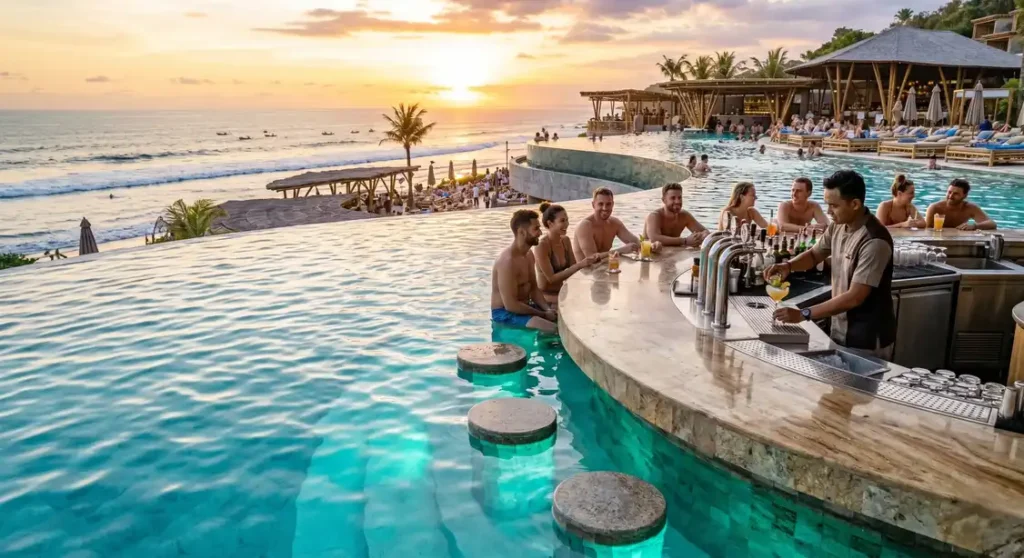
A commercial beach club pool is a different problem from a residential one. You are putting hundreds of heavily sun-screened, intoxicated bodies into a body of water under a blazing equatorial sun.
- Filtration Turn-Over Rates: A standard pool turns its water over once every 8 to 12 hours. A mega-venue pool needs industrial filtration systems capable of turning over the entire water volume every 2 to 3 hours. If the MEP engineer undersizes the pumps, the pool turns cloudy and green by 3:00 PM on a busy Saturday.
- Sanitation: Heavy chlorine use will bleach your guests’ expensive swimwear and burn their eyes. Elite venues use advanced Ozone or UV-C sanitation combined with magnesium salt chlorinators. This keeps the water crystal clear and skin-friendly despite heavy bather loads.
- Ergonomics of the Swim-Up Bar: Underwater seating depth must be calibrated precisely so guests sit comfortably while keeping drinks dry. The bartender’s floor on the dry side must also be sunken. This keeps staff speaking to seated guests at eye level.
Crowd Control and The Invisible BOH (Back of House)
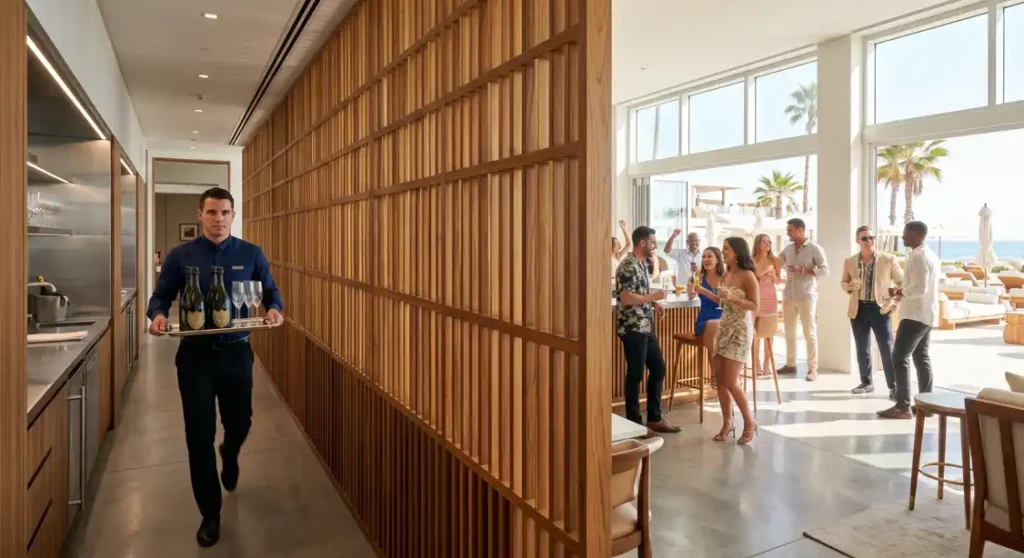
Moving 2,000 guests through a venue while delivering hot food and cold drinks is a major logistical challenge. In beach club design Bali, this must be solved in the floor plan — not in your operations manual.
Your Back of House must be massive, but completely invisible to the paying guests. In mega-venues, architects design “Service Veins.” These are hidden corridors running under pool decks or behind cabana structures.
This allows bar-backs and food runners to move from kitchens to VIP stations efficiently. Staff never need to cross the crowded dancefloor. Waiters pushing through crowded dancefloors with bottle service trays create safety hazards, broken glassware, and service delays.
Open-Air Acoustic Zoning and the Banjar Politics
Bass should energize the dancefloor without triggering complaints. The last thing an operator needs is a shutdown order from the local village council (Banjar).
Sound travels far over water. Local noise regulations are increasingly strict across coastal hotspots like Seseh, Pererenan, and Cemagi. Acoustic compliance is frequently under-specified in beach club design Bali. A single Banjar shutdown costs far more in lost revenue than proper acoustic engineering.
You need specialized acoustic engineers to map the sound dispersion. Elite venues use highly directional line-array speaker systems that focus the sound pressure tightly onto the dancefloor and pool areas. Architectural acoustic barriers are equally vital. Sloped green roofs, thick perimeter walls, and dense planting absorb low-frequency bass before it reaches neighboring residential zones or temples.
Beach Club Design Bali: Navigating MEP, AMDAL, and Setbacks
This is where the dream dies for unprepared investors. Building a beach club in Bali means working through a set of environmental and structural regulations.
- Sempadan Pantai (The Setback Rule): Indonesian law mandates a strict coastal setback from the highest tide line where permanent, roofed structures cannot be built. Permanent facilities like kitchens and indoor dining must sit behind this line. The coastal zone is reserved exclusively for temporary decking, daybeds, and pools.
- AMDAL and Waste Management: You cannot just dump your wastewater into the ocean. To get your building permits, you must pass rigorous environmental impact assessments (AMDAL or UKL-UPL). Venues must build an on-site subterranean Sewage Treatment Plant (STP). This system cleans kitchen grease, wastewater, and runoff before recycling it for garden irrigation.
- Power and Water Independence: Beachfront areas often suffer from voltage drops and limited municipal water supply. Commercial infrastructure requires synchronized diesel generator backups for power continuity during grid drops. Coastal venues also frequently need commercial Reverse Osmosis (RO) desalination plants for brackish wells.
Before mapping out DJ booths or ordering furniture, your core infrastructure must be flawless. Review the realities of heavy commercial projects in our guide to commercial interior design Bali.
You are not building a simple beach bar. You are building a complex, high-volume commercial operation. Engineer it to withstand the chaos of the coast.
Planning a Beach Club in Bali?
If you are developing or refitting a beach club in Bali, the design and engineering decisions you make now shape how your venue trades and survives the coast. Book a free design consultation. We will help you plan operational flow, durable marine-grade materials, and acoustic zoning before construction begins.
The food and beverage side of a beach club runs on the same logic as a standalone venue. See our guide to restaurant interior design for how those spaces are engineered.
The same principles scale down to smaller formats, covered in our guide to cafe interior design.
Frequently Asked Questions About Beach Club Architecture
To survive the corrosive salt air, extreme UV rays, and high humidity, you must avoid mild steel completely. Use 316 Marine-Grade Stainless Steel or heavy powder-coated aluminum. For decking, utilize Kayu Ulin (Indonesian Ironwood), which is dense and naturally resistant to rot. For seating, mandate marine-grade vinyl or extreme performance yacht fabrics.
Indonesian law strictly prohibits permanent, roofed structures from being built within a certain distance from the highest tide line (typically 100 meters, though local variances exist). Commercial venues must strategically place permanent kitchens and indoor dining behind this line, using the setback zone exclusively for temporary decking, daybeds, and pools.
To obtain commercial operating permits, coastal mega-venues must pass rigorous environmental impact assessments (AMDAL or UKL-UPL). This requires engineering a subterranean Sewage Treatment Plant (STP) to filter and clean kitchen grease, toilet waste, and pool runoff before it is safely discharged or recycled for landscape irrigation.