Last Updated on June 20, 2026 by Wisnu Arista H.
Bali Interior Design Mistakes: 7 Costly Errors Expats Make (and How to Avoid Them)
Most Bali interior design mistakes come from a single root cause: importing design thinking built for a temperate climate and dropping it, unchanged, into the tropics. A sofa that looked right in a Melbourne apartment warps within a season. A sealed, air-conditioned room grows mould in the corners. The villa photographs well and then fails to live well.
We have designed and built interiors across the island since 2005, with our own furniture production in-house — so the seven Bali interior design mistakes below are the ones we watch clients make, and the fixes are the ones we apply on real projects. Each entry covers the mistake, why it bites harder in Bali, and what to do instead.
Why Bali Interiors Fail Differently Than Elsewhere
The tropics are unforgiving in specific ways. Relative humidity in Bali averages between 80% and 85% year-round — it never drops below 80%, even in the dry season — salt air carries inland on the coast, and the sun is intense enough to fade and crack finishes that survive happily in cooler latitudes. On top of that, Balinese living is genuinely indoor-outdoor — the boundary between a room and a garden is a design feature, not an afterthought.
That combination means a decision that is purely cosmetic elsewhere becomes structural here. Material choice, ventilation, and furniture scale stop being style questions and start being durability questions. Get them wrong and the interior degrades; get them right and it ages well with very little intervention.
The 7 Bali Interior Design Mistakes That Cost Expats the Most
Mistake 1 — Importing a European or Australian Design Unchanged
The mistake: lifting a full design concept — proportions, materials, layout logic — from a temperate home and reproducing it here.
Why it hurts in Bali: schemes designed for closed, heated homes assume sealed rooms and low humidity. Heavy upholstery traps moisture, dark enclosed layouts fight the climate, and proportions scaled for smaller temperate rooms feel wrong in open tropical volumes.
The fix: start from the climate, not the mood board. Decide how air, light, and people move through the space first, then layer the aesthetic on top. The look you want is usually achievable — it just needs tropical-appropriate materials and a layout that breathes.
Mistake 2 — Choosing the Wrong Materials for Bali’s Humidity
The mistake: specifying MDF, untreated softwoods, veneers, or standard steel hardware sourced from non-tropical suppliers.
Why it hurts in Bali: at sustained high humidity, MDF swells and delaminates, untreated timber warps and feeds mould, and ordinary hardware corrodes. Replacement comes fast, and it is rarely cheap once installation is factored in.
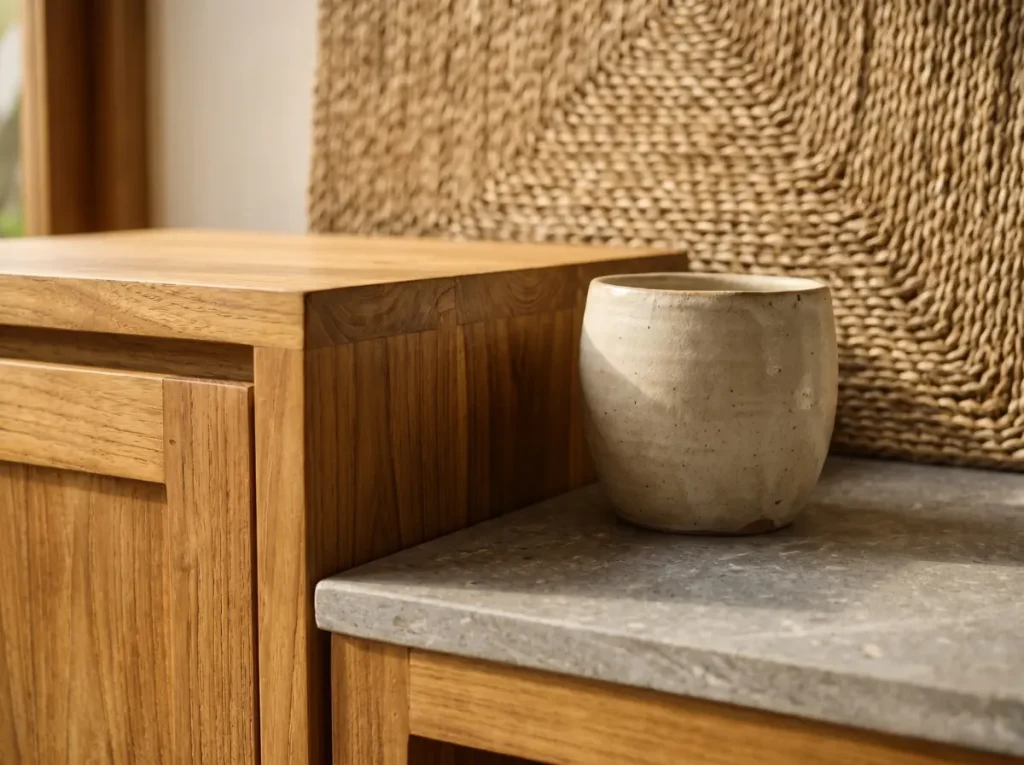
The fix: choose materials that have earned their place in the tropics — properly kiln-dried plantation teak, stone, and ceramic among them. Kiln drying brings timber moisture content down so the piece is stable once it reaches a humid environment. If you want to go deeper on this, see our guide to passive cooling techniques, which pairs naturally with humidity-resistant material choices.
A quick reference for the swaps that matter most:
| Common choice that fails | What goes wrong here | Tropical-appropriate alternative |
|---|---|---|
| MDF, particleboard, or veneer | Absorbs moisture, swells, and delaminates; finishes lift | Solid kiln-dried plantation teak |
| Untreated softwood | Warps and is vulnerable to rot and pests in humid conditions | Kiln-dried hardwood; stone or ceramic for surfaces |
| Standard steel fittings and hardware | Corrodes in humid, salt-laden air, especially near the coast | Marine-grade (316) stainless or coated/powder-coated hardware |
Mistake 3 — Sealing Rooms for Air Conditioning and Killing Ventilation
The mistake: closing up an open Balinese layout into hermetically sealed rooms so the air conditioning works harder.
Why it hurts in Bali: sealed, cooled rooms with poor airflow are mould factories, and running AC as the primary climate strategy is expensive month after month. You also lose the island’s biggest free asset — the breeze.
The fix: treat cross-ventilation and passive cooling as the baseline and air conditioning as a supplement for the hottest hours, not the whole strategy. Cross-flow openings, shaded apertures, and high ceilings do a great deal of the work before a compressor ever switches on.
Mistake 4 — Ignoring Indoor-Outdoor Flow
The mistake: designing the interior as a sealed box and the garden as a separate zone, with a hard wall between them.
Why it hurts in Bali: it produces a cramped, oddly un-tropical result that wastes the exact quality people move here for. Rooms feel smaller than they are, and the outdoor space goes underused.
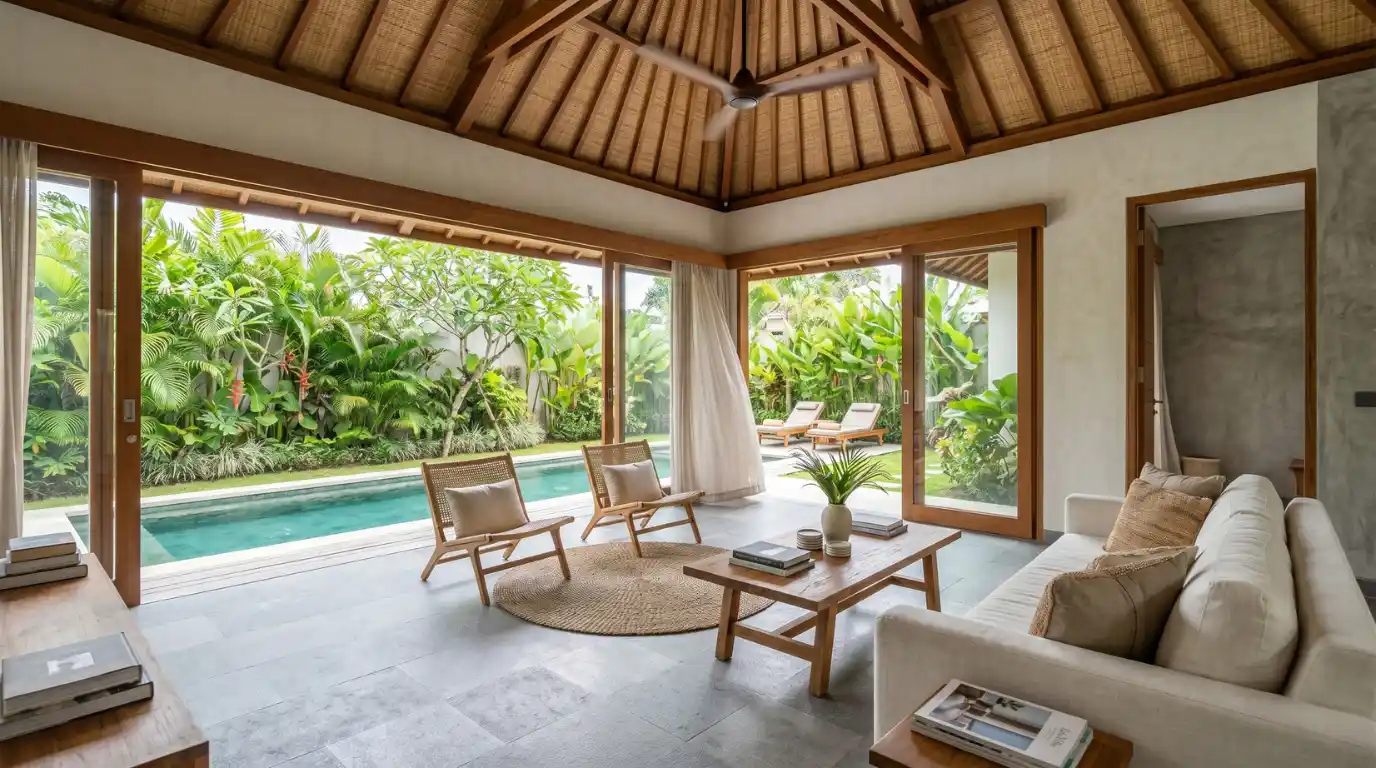
The fix: design the threshold deliberately. Folding or sliding systems, a consistent floor material running from inside to terrace, and aligned sightlines make a modest interior feel generous and connect it to the garden. The transition is where a tropical interior earns its character.
Mistake 5 — Cheap or Wrongly-Scaled Furniture
The mistake: either buying budget mass-produced furniture to save upfront, or shipping in oversized temperate-climate pieces that overwhelm an open plan.
Why it hurts in Bali: low-grade furniture is often replaced within a year once humidity gets to it, and oversized pieces block the airflow you worked to create. Both are false economies — one in money, one in comfort.
The fix: scale furniture to the volume and the airflow of the room, and invest once in pieces built to last in the climate. Because we produce furniture in-house, we can match scale, material, and finish to a specific room rather than forcing a stock size to fit.
Mistake 6 — Open-Plan with No Privacy or Acoustic Zoning
The mistake: committing to a fully open plan with no visual or acoustic separation anywhere.
Why it hurts in Bali: it looks clean in photos and becomes unlivable for families or remote workers, where one video call or one noisy kitchen disrupts the whole floor. Sound and sightlines travel uninterrupted across the space.
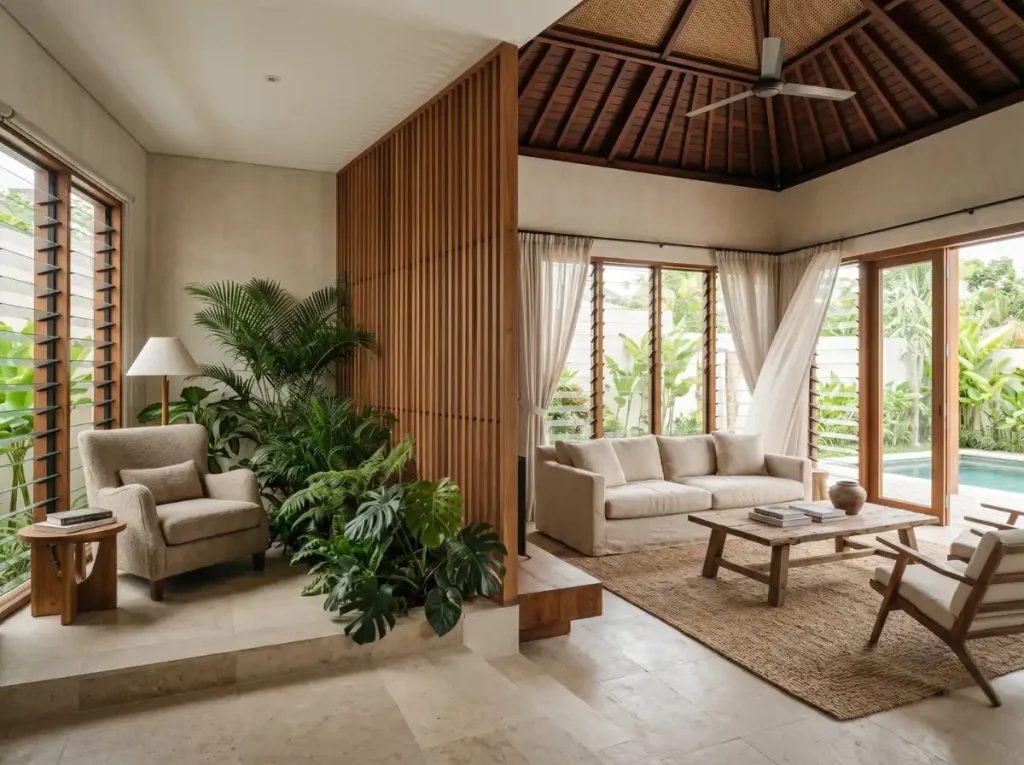
The fix: keep the openness but introduce soft zoning — screens, a change in floor level, planting, or a shift in material to signal where one zone ends and another begins. You get the airy feel without sacrificing the quiet corners that full-time living needs.
Mistake 7 — Forgetting Storage and Daily Livability
The mistake: designing the villa for how it photographs rather than how it is lived in day to day.
Why it hurts in Bali: storage gets treated as an afterthought, so clutter quickly undoes the clean aesthetic, and impractical layouts create friction every single day for full-time residents rather than short-stay guests.
The fix: build storage into the concept from the start — integrated, climate-appropriate, and sized for the household — and pressure-test the layout against real daily routines. This is also where local knowledge pays off: a studio that lives and works here designs for residents, not just for a launch photo.
How a Bali Design Studio Prevents These Bali Interior Design Mistakes
The reason these Bali interior design mistakes cluster is that they are usually made in isolation — a material chosen without thinking about humidity, a layout drawn without thinking about airflow. A studio working end to end catches them because the stages connect.
In practice that runs concept → material selection → custom production → installation, with climate logic threaded through each step. Concept fixes the layout and flow; material selection rules out anything that will not survive the humidity; in-house production matches furniture to the actual room; installation closes the gap between drawing and built result. If you want that handled as one process, our Bali interior design service covers it from first concept through install.
Avoiding these mistakes starts with understanding how the interior design process works in Bali.
FAQ — Bali Interior Design Mistakes
Importing a design built for a temperate climate without adapting it. Materials, proportions, and sealed layouts that work in Europe or Australia fail against Bali’s humidity, heat, and indoor-outdoor living. Adapting the concept to the climate first prevents most of the problems that follow.
Sustained high humidity is the culprit. MDF swells and delaminates, untreated or improperly dried timber warps and grows mould, and standard hardware corrodes. Pieces that are stable in a dry, cool climate were never tested against tropical conditions, so they degrade far faster here than buyers expect.
Usually only as a supplement. A villa designed with cross-ventilation, shading, and high ceilings stays comfortable for much of the day without mechanical cooling. Air conditioning then covers the hottest hours rather than running constantly, which lowers both running costs and mould risk.
Open-plan suits the climate and the airflow, but a fully open layout with no zoning becomes hard to live in. Families and remote workers need quiet, separable areas. The workable version keeps the openness while using screens, levels, or planting to create acoustic and visual separation.
It varies widely by the scale of the problem, but retrofitting is almost always more expensive than getting it right the first time. Replacing failed materials, reworking ventilation, or re-furnishing a space after the fact carries demolition, disposal, and re-installation costs that a considered initial design avoids.