Last Updated on September 17, 2026 by Wisnu Arista H.
Bali Kitchen Design: The 2026 Tropical Luxury Blueprint
Let’s be honest about building a house near the equator. A stunning Bali kitchen design is entirely useless if the cabinets warp from humidity within six months. It is just as useless if your open-plan layout invites local wildlife inside every time you cook dinner. See our guide to how Bali’s tropical climate shapes interior design for the principles behind this.
When designing a permanent residence for the long term, the kitchen must act as the absolute heart of the home. It is the centerpiece of your daily life, the place where you entertain guests, and the functional core of your household. However, designing a kitchen here requires a fundamentally different approach than designing one in Europe, America, or Australia.
You need a space that balances high-end, magazine-worthy aesthetics with extreme climate resilience. Here is our exact blueprint for building residential, tropical luxury kitchens that survive and thrive in the tropics.
What Is Balinese Kitchen Design?
Balinese kitchen design is a tropical approach to the kitchen that treats climate as the primary constraint rather than a styling choice. It favours natural, locally worked materials such as kiln-dried teak, volcanic stone and terrazzo, open or semi-open plans that let air move, and joinery detailed for constant humidity. The result reads warm and tactile rather than glossy, and the layout usually blurs the line between the cooking space and the outdoors.
What Defines a Balinese Kitchen
- Climate-first material choice. Kiln-dried teak, volcanic stone, terrazzo and powder-coated aluminium, chosen because they tolerate humidity and salt air.
- Open or semi-open plan. Bi-fold or sliding doors and pass-through counters let the room ventilate naturally instead of relying on extraction alone.
- Hand-worked natural stone. Paras Kerobokan, river stone and terrazzo stay cool to the touch in constant heat.
- Concealed technology. Induction hobs, integrated appliances and hidden storage keep the surfaces uninterrupted.
- Protected dry storage. A walk-in pantry, often dehumidified, keeps dry goods and equipment out of the humid main space.
What Makes a Bali Kitchen Design Survive the Tropics?
A successful Bali kitchen design survives the tropics by utilizing hyper-local, climate-resistant materials engineered to withstand high humidity, salt air, and intense heat. The foundation of tropical durability relies on replacing mass-produced factory elements with custom natural materials that naturally expand and breathe.
If you want your investment to last, key survival materials include:
- Kiln-dried teak (certified plantation, or reclaimed with documented provenance) for structural cabinetry and hidden frames.
- Natural volcanic stone for porous, breathable feature walls that regulate moisture.
- Powder-coated aluminum to prevent coastal rust on heavy sliding door tracks.
- Solid river stone or high-grade terrazzo for cool, hyper-durable prep surfaces.
The Secret Centerpiece: Custom Teak & Stone Islands
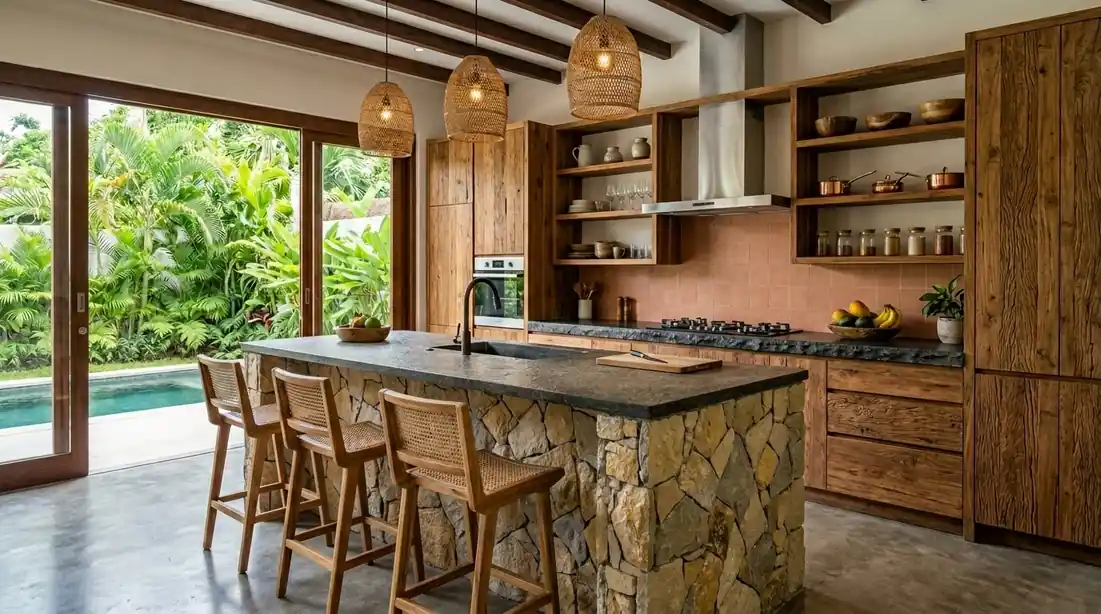
In many new villas, the kitchen island now carries the social role the dining table used to. In 2026, it is often the focal point of the home. This is where we deploy our finest custom furniture craftsmanship to ground the entire room and create a social hub.
Hand-Chiseled River Stone Surfaces
We are actively moving away from thin, clinical quartz countertops. The new standard of luxury involves massive, monolithic islands hand-chiseled from local river stone or seamlessly poured terrazzo. These natural surfaces are consistently cool to the touch, a massive benefit in a constantly hot climate, and offer a raw, tactile beauty that factory-pressed materials simply cannot replicate.
Kiln-Dried Teak for Humidity Resistance
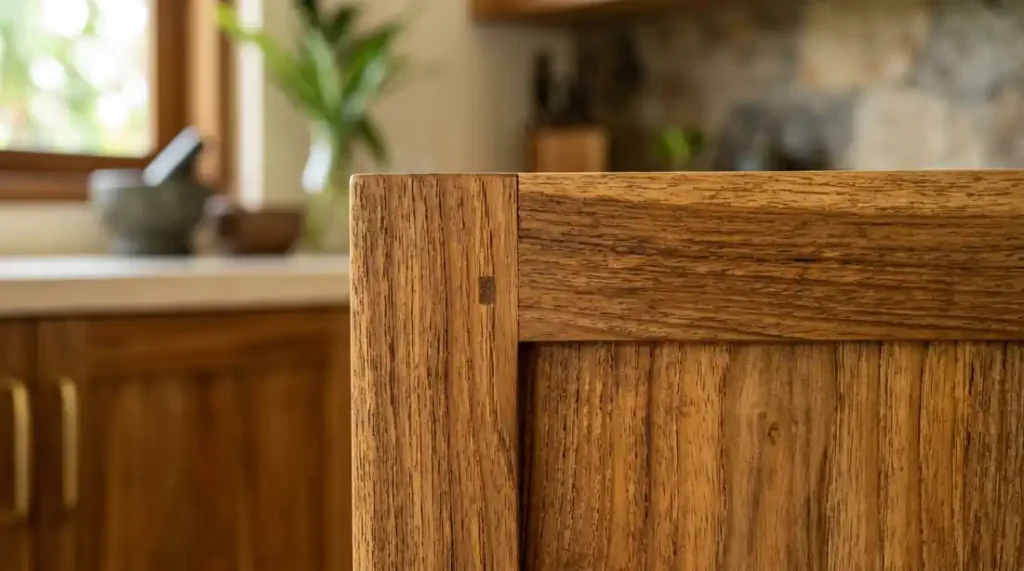
Here is the hard truth that many new residents learn the hard way: imported MDF absorbs moisture and warps in Bali. For the base of your island and all surrounding cabinetry, custom-built teak, from certified plantations or reclaimed with documented provenance, is one of the best choices. We make these units as custom furniture in the Bali workshop we share with our parent company, Bali Best Buy, cut to the room’s real dimensions. Traditional Balinese interlocking joinery allows the dense tropical wood to shift with the wet and dry seasons without cracking, ensuring your investment lasts for decades.
Hidden Induction & Seamless Technology
To maintain the pristine illusion of raw nature, modern technology must be concealed. We integrate state-of-the-art induction cooktops flush into the stone surfaces and utilize downdraft extractors that rise from the counter only when you are actively cooking. It is the perfect marriage of biophilic design and smart home capability.
Why Custom Coordination Matters
This level of integration of stone, timber, joinery, and technology does not come from a furniture catalog. Every element has to be specified, sourced, and engineered to work together in the same humid, salt-laden climate. That coordination is where most kitchen builds quietly fail. If you are planning a permanent residence and want this kind of cohesive execution from day one, talk to our interior designer in Bali. We handle the full design and procurement scope as one workflow, not as separate vendor handoffs.
Mastering Tropical Kitchen Lighting
One crucial aspect that most overseas designers often overlook is how lighting interacts with tropical wildlife. If you install standard bright white overhead lights in an open-plan house, your kitchen will attract significant insect activity in the neighborhood the second the sun goes down.
To prevent this, our residential lighting protocol focuses on warm, layered illumination.
We utilize amber-toned LED strip lighting hidden beneath the stone countertops and inside the cabinetry. For task lighting, we install focused, low-glare pendant lights directly over the island. This creates a moody, sophisticated atmosphere that deters insects while providing plenty of visibility for evening meal preparation.
Key Elements for Your Tropical Culinary Space
Beyond the central island and lighting, every supporting element in your kitchen must be tailored for the island’s unique environmental challenges.
Paras Kerobokan Feature Walls
Instead of standard ceramic subway tiles, we utilize Paras Kerobokan (local volcanic tuff) for backsplashes and feature walls. This natural stone absorbs excess moisture in the air and casts deep, dramatic shadows during the golden hour, bringing the texture of the Balinese outdoors inside your home.
Powder-Coated Aluminum Fixtures
If your house is located in coastal areas like Canggu or Uluwatu, the salt breeze is relentless and highly corrosive. All visible metal fixtures, cabinet handles, and window frames must be upgraded to powder-coated aluminum or marine-grade brass to prevent rapid oxidation and rust.
The Walk-In Pantry with Micro-Dehumidifiers
Interestingly, the most critical part of a tropical kitchen is often hidden behind a closed door. Humidity is a serious threat to dry goods, spices, and high-end electronics. We design highly functional walk-in pantries equipped with passive louver ventilation and active micro-dehumidifiers, ensuring your flour, organic snacks, and expensive espresso machines remain perfectly dry.
Designing a Kitchen That Opens to the Outdoors
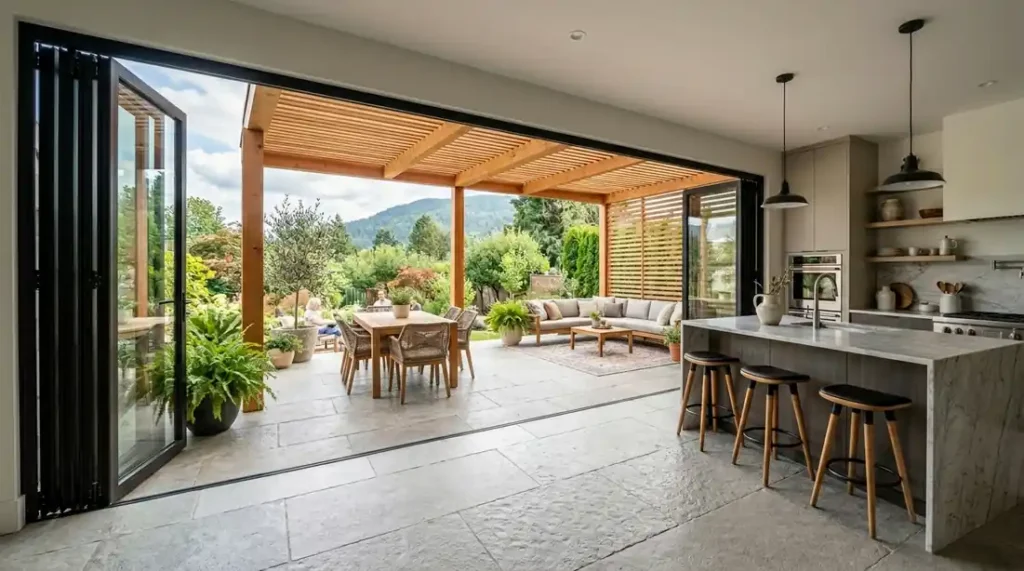
You moved to Bali for the tropical lifestyle, so trapping yourself in a completely enclosed, windowless box feels uncomfortable. Yet, a 100% open-air kitchen makes cooking in the midday heat unbearable.
The configuration we design for clients who want both: a kitchen that transforms.
We specify floor-to-ceiling glass bi-fold doors that fold completely away. On a breezy July morning, you can fold the doors completely away to connect your kitchen directly to the outdoor deck and garden. When the January monsoon hits, or when you need a quiet environment for a remote work call, simply slide them shut. You get a fully air-conditioned, weatherproof sanctuary that still offers panoramic jungle or ocean views.
This kind of integration is most common on luxury villa projects, and it needs upfront architectural planning. The structural openings, the door track engineering and the flooring continuity all have to be specified during the design phase, not retrofitted later.
Bali Kitchen Cabinet Materials That Handle the Humidity
Cabinetry is where an imported kitchen usually fails first. Flat-pack carcasses built for dry climates swell at the edges, delaminate and drop their doors inside two wet seasons. What survives here is kiln-dried hardwood, marine-grade plywood and powder-coated aluminium. Build the carcasses with solid backs instead of stapled hardboard, and leave a ventilation gap behind every run so trapped humidity has somewhere to go.
A Finished Example: Soho Blue, Kayu Tulang
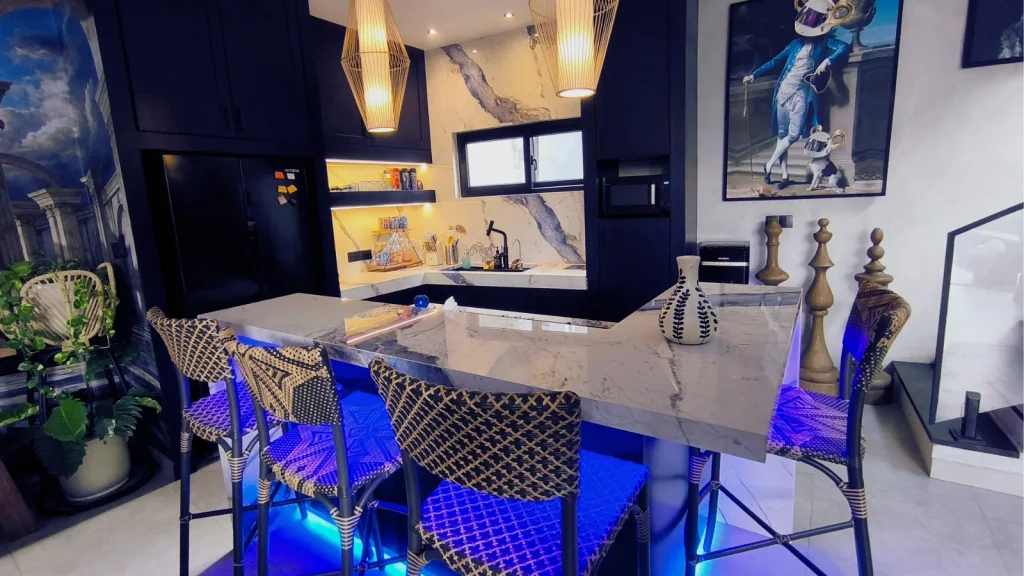
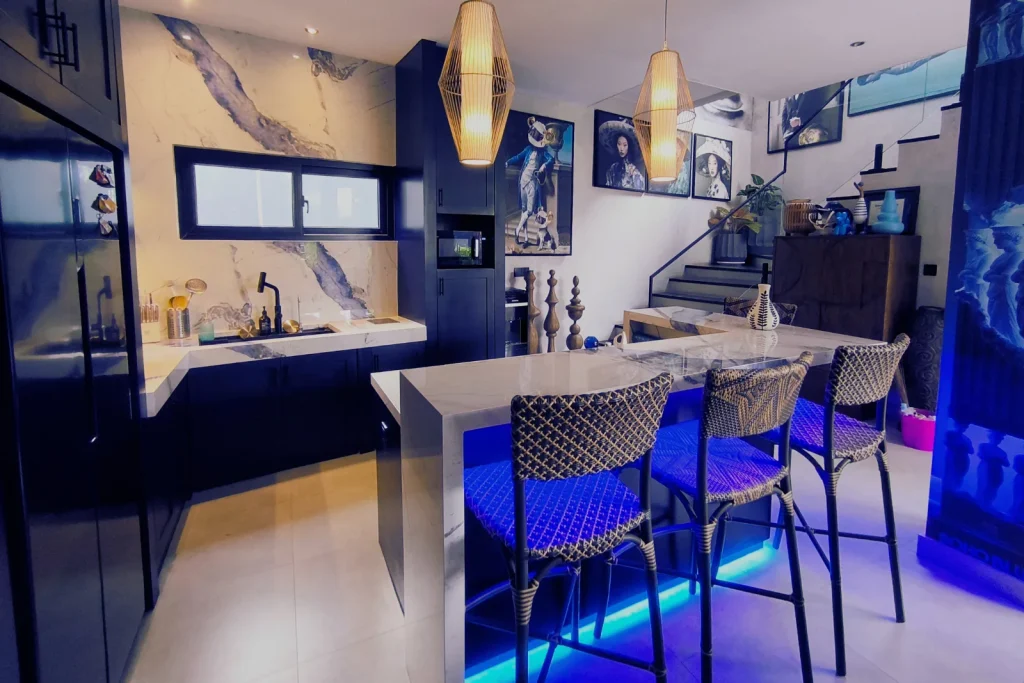
Soho Blue is a villa kitchen in Kayu Tulang, on the quiet inland side of Canggu, where we handled the interior design and the custom cabinetry. It started as a grey box: a polished concrete island, concrete open shelving, a plain herringbone splashback and a black fridge standing against bare plaster. Rather than soften the room with neutrals, we committed to one confident colour and built everything around it.
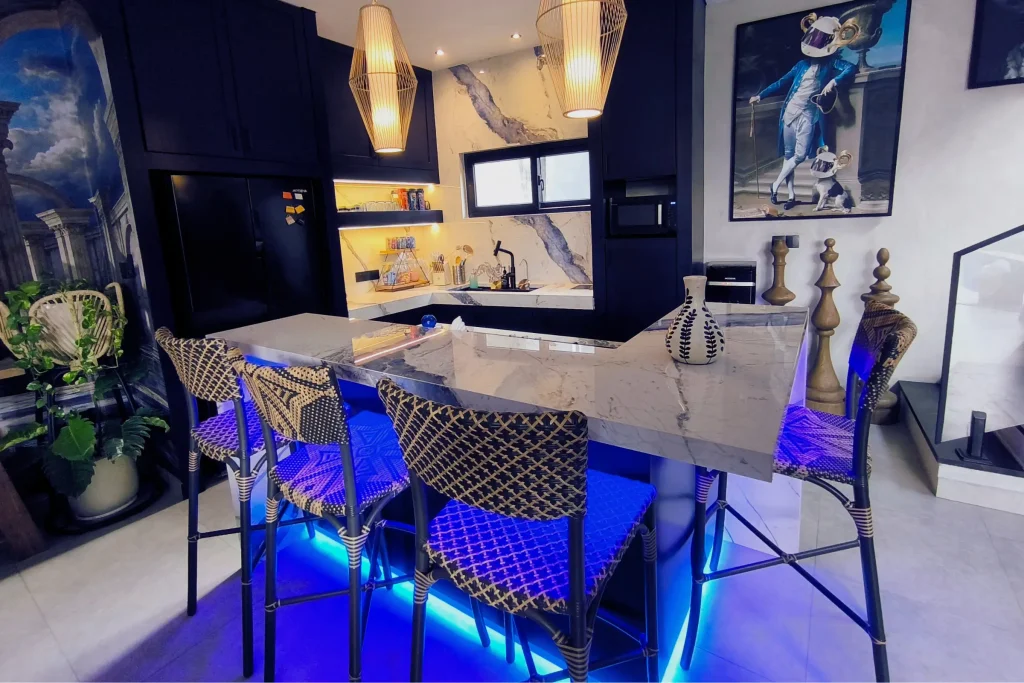
Deep navy cabinetry in Permanent Blue 5438 replaced the raw concrete perimeter, with tall shaker units framing the fridge and pantry. Bookmatched Quadra Glacier Blue marble runs from the splashback down into a waterfall island, and a recessed LED strip lights the bar counter from beneath. The gallery-wall art and woven pendant lights the owner already had were kept, so the kitchen reads as part of the house rather than a showroom dropped into it.
The same climate logic runs through the rest of our tropical work, starting with the room next door: luxury tropical bathroom design in Bali.
For whole-villa direction, the heavier tropical brutalism approach sits at one end of the range.
The warmer modern Mediterranean tropical villa style sits at the other.
Ready to Bring Your Bali Kitchen Design to Life?
A well-executed Bali kitchen design does not force you to choose between stunning tropical aesthetics and practical Western functionality.
By trusting local artisans, prioritizing climate-specific materials, and planning for extreme weather shifts, you can build a culinary space that handles the rigors of daily living effortlessly. If you want help with yours, our Bali interior design team can take it from the first sketch to the finished joinery.
Ready to integrate this vision into your entire property? Explore our comprehensive guide to Home Interior Design Bali to build a permanent island sanctuary that stands the test of time.
For more room-by-room inspiration, browse our Bali home interior design ideas.
FAQ: Bali Kitchen Design
Mold prevention relies on three critical factors: cross-ventilation, material choice, and climate-controlled zones. Using solid teak instead of porous particleboard prevents internal moisture absorption. Additionally, isolating your dry goods in a dedicated, dehumidified walk-in pantry stops mold spores before they can spread.
Yes, but it requires incredibly high maintenance. Marble is naturally porous and can stain easily from tropical fruits like lime, mango, or papaya. For high-traffic residential homes where you will be cooking daily, we strongly recommend thick terrazzo or treated river stone as they are far more durable and capture the island aesthetic perfectly.
Indonesian teak, from certified plantations or reclaimed with documented provenance, is widely recommended for tropical kitchens. It has a naturally high oil content that repels termites and strongly resists water damage, making it a far better choice than imported softwoods or engineered boards.