Last Updated on September 16, 2026 by Wisnu Arista H.
Net Zero Villa Bali: How Interior Design Drives Energy Efficiency
Let’s clear up a massive misconception right now. If you are trying to build a net zero villa Bali in 2026, slapping forty solar panels on your roof and buying a rainwater tank is not enough.
Most eco-conscious developers focus 100% of their attention on the architecture and the MEP (Mechanical, Electrical, and Plumbing) engineering. They treat the interior design as just the “pretty stuff” that comes at the end—the cushions, the rugs, and the paint colors. This is a costly and easily avoidable engineering oversight.
If your interior designer Bali is not aligned with your climate goals, the building will consume too much energy. Your expensive solar batteries will drain by midnight, and your “net zero” dream will fail. True sustainability is an ecosystem. Here is the brutal reality of how your interior finishes, lighting loads, and material sourcing directly dictate your villa’s energy efficiency.
How does interior design impact a net zero villa?
Interior design fundamentally impacts a net zero villa by controlling the building’s internal thermal mass, lighting energy loads, and embodied carbon footprint. Strategic interior choices—such as high-density stone flooring, automated solar shading, and locally sourced reclaimed materials—drastically reduce the energy burden on the property’s HVAC and solar power systems.
Key ways interiors drive net zero performance:
- Thermal Mass Optimization: Using dense materials to retain AC cooling.
- Automated Solar Shading: Motorized blinds that block heat before it warms the room.
- Phantom Load Reduction: Centralized smart-home kill switches.
- Embodied Carbon: Sourcing local Balinese materials to eliminate shipping emissions.
- Water-Efficient Luxury Fixtures: Reducing the load on eco-water filtration systems.
The Physics of Cooling and “Thermal Mass”
In Bali, your biggest enemy isn’t the cold; it’s the 32-degree tropical heat. The vast majority of a villa’s energy consumption comes from running air conditioning units. This is why thermal mass specification is one of the most underappreciated interior decisions in any net zero villa Bali project.
Design a living room with thin wooden floors and lightweight drywall and those materials have very little “thermal mass.” Turn the AC off and the room heats up again quickly. Your AC compressor runs near full capacity all day just to fight the ambient temperature.
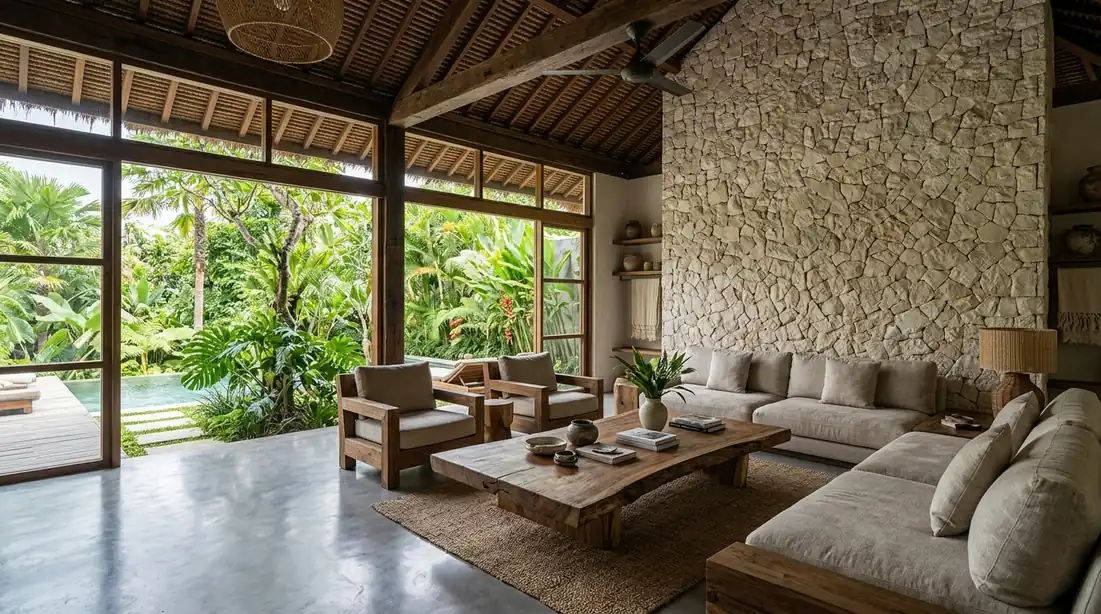
Elite eco-interior design uses high thermal mass materials on the inside of the home: heavy, poured microcement floors, thick raw limestone feature walls, and rammed earth partitions. These dense materials act like thermal buffers. They absorb heat slowly, so a cooled room warms up far more gradually once the AC is switched off. The afternoon heat peak arrives later, and lower. That lets you run the AC for shorter periods, reducing the draw on your solar battery array.
Beating the Sun: Automated Interior Shading
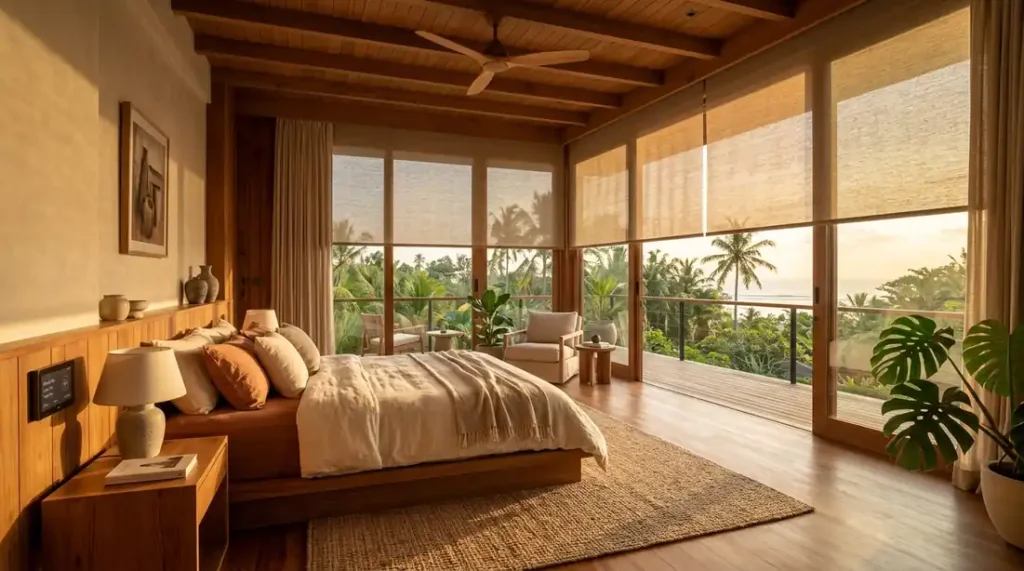
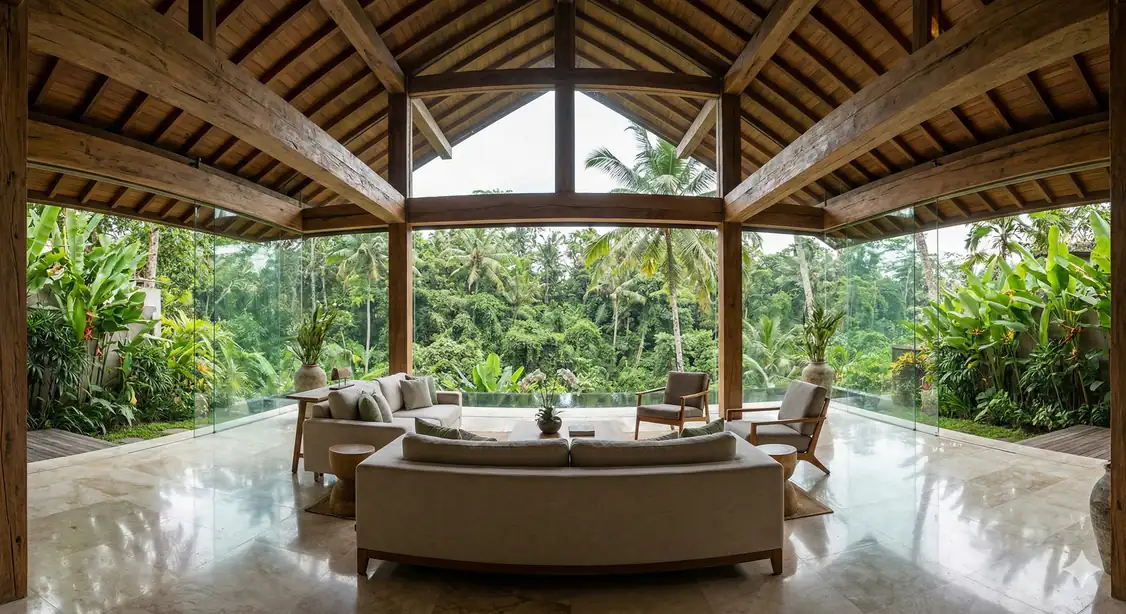
Architects love massive floor-to-ceiling glass windows because they frame the jungle or ocean views perfectly. But glass is a thermal disaster. It creates a greenhouse effect that cooks your interior.
You cannot achieve net zero if your interior is constantly fighting the sun.
This is where interior design meets smart engineering. You must integrate automated, motorized solar shades seamlessly into the ceiling bulkheads. These aren’t just for privacy; they are thermal shields. Connected to a smart home weather system, these semi-translucent UV blinds automatically lower on the West-facing windows at 3:00 PM when the sun is harshest. By blocking the solar heat gain before it penetrates the room, you cut the heat your AC has to remove.
Embodied Carbon vs. Operational Carbon
This is where fake eco-villas get exposed.
Operational carbon is the energy your villa uses while people live in it. Embodied carbon is the total environmental cost of manufacturing, transporting, and installing the materials used to build it.
You cannot call your project a net zero villa if you imported your kitchen marble from Italy, your lighting fixtures from China, and your oak flooring from Canada. The carbon emissions from the cargo ships bringing those materials to Benoa Harbor can significantly offset the environmental benefit of your solar panels.
Every net zero villa Bali should be built around a hyper-local material palette — not just for sustainability, but for authenticity.
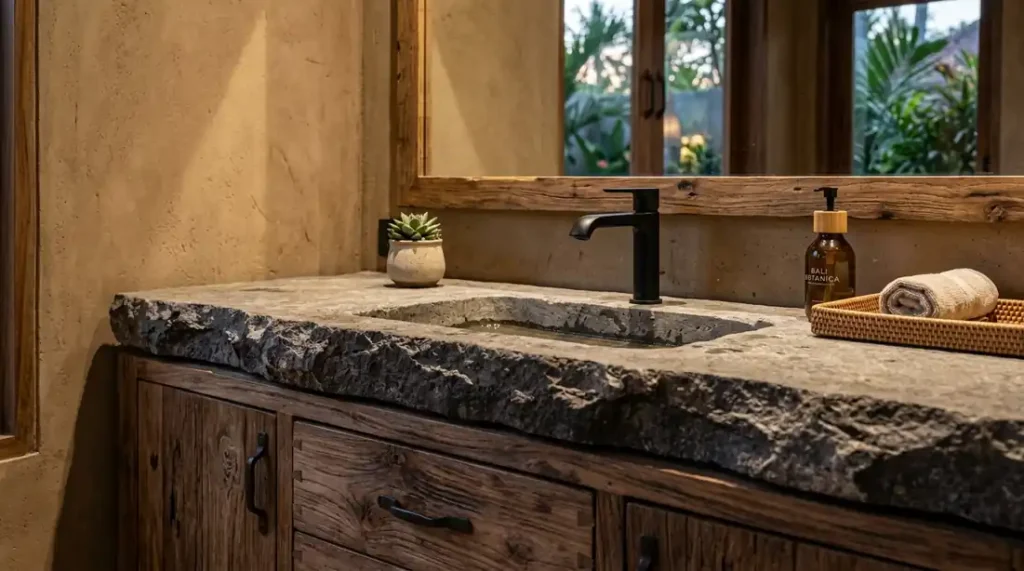
Sustainable luxury relies on hyper-local sourcing. That means materials like reclaimed Indonesian teak (Kayu Jati) where the salvage can be documented, certified plantation teak where it cannot, natural Paras Taro stone, a volcanic tuff quarried right here in Bali, and fast-growing bamboo for acoustic ceiling treatments. It gives the villa an authentic, grounded sense of place while cutting your carbon footprint.
Phantom Loads and Smart Lighting Architecture
A typical luxury villa has dozens of hidden energy drains. A TV on standby, an espresso machine plugged in, or a few forgotten garden lights can quietly drain a solar battery overnight. We call these “phantom loads.”
Your interior lighting plan must be ruthlessly efficient. Yes, using warm 2700K LED bulbs is the baseline. But the real energy savings come from the control architecture.
A well-planned lighting scheme includes “All-Off” kill switches located at the front door and next to the master bed. With one touch, the system cuts power to non-essential outlets and lights. It also relies on highly targeted task lighting (like low-wattage reading lamps and under-cabinet LEDs) rather than flooding the entire room with massive, energy-hungry ceiling downlights.
To truly understand how this fits into the bigger picture of the island’s evolving architectural standards, you need to look at the broader ecosystem. Dive into our comprehensive guide on Sustainable Interior Trends in Bali to see how these localized strategies are shaping the future of high-end real estate.
Achieving a net zero rating is a holistic war against waste. Your interior design is the frontline defense. Engineer it properly, and your net zero villa Bali will run efficiently, authentically, and profitably for decades. Two levers do the most work. Passive cooling techniques cut mechanical load before automation gets involved.
Smart home automation then trims the waste that is left over.
Working towards net zero on a Bali villa? Our interior design team in Bali can take the interior side of it, from thermal mass and shading to a material palette sourced close to the site. Get in touch and we will look at your plans.
Frequently Asked Questions About Net Zero Villa Design
A net zero villa is a highly engineered property that produces as much renewable energy (usually via high-capacity solar panel arrays) as it consumes over the course of a year. In Bali’s tropical climate, achieving this requires a heavily insulated architectural envelope, advanced MEP systems, and interior design choices that drastically reduce the daily need for air conditioning and artificial lighting.
By utilizing materials with high thermal mass—such as polished concrete, microcement, and natural stone—the interior surfaces absorb heat slowly and stay cool long after the AC has brought the room down. When the AC is turned down or off, these materials slow the rise in room temperature, keeping the room comfortable for longer and reducing the electrical load on the villa’s energy system.
Embodied carbon refers to the greenhouse gas emissions associated with the entire lifecycle of a material, including extraction, manufacturing, and transportation. A true eco-villa minimizes embodied carbon by refusing to use imported materials shipped across the world. Instead, it utilizes hyper-local resources like reclaimed Indonesian teak, local limestone, and natural rattan.