Last Updated on September 17, 2026 by Wisnu Arista H.
Restaurant Furniture in Lombok: What Survives an Open Coastal Site
Choosing restaurant furniture in Lombok is not the same job as choosing it in Denpasar or Jakarta. The island’s best commercial spaces sit close to the water. They stay open on more than one side, and they take guest traffic every day of the year.
Furniture specified for an indoor dining room will not last there. This is about what survives, what fails first, and why.
The short answer: on an open coastal site, specify kiln dried teak with an oiled or marine grade finish, outdoor grade upholstery, and stainless or coated fixings. Those four choices prevent most of the failures described below.
The same logic applies to hotel furniture in Lombok, where rooms are sheltered but restaurants, bars and shared terraces usually are not.
What Makes a Coastal Lombok Site Harder Than an Inland One
Three things work against furniture on the south Lombok coast, and they compound.
Salt is the first. Wind carries it inland well beyond the beach itself, and it settles on every surface. It attacks metal, dulls finishes and works into open timber grain.
Sun is the second. Lombok sits close to the equator, so light is direct for most of the day. Ultraviolet breaks down surface finishes and fades fabric faster than most owners expect.
Humidity is the third, and it moves. Timber takes on moisture in the wet season and gives it back in the dry, so joints work loose over time unless the timber was dried properly before it was ever cut.
Individually each is manageable. Together, on an open site, they shorten the life of anything specified casually.
The Rooftop Problem: Covered, Open and Fully Exposed
Rooftop restaurants and bars are the hardest case, and they are also the spaces owners most want.
A rooftop is usually covered but not enclosed. A pergola or a light roof gives shade, and the sides stay open for the view. That is exactly the point of the space, and it is also why the furniture has a harder life than it would either indoors or in a garden.
Indoors, furniture is protected. Fully outdoors, everyone accepts that pieces are outdoor grade. A covered rooftop sits between the two, and it gets specified as though it were indoors far more often than it should be.
Rain arrives sideways in a squall. Sun reaches under the roof line for part of the day as the angle changes. Salt does not care that there is a roof.
Treat a covered rooftop as an outdoor site that happens to have shade. Specify the restaurant furniture on that basis and most of the common failures never start.
Restaurant Furniture in Lombok: Which Timber Actually Holds Up
Teak is the reliable answer for anything exposed, and the reason is in the timber itself rather than the finish on it. Teak’s natural oils resist moisture and insects, which is why it has been used on boat decks for centuries. Left alone it silvers; oiled, it holds its colour.
Suar makes beautiful wide slab tops, and it is a common choice for a statement table. It wants shelter. On a fully exposed terrace it moves and checks more than teak does.
Mahogany works well for interior pieces and for anything under solid cover, but it is not a first choice for an open site.
Rattan belongs under a roof and out of the weather. It is light, it suits the setting and guests like it, but it is a poor choice for anything that will sit in the rain. Synthetic rattan is a legitimate alternative outdoors, though it reads differently up close.
The other question is drying. Kiln dried timber has been brought to a stable moisture content before it is worked. Air dried timber that went into production too early will move on site, and no finish will save it.
Why Indoor Finishes Fail Outdoors
A finish is not decoration. On an exposed site it is the barrier between the timber and everything described above.
Standard interior lacquer is the most common mistake on coastal projects. It looks excellent on delivery, then it clouds, cracks and lifts once ultraviolet and moisture get to work. Once it has lifted, water gets underneath and the repair means stripping the whole surface rather than touching it up.
Penetrating oil finishes behave better outdoors because they soak into the timber rather than sitting on top of it. They need reapplying, typically once or twice a year on an exposed site, but reapplication is a light task rather than a refinishing job.
Marine grade finishes cost more at the outset and last considerably longer under direct exposure. On a rooftop that takes full sun, the difference over three years is not close.
Ask which finish is being used before an order is confirmed, and ask what the maintenance cycle looks like. Any workshop that cannot answer both is guessing.
Upholstery Under Daily Guest Use
Upholstery is where most commercial projects underestimate the conditions, and it is the shortest-lived part of any specification.
Indoor fabric on a coastal terrace fades within a season, holds damp, and eventually grows mould in the seams where air does not reach. Outdoor grade fabric is not a luxury in that setting. It is the difference between recovering seats once and recovering them every year.
Solution dyed acrylics hold colour under ultraviolet because the pigment goes through the fibre rather than sitting on the surface. Quick dry foam matters as much as the cover does, because a cushion that holds water after a squall stays damp underneath even when the top feels dry.
Removable covers are worth specifying from the start. On a commercial site they will need washing, and covers that come off easily get washed.
The Fixings Nobody Sees Until They Fail
Hardware is the quiet failure point on restaurant furniture in Lombok, and it is almost never in the specification conversation.
Ordinary steel fixings rust within sight of the sea. The first sign is usually a stain bleeding out of the timber around a screw head, and by then the fixing itself is already compromised.
Stainless steel or properly coated hardware costs a little more per piece and removes the problem. On a chair that will be moved several times a day for years, it is the difference between a frame that stays tight and one that develops a wobble nobody can trace.
Ask what the fixings are. It is a short question and it tells you a lot about how the rest was specified.
Put together, the four decisions above give a specification you can hand to a supplier. This is what we would specify for restaurant furniture in Lombok on an exposed site, and what we would avoid.
| Component | Specify | Avoid |
|---|---|---|
| Timber, exposed | Kiln dried teak | Untreated or air dried softwood |
| Timber, sheltered | Suar or mahogany | Suar in open weather |
| Finish | Penetrating oil or marine grade | Interior lacquer |
| Upholstery | Solution dyed acrylic, quick dry foam | Indoor fabric, standard foam |
| Fixings | Stainless or properly coated | Ordinary steel |
Ordering Restaurant Furniture in Lombok in Batches You Can Match Later
Restaurant furniture gets damaged. A chair breaks, a table top is scarred, and the piece has to be replaced.
If the original order came from several suppliers, or from stock that has since changed, matching it is close to impossible. Restaurants end up with a mixed set, or replacing a whole run to keep the room consistent.
Ordering in batches from one workshop avoids that, and it is the practical case for custom furniture and local procurement over stock buying. The drawings, timber selection and finish stay on record, so the same chair can be made again in a year or in three.
For a commercial operator that is worth more than it sounds, because the alternative is an unplanned refurbishment driven by two broken chairs.
Project Snapshot: The Rooftop at Boni Beach, Selong Belanak
Bali Best Buy Furniture supplied and installed the furniture for the rooftop restaurant at Boni Beach Lombok, a boutique hotel and villas on the south coast. Bali Best Design is the design arm of Bali Best Buy. The furniture was delivered and installed in July 2026. To be clear about the role, this was a furniture commission and the space itself was designed by others.
The terrace runs the length of the building under a timber pergola with exposed rafters. It stays open on both sides, with the sea on one aspect and fields and hills on the other. Everything above applies to it directly.
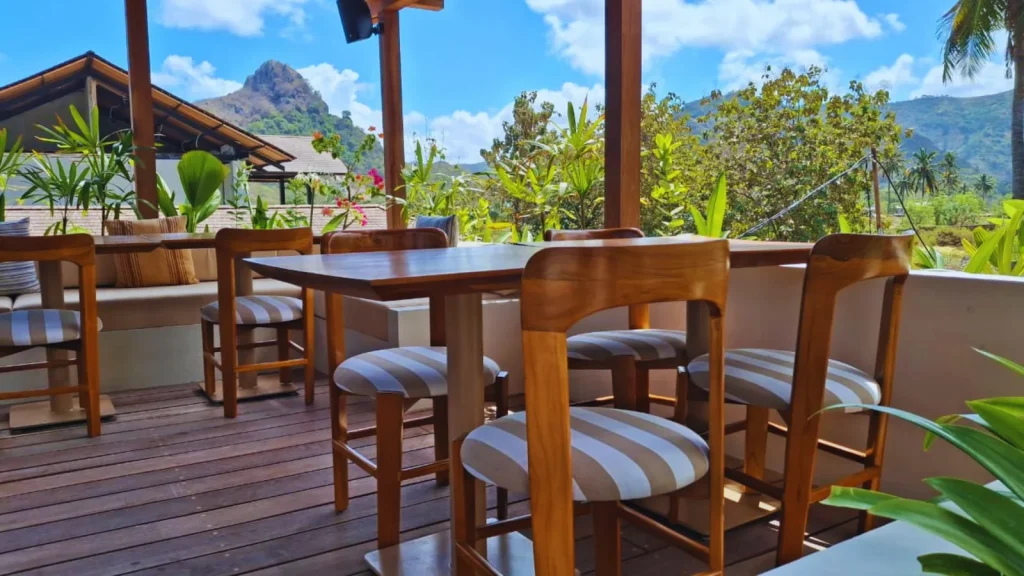
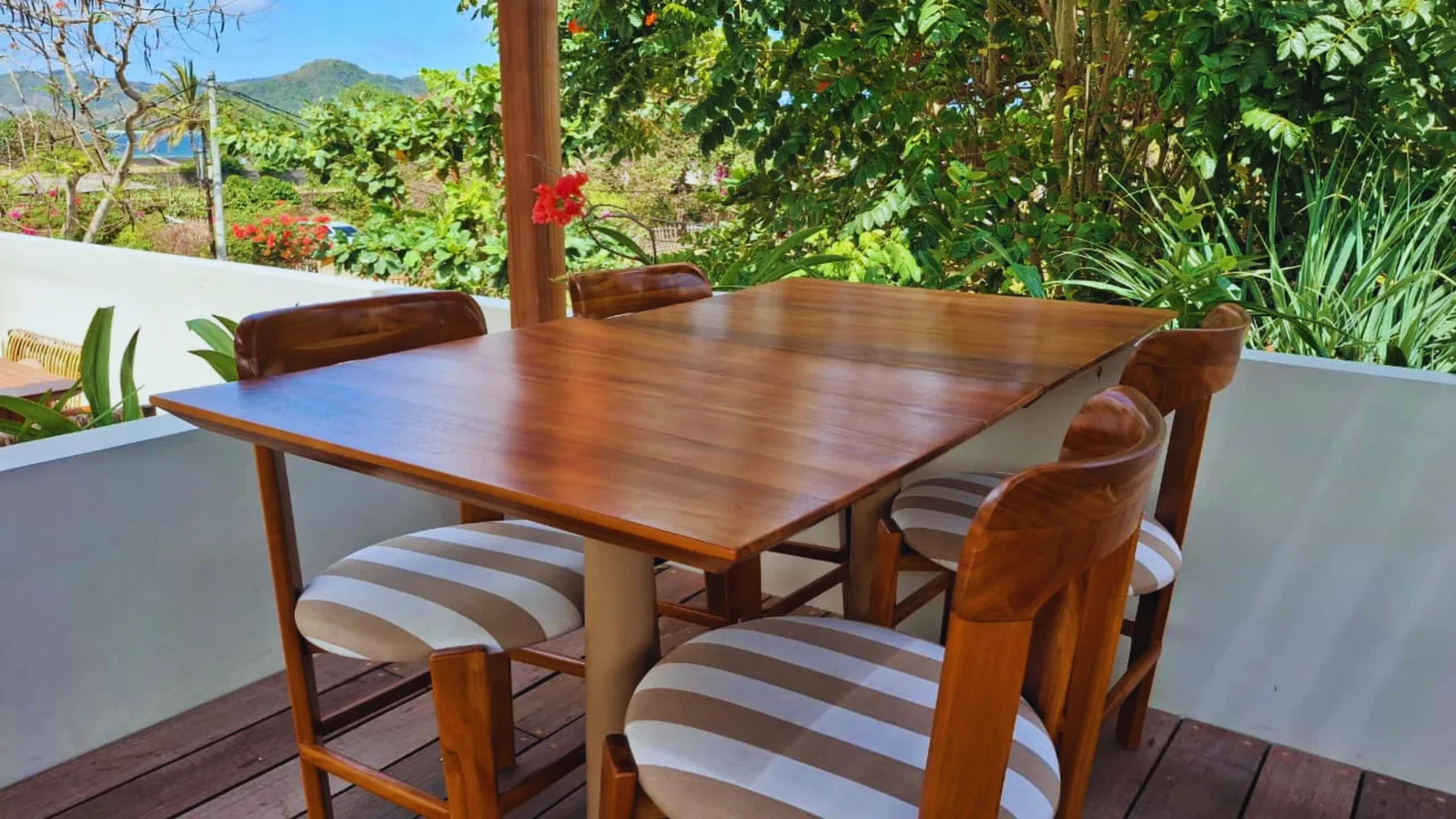
The supply covered solid timber dining tables on slim pedestal bases, dining chairs with curved backrests and striped upholstered seats, and bar stools for the counter further along.
The pieces were made in our own workshop in Kerobokan and travelled to Lombok by road and ferry on our own vehicles, then installed by the same team. Because the route is domestic there is no container, no port handling and no customs stage, which means two handling points rather than six or seven. Every handling point is an opportunity to mark a finish.
Bali Best Buy Furniture has a project page for Boni Beach on its own site, with photographs of the teak tables and chairs at the restaurant.
This project sits inside our wider interior design and custom furniture in Lombok work, which covers villas and hotels as well as restaurants.
Working Around Fixed Banquettes and Built-In Seating
Most hospitality spaces are not empty rooms. Built-in seating is usually poured or framed before the loose furniture is ordered, which means the loose pieces have to work around something already fixed in place. The sequencing problem is the same one that runs through any commercial interior design project.
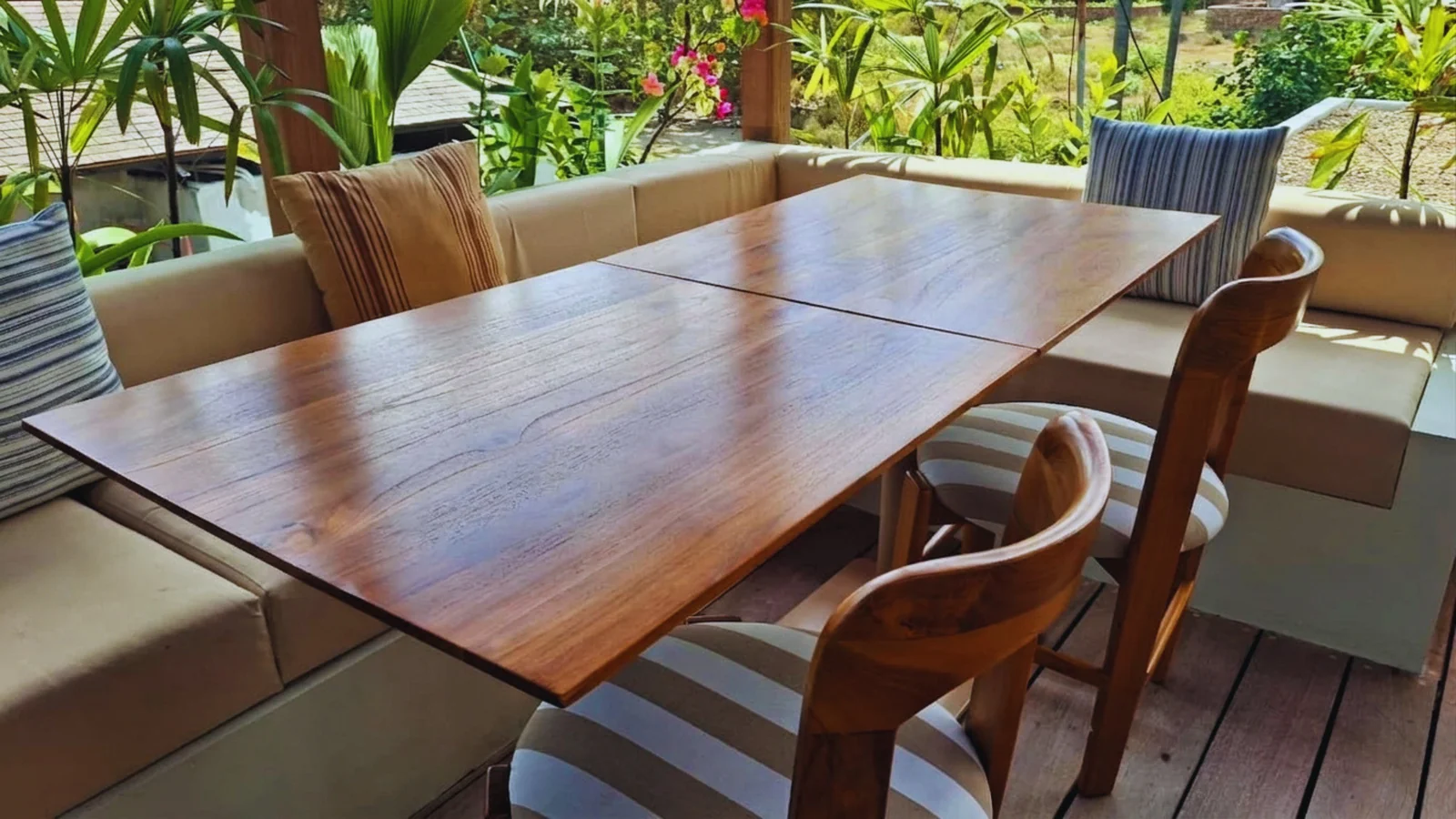
At Boni Beach, rendered banquettes run down both edges of the terrace. Table heights, seat heights and the clearance between them all had to sit correctly against seating that could not move.
Get the measurements of anything built in before furniture is drawn, not after. A table that is twenty millimetres too tall for a fixed bench is a table that gets used awkwardly for its entire life.
Furnishing a Restaurant in Lombok?
Tell us about the site, how exposed it is, and what stage the build is at. We will tell you honestly what will hold up there and what will not, and which restaurant furniture in Lombok we would order first. You can also read more about what we do in Lombok.
Frequently Asked Questions
For restaurant furniture in Lombok on an exposed site: kiln dried teak with an oiled or marine grade finish, outdoor grade upholstery, and stainless or coated fixings. Those four choices between them prevent most coastal failures.
On an exposed coastal site, generally yes. The cost difference is at purchase; the difference in replacement cycle plays out over years.
Under solid cover and out of the rain, yes. On an open edge that takes weather, natural rattan will not last. Synthetic rattan is the alternative if the look is important.
An oiled finish on an exposed site typically wants reapplying once or twice a year. Sheltered pieces go longer. Ask the workshop for the cycle on the specific finish used.
If it was made to order and the drawings and finish are on record, yes. That is the main practical advantage of ordering in batches from one workshop.
We deliver on our own vehicles by road and ferry, and our own team installs on site.
Yes. Rooms, restaurants and shared areas, often in phases as a build completes. Room furniture is sheltered and can be specified differently from anything on an open terrace.