Last Updated on August 22, 2026 by Wisnu Arista H.
Interior Designer vs Interior Decorator in Bali: What’s the Difference?
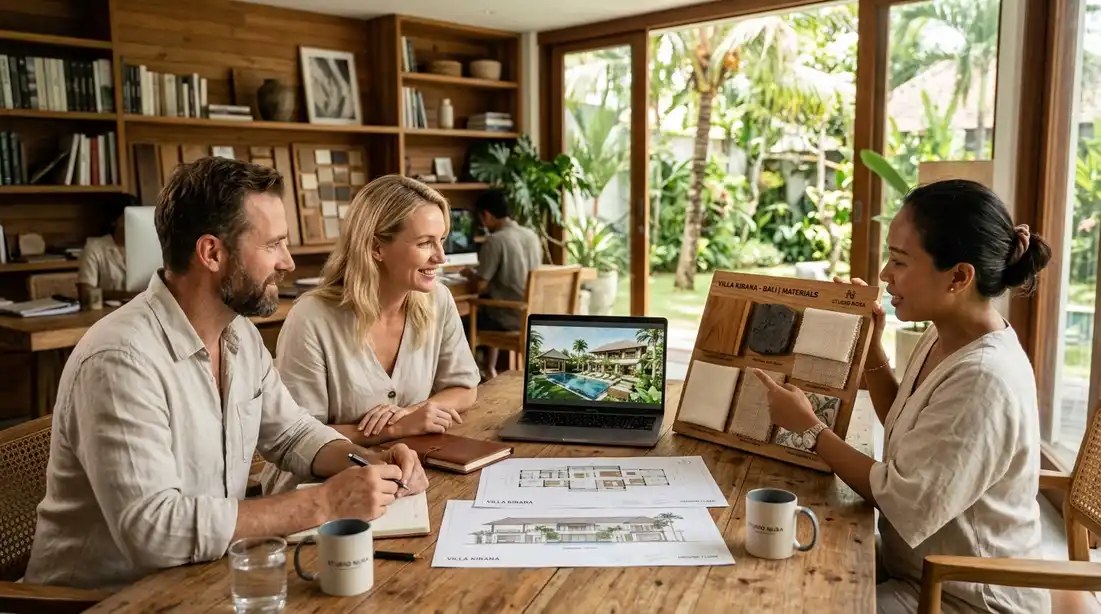
When weighing up an interior designer vs decorator in Bali, the decision comes down to one question: does the space itself need structural work, or just a styling refresh? A decorator focuses on the look of an existing space — furniture, colour palettes, textiles, and accessories. A designer also plans how the space works: layout, flow, lighting, built-in elements, structural changes, and full project coordination from brief to handover. For most villa renovations or new fit-outs in Bali, you need a designer. For a cosmetic refresh of a space that is already structurally sound and well-proportioned, a decorator may be all you need. The distinction matters more in Bali than in many markets, for reasons explained below. Understanding how our design process works will help you work out which approach fits your project.
Interior Designer vs Decorator in Bali: The Core Difference
Interior decorating sits above the surface. It takes a defined space and makes it more beautiful — better furnished, better styled, more coherent in its colour and material choices. Interior design begins earlier in the process, when the space itself is still taking shape: How should the rooms relate to each other? Where should the light come from? Which built-in elements does the space need, and what can open up or reconfigure?
| Interior Decorator | Interior Designer | |
|---|---|---|
| Focus | Aesthetics: furniture, colour, textiles, accessories, and styling | Space planning, layout, lighting, built-ins, material specification, and structural scope |
| What they change | Furnishings and surface dressing — nothing structural | Layout, flow, built-in storage, lighting circuits, finishes, and sometimes walls |
| Training | No formal regulatory requirement; skills-based | Formal training in spatial design, building materials, and technical drawing |
| Permits | Not required | Often required, depending on scope |
| Best for | Cosmetic refresh of a well-proportioned, structurally sound space | New fit-out, full renovation, reconfiguration, or any project where the bones need work |
A decorator works with what is already there. The walls stay, the ceiling stays, the layout stays — what changes is how the space looks. A designer can interrogate the space itself: is the room the right size? Does the circulation work? Is the lighting planned for function, or retrofitted as an afterthought? Professional bodies such as the American Society of Interior Designers define this distinction formally; in Bali, the practical consequences of getting it wrong are what make the choice worth understanding.
Which One Do You Need? (By Project Type)
The answer depends on what the project actually requires.
New Villa Fit-Out or Full Renovation
If you are starting from scratch — or gutting an existing structure — you need an interior designer. Spatial planning, materials selection, lighting design, and the coordination of multiple trades all fall outside a decorator’s scope. An unplanned fit-out will show it in the finished space: rooms that feel proportionally off, lighting added without a scheme, built-in storage no one planned for.
Reconfiguring Layout or Adding Built-In Storage
Any change to how you divide a room, how you specify built-in joinery, or where you position electrical points is design work. A decorator cannot move a wall, specify bespoke cabinetry to a construction standard, or coordinate with a structural engineer. A designer, or an integrated design studio, can.
Cosmetic Refresh of a Sound Space
If the space already works well — good proportions, functional layout, decent natural light — and you simply want new furniture, updated textiles, and a fresh colour palette, a decorator is genuinely the right choice. Not every project needs a full redesign, and a good designer will tell you so. If you are not sure whether your scope justifies a designer at all, our guide on whether an interior designer is worth it in Bali looks at that question directly.
Preparing a Rental Villa for Guests
This depends on the current state of the property. If the villa photographs well and the layout flows naturally, a styling-level refresh may be all you need before the next booking season. If guests are leaving reviews about dark rooms, awkward furniture placement, or worn-out built-ins, those are design problems — not decoration problems.

Why the Interior Designer vs Decorator Line Blurs in Bali
Bali’s building environment makes the decorator–designer boundary less clear-cut than it appears on paper.
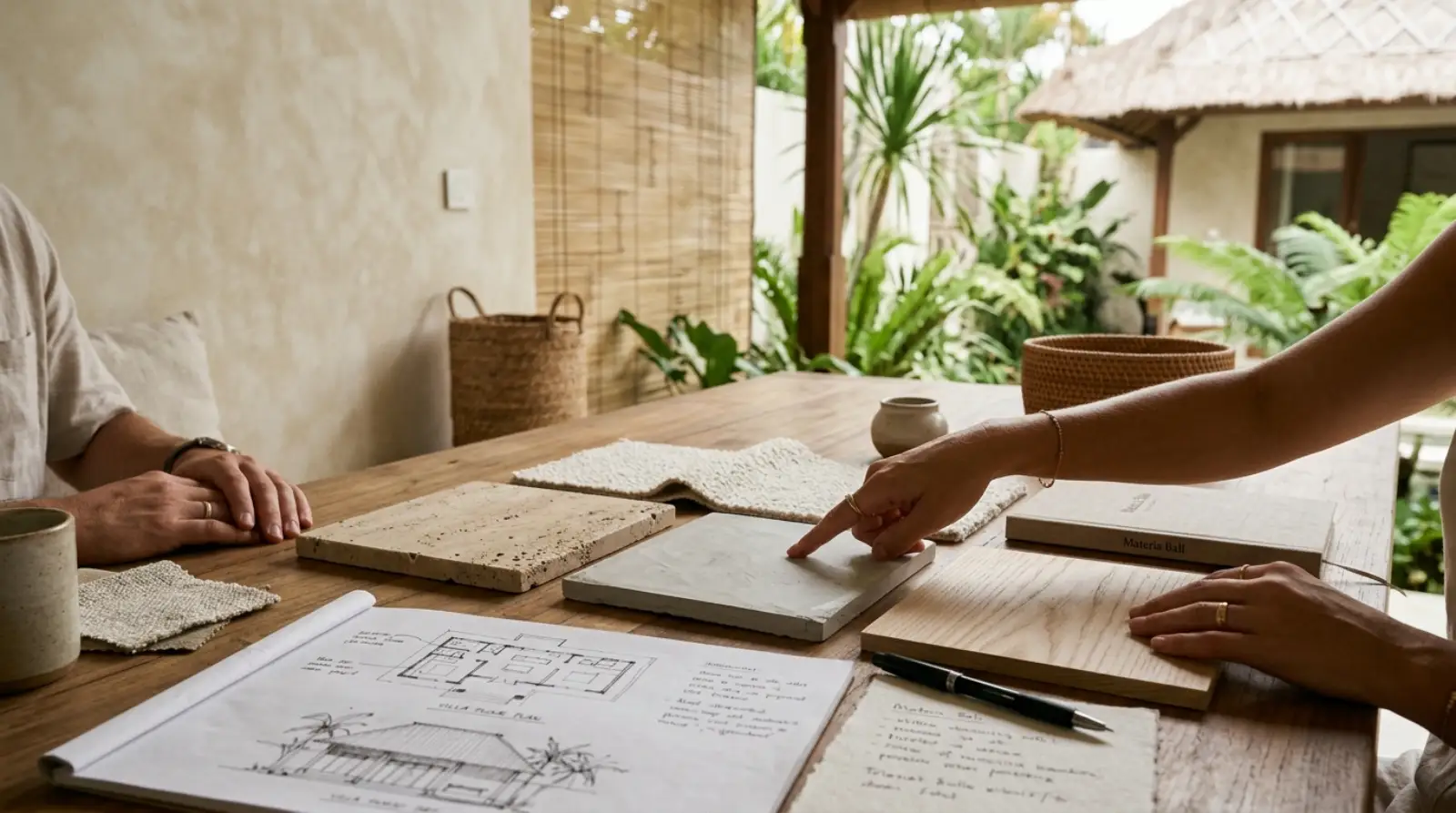
Humidity is the first complication. Many finishes that perform reliably in temperate climates — standard MDF cabinetry, certain laminates, some upholstery fabrics — hold up poorly in a tropical, humid environment. Choosing materials that survive a wet season without warping, rusting, or deteriorating requires knowledge of local production and sourcing that falls squarely within a designer’s scope.
Build quality compounds the problem. Construction standards in Bali vary significantly from project to project. A property that looks finished may have walls that are not plumb, uneven floor levels, or electrical work that will not meet a refurbishment specification. A decorator will dress the room; a designer will identify those problems before they become expensive to correct mid-project.
Then there is sourcing. Bali has a genuinely strong artisan production ecosystem — stone carving, timber joinery, metalwork, and custom furniture — but navigating it to a quality and specification standard requires technical engagement well beyond curation. Studios with in-house production capability are better placed to use that ecosystem effectively.
The net effect is that a project scoped as “decoration” over email often reveals itself as a design project once someone with a trained eye is on site. This is not an argument against decorators — it is simply what tends to happen when specification moves beyond soft furnishings and paint.
How an Integrated Design Studio Fits
One practical limitation of separating design from decoration sometimes creates what the industry calls a hand-off problem. The designer completes the concept, passes it to a decorator to source furnishings and styling elements, who passes the build scope to a contractor. Each transition risks losing something: a contractor substitutes a specified finish, a proportion that mattered to the designer does not survive their interpretation, and a detail simplifies at the build stage because no one holds the original brief.
An integrated design studio closes that gap. Spatial planning, material specification, furniture design, and in-house production sit under one roof, so the intent of the original design carries through to the finished space. For a villa renovation or new fit-out in Bali, that integration tends to produce more consistent results — and fewer mid-build corrections.
If you are ready to work out which service fits your project, our Bali interior design service is the right place to start.
Frequently Asked Questions
An interior decorator focuses on aesthetics — furniture, colour, textiles, and styling — within an existing space. An interior designer also addresses how the space works: layout, lighting, built-ins, and structural changes. The core distinction is that a designer can alter the bones of a room; a decorator works with what is already there.
For a new fit-out, full renovation, or any project involving layout changes, structural work, or material specification, you need a designer. If the space is already well-proportioned and functional, and you want a cosmetic update — new furnishings, a fresh colour palette, or updated textiles — a decorator may be sufficient.
No. Layout changes — moving walls, repositioning openings, altering ceiling heights, or reconfiguring the flow of a space — fall within an interior designer’s scope, not a decorator’s. A decorator works with the existing spatial arrangement and dresses it; they cannot change how it is structured.
A designer’s scope is broader, which typically means the overall project investment is larger — but so is what gets delivered. A decorator handles the furnishing and styling layer; a designer covers everything from spatial planning to finished surfaces. The meaningful comparison is scope, not a direct fee-for-fee contrast.
Yes. A full-service integrated design studio integrates spatial design, material specification, furniture design, and in-house production. This removes the hand-off between separate professionals and means the design intent carries through consistently from brief to finished space, without each stage being interpreted by a different team.