Last Updated on September 1, 2026 by Wisnu Arista H.
Coastal Interior Design in Bali: The Mediterranean-Tropical Approach
Coastal interior design in Bali draws on a Mediterranean reference: whitewashed renders, arched openings, rattan, pale stone. The style translates that through tropical living — breezy and holiday-like, without replicating the Aegean. For the full range of approaches designers use in Bali, the Bali interior design styles guide is where to start.
What Defines the Coastal-Mediterranean Approach
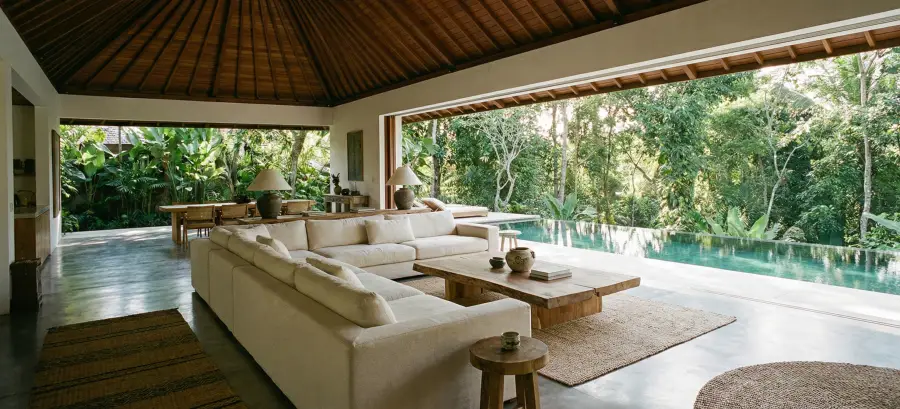
The defining characteristic is lightness — in colour, in material weight, and in the relationship between inside and outside. Where traditional Balinese style builds inward around a courtyard, the coastal approach opens outward. That means wide openings, covered terraces, and living areas that spill naturally toward a garden or pool.
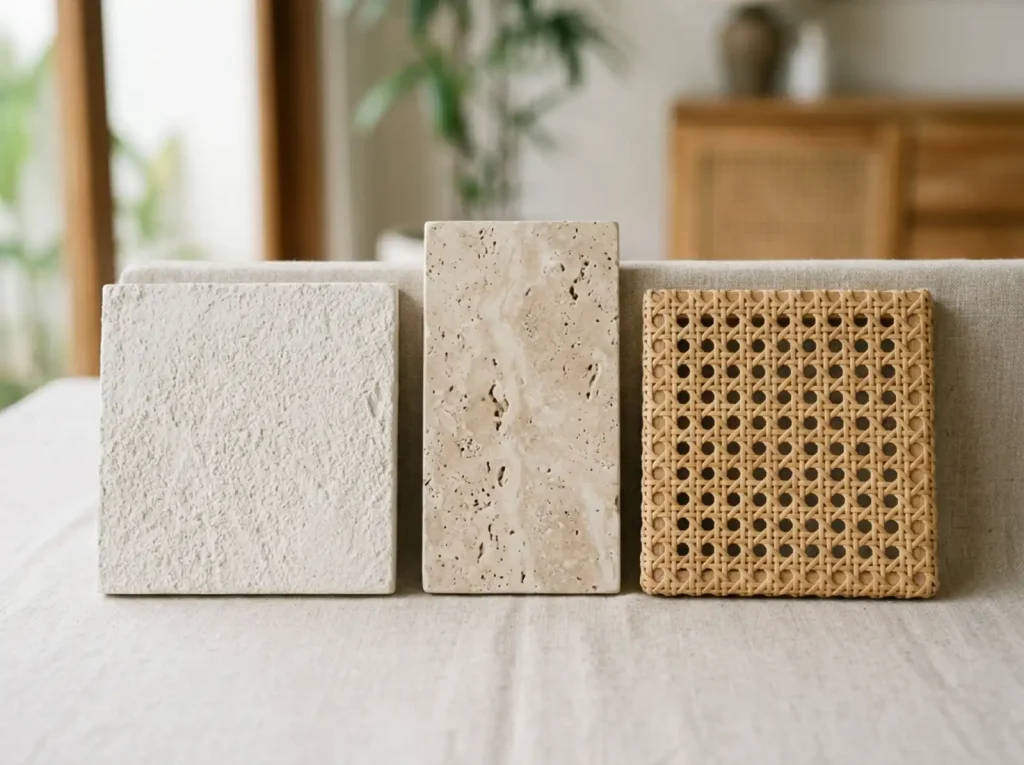
Whitewashed walls form the base. This means mineral or silicate render, not standard vinyl paint. In Bali, a non-breathable coating traps moisture and peels within a season. Arched passageways and limestone flooring also complete the look. The palette reads as warm rather than cold, despite being predominantly white.
Rattan is also the dominant furniture material. It appears in lounge chairs, pendant lights, side tables, and shelving — always natural or lightly bleached, never stained dark. Furniture sits low and loosely arranged, reinforcing the informal, relaxed quality the style is aiming for.
Materials That Hold Up Near the Coast
Material choice in coastal interior design Bali is partly aesthetic and partly practical. Salt air, high humidity, and year-round UV exposure all shape what lasts and what fails.
For wall finishes, mineral render and limewash are the sensible choices. Both allow the wall to breathe — essential where moisture moves through the building fabric daily. By contrast, standard acrylic paint performs poorly here. It looks pristine for a few months, then shows mould shadows and peeling by the first wet season.
Limestone, coral stone, and white-grey travertine all suit the palette and handle barefoot indoor-outdoor traffic well. These stones are naturally porous and therefore require sealing, but once treated they are straightforward to maintain.
For textiles, breathability is the rule. Linen and loosely woven cotton work well. In contrast, synthetic upholstery retains heat and traps moisture in Bali’s humidity — it feels clammy and degrades faster than natural fibre.
Hardware near the coast deserves specific attention. Standard chrome fittings corrode quickly in salt air. Instead, the practical choices are marine-grade stainless steel (grade 316), powder-coated steel, or unlacquered brass. Brass develops a patina rather than pitting — an advantage for properties near the sea.
Where in Bali Coastal Style Works Best
The south and south-west coast is where this style is most naturally at home. That includes Canggu, Pererenan, Seminyak, Umalas, and the Bukit peninsula. We work across all of them, and our area guide covers interior design near you in Bali. These areas receive consistent sea breezes and lower rainfall than the humid interior around Ubud. As a result, lighter-coloured finishes become more viable. Less moisture means less mildew risk on pale render, and the breeze handles the ventilation air-conditioning would otherwise provide.
The north coast (Lovina, Singaraja) and east coast (Amed, Tulamben) share a dry microclimate and support coastal style well. However, the wetter hillside belts — Ubud, Tegallalang, parts of Tabanan — require more careful detailing. That means thicker render coats, anti-mould additives, and reapplication every few years.
Elevation also matters independently of location. A hilltop site above Uluwatu with good airflow often outperforms a valley-floor plot for light finishes. Even when the two are just a few kilometres apart.
Indoor-Outdoor Flow
Bali’s climate makes covered outdoor living almost obligatory, and coastal style accommodates this better than most. Folding or sliding timber-framed doors open the living area fully to a terrace. The terrace becomes its own room — outdoor sofas, a daybed, a dining area — sheltered under a deep roof overhang.
Pools typically follow the same palette: white or pale plaster with limestone coping, rather than blue mosaic. Similarly, stone floors, terrace, and pool surround share the same warm-neutral tone. That continuity is what makes these interiors feel coherent.
Furthermore, ceiling heights are kept generous, and ceiling fans supplement or replace air-conditioning in the main living areas. The choice is both practical and aesthetic. A slowly turning fan reinforces the unhurried quality the style is working toward.

Common Missteps to Avoid
Mixing too many shades of white creates a muddled result. Instead, the palette works when whites are consistent — the same warm tone from walls to ceiling to floor. Introducing cool whites alongside warm ones fragments the lightness that makes the style coherent.
Over-accessorising undermines restraint. Specifically, these interiors read best when surfaces stay clear: a few ceramic pieces, a woven basket, one oversized rattan pendant. Adding shells, driftwood, and nautical motifs tips into themed territory and quickly dates.
Using rattan throughout every room without variation flattens the interior. Rattan works best when it shares space with smooth plaster, stone floors, and plain linen. The contrast between rough woven cane and smooth mineral finishes is what makes it interesting.
Want guidance on how coastal interior design Bali works for a specific site? The Bali interior design studio page is the right starting point.
It is a Mediterranean-tropical hybrid that combines whitewashed renders, arched openings, and rattan with Bali’s indoor-outdoor living tradition. The goal is a breezy, informal feel suited to beach-adjacent properties — light in palette, open in plan, and built around natural materials that perform well in a tropical climate.
The south and south-west coast — Canggu, Seminyak, Pererenan, the Bukit peninsula — and the drier north and east coasts (Lovina, Amed) are the most natural fit. Consistent sea breezes and lower rainfall in these areas reduce the mildew risk that light-coloured finishes face on wetter hillside sites.
Mineral or silicate render rather than vinyl paint is the starting point — breathable coatings allow moisture to move through the wall rather than trapping it behind the finish. Anti-mould additives in the base coat help on more exposed sites, and a reapplication schedule every few years keeps the finish intact.
Limestone, travertine, and coral stone for floors; mineral render and limewash for walls; rattan for furniture and lighting; linen and loosely woven cotton for textiles. For hardware near the sea, marine-grade stainless steel (grade 316) or powder-coated steel rather than chrome, which corrodes quickly in salt air.
It can, but it requires more careful detailing. Higher ambient humidity on hillside and valley-floor sites means light finishes need breathable render coats, anti-mould treatment, and a realistic maintenance commitment. A well-ventilated design — cross-ventilation, high ceilings, generous roof overhangs — reduces the burden considerably.