Last Updated on September 22, 2026 by Wisnu Arista H.
Bali Bedroom Design Ideas: How to Build a Deep Sleep Sanctuary
Living on a tropical island is deeply inspiring during the day. The nights are a different story. Many new residents quickly discover that their bali bedroom design ideas — however beautiful on a mood board — collapse against the reality of 85% humidity, 5am roosters, and monsoon rain loud enough to make sleep genuinely difficult. The bedroom that photographs beautifully in July becomes a different room entirely by January. See our guide to how Bali’s tropical climate shapes interior design for what actually solves this.
If you’re building a permanent home here, the bedroom can no longer be just a pretty backdrop for morning coffee. It needs to be an engineered environment optimized for genuine rest — acoustic protection, climate control, and material durability working together as a single system.
Here’s how that’s done properly.
What Makes a Bali Bedroom Design Ideal for Long-Term Living?
An ideal Bali bedroom design for permanent residents shifts focus from open-air aesthetics to rigorous climate and acoustic control. A successful tropical bedroom must actively protect the homeowner from the island’s environment while maintaining a natural, organic feel.
Key principles for a permanent tropical bedroom:
- Acoustic dampening — blocking roosters, dogs, construction, and monsoon rain
- Heavy kiln-dried teak furniture — resisting humidity and termites for decades
- Dehumidified enclosed wardrobes — protecting clothing, leather, and electronics from mold
- Layered window treatments — sheer linen for daytime, blackout drape for total night silence
- Concealed climate control — ducted systems that don’t compromise the aesthetic
These are the foundational principles behind any successful Bali bedroom design ideas project.
Acoustic Armor: Defeating Island Noise
Acoustic performance is one of the most underestimated elements in Bali bedroom design ideas, and the one that new residents regret ignoring most. The most common complaint from long-term Bali residents isn’t heat — it’s noise. Roosters at 5am. Dogs through the night. Construction hum from 7am across half the island. Achieving real silence requires deliberate engineering, not wishful thinking.
Sound-Dampening Custom Headboards
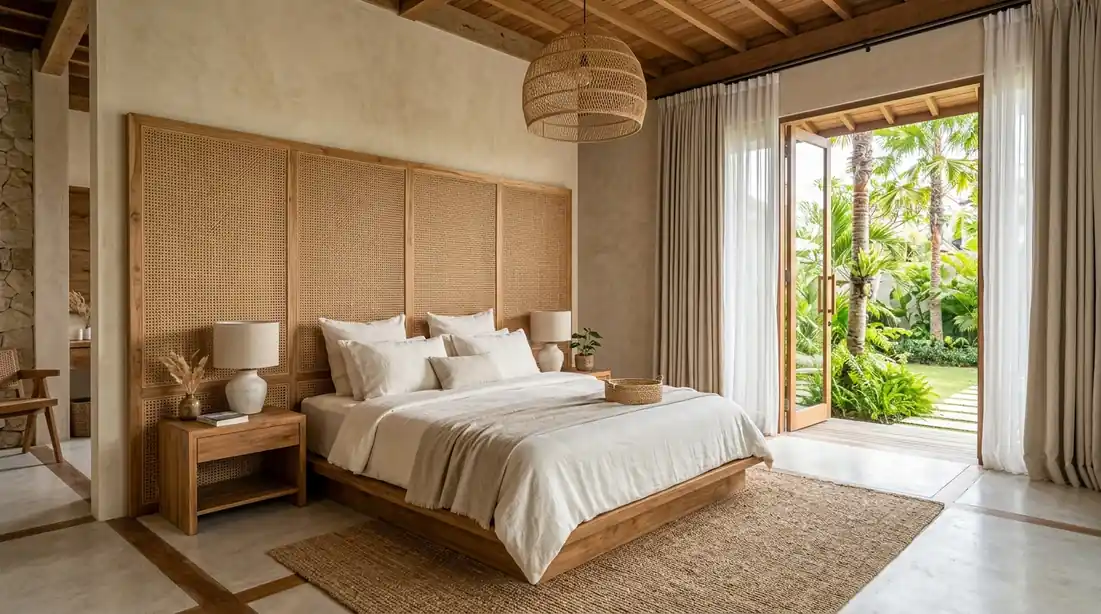
The most effective acoustic intervention in a Bali bedroom is also the most beautiful one. Instead of a flat painted wall behind the bed, an oversized bespoke headboard built specifically for sound absorption serves both functions simultaneously. Marine-grade performance fabric or densely woven natural rattan, backed with high-density acoustic foam, absorbs high-frequency sounds before they reach your ears.
It anchors the room visually while doing real acoustic work. Through our parent manufacturing company, Bali Best Buy, we build these custom-sized to the exact wall dimension, materials specified for tropical performance, and crafted as the room’s defining feature.
Double Glazing and Layered Curtains
Beautiful timber louvers are iconic in tropical design. They also do nothing to stop sound. For a permanent residential bedroom, double-glazed glass on all windows and sliding doors is non-negotiable.
Pair the glazing with a dual-track curtain system — a sheer linen layer to diffuse harsh morning light, and a heavy acoustically-rated blackout drape for total darkness and silence at night. Both layers on independent tracks so the room’s sensory environment can be dialed precisely at any time of day.
The Core Investment: Custom Teak Bed Frame
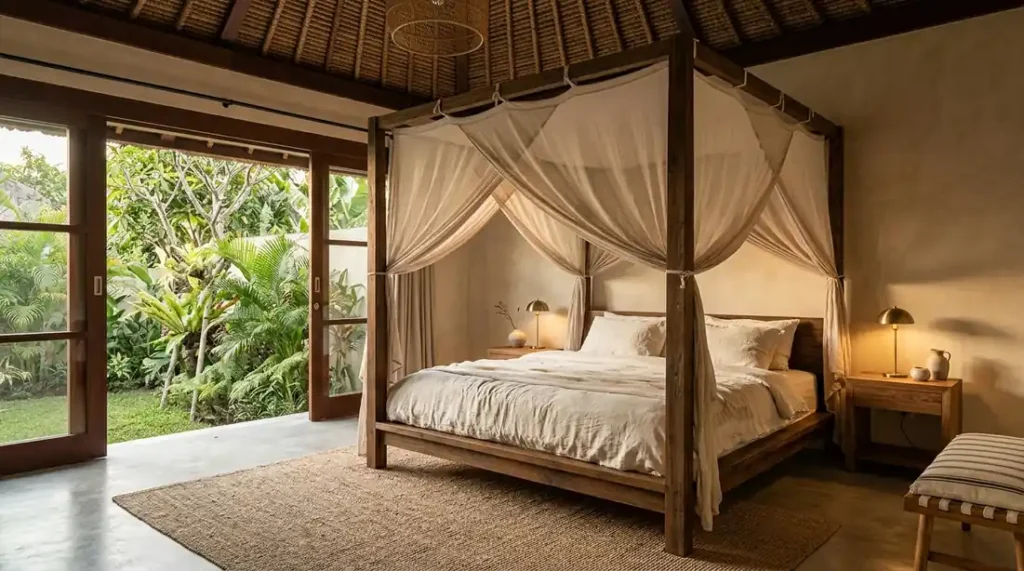
Among all Bali bedroom design ideas, the bed frame is the decision that determines everything else. The bed frame is the structural and visual anchor of everything else in the room. Get it right and the bedroom has a real foundation. Get it wrong and no amount of styling compensates.
Importing a mass-produced frame from Europe or buying flat-pack furniture locally is a guaranteed mistake. Engineered wood absorbs humidity and warps within months. Metal-screw joints loosen with seasonal expansion and contraction — then squeak loudly in the humid air every time you move.
Solid kiln-dried reclaimed Indonesian teak resolves all of those failure modes. Its natural oil content repels termites and resists rot. Traditional interlocking joinery — without metal screws — allows the wood to expand and contract with seasonal changes silently and indefinitely. A custom teak frame doesn’t just look luxurious. It’s a structurally permanent foundation built to last decades. Teak’s durability in tropical climates is well-documented, and Indonesia’s own SVLK forestry certification verifies that the timber was legally harvested and traced through the supply chain, which is the proof to ask a supplier for.
Our production team at BaliBestBuy designs and manufactures custom teak bed frames to the exact dimensions of your bedroom — from low-profile minimalist platforms to four-poster frames built for mosquito netting. Every piece engineered for Bali’s climate from day one.
Climate Control and Dehumidified Storage
The Enclosed Custom Wardrobe
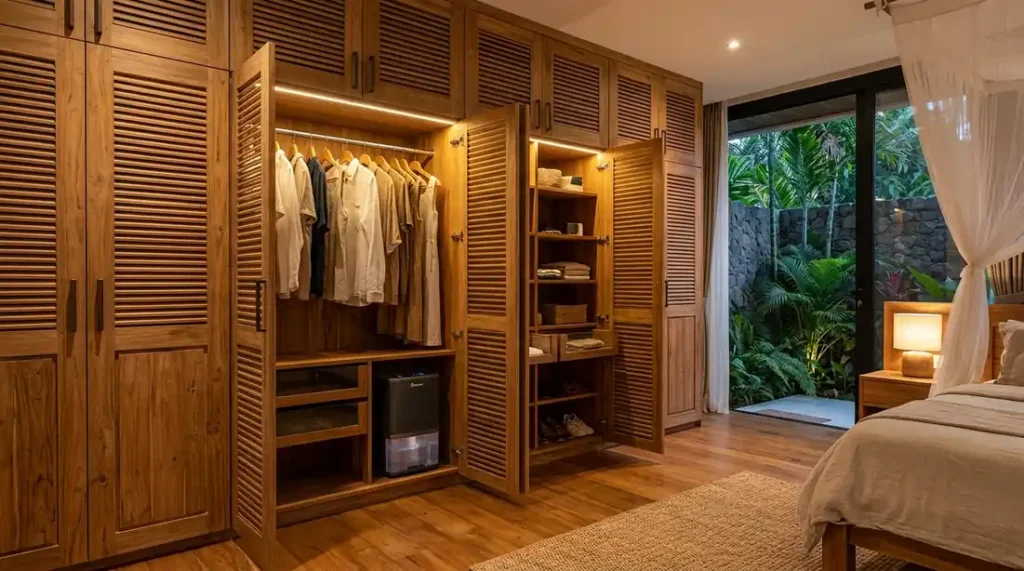
Open rack clothing concepts look great in tropical design magazines. They’re genuinely terrible for permanent residents. Humidity penetrates fabrics directly. Mold develops on leather within weeks.
The correct solution is floor-to-ceiling fully enclosed custom cabinetry, fitted with rubber air seals, passive ventilation louvers in the doors, and dedicated micro-dehumidification units inside. This creates a hyper-dry microclimate for clothing significantly drier than ambient room humidity. Leather goods stay supple. Electronics remain operational. Wool doesn’t develop mildew. Wardrobes at this specification are custom furniture in Bali, built to the room rather than bought to fit it.
Silent AC Concealment
A standard wall-mounted AC unit above the bed is aesthetically wrong and acoustically worse — the compressor hum and direct airflow onto the face both disrupt sleep. The correct solution: ducted VRF systems concealed entirely within the ceiling, or split units hidden behind custom teak slatted bulkheads. Powerful, whisper-quiet, even cooling — with the unit completely invisible.
Style and Material Direction
When it comes to Bali bedroom design ideas for permanent residents, two styles consistently outperform everything else. Two styles dominate permanent Bali bedrooms right now.
Wabi-Sabi
It suits long-term residents who want a room that improves over time. Limewash walls develop patina. Teak silvers gracefully. Linen softens with washing. Instead of fighting the aging effects of Bali’s climate, wabi-sabi incorporates them as the intended outcome.
Japandi
Japandi is the most requested style among expat residents working remotely. Japanese spatial discipline — low furniture, hidden storage, negative space — combined with Scandinavian material warmth. For someone needing a bedroom that genuinely resets the nervous system at the end of every day, Japandi consistently delivers.
In both styles, the material palette is consistent: limewash or clay plaster walls, natural linen bedding, rattan pendant lighting, and reclaimed teak as the structural anchor. Warm white at 2700K across all light sources — the only color temperature that supports sleep preparation rather than working against it.
For a complete picture of how bedroom design fits into a permanent tropical home, explore our full guide to home interior design Bali.
Ready to Bring Your Bali Bedroom Design Ideas to Life?
The Bali bedroom design ideas that genuinely work are the ones you stop noticing after a week — because the result is just comfortable.. The noise stays outside. The air stays dry. The materials don’t fight the climate. If your current bedroom isn’t delivering those three things, the fix is almost always in design decisions made before the furniture arrived.
Ready to start planning your specific space? Speak with our interior design in Bali team about what a full residential brief looks like for your property.
FAQ — Bali Bedroom Design Ideas
Reclaimed Indonesian teak. Its natural oil content repels termites and resists rot. Traditional interlocking joinery allows the wood to move with seasonal humidity changes silently and indefinitely. Imported softwoods, MDF-based frames, and engineered board all fail within a few seasons in Bali’s sustained humidity.
Mold thrives in stagnant damp air. Use fully enclosed cabinetry with rubber air seals and passive ventilation louvers. Install a micro-dehumidifier or replaceable silica moisture absorbers inside the wardrobe — particularly during wet season. The goal is a microclimate 20–30% drier than the ambient room.
Start with double-glazed windows and solid timber doors with weather-stripping seals. Inside, add an oversized upholstered or rattan-faced acoustic headboard, heavy blackout curtains, and a thick natural fiber rug. For rain noise specifically, a low-volume ambient sound source through a ceiling speaker masks the irregular pattern that disrupts sleep more than volume itself.
Working from home too? Our Bali home office design ideas cover the adjoining space many owners plan alongside the bedroom.