Last Updated on August 6, 2026 by Wisnu Arista H.
How Bali’s Tropical Climate Shapes Interior Design
Tropical climate interior design in Bali starts with one fact: humidity, not taste, is the governing variable. A material that performs for years in a dry climate can warp, mould, or corrode within a single wet season here. Bali sits a few degrees south of the equator, with humidity often above 80 percent, salt-laden air near the coast, and a monsoon that soaks everything for months. Design that ignores this ages badly and fast. Design that respects it can look effortless and last for decades. This guide explains how the climate changes each interior decision, which materials survive it, and where ventilation does the work that finishes and furniture cannot, as part of our wider home interior design in Bali coverage.
Why Climate Is the First Design Decision, Not the Last
In most markets, climate is a background concern. In Bali it is the brief. High year-round humidity keeps timber, textiles, metal, and plaster in a constant exchange with the moisture in the air. Wood absorbs it and swells, then releases it and shrinks, so joinery that was tight on install can gap or bow. Fabric holds it, which is how sofas and curtains start to smell musty. Metal reacts to it, and near the coast salt accelerates that into visible rust within months.
The practical consequence is that specification comes before styling. A designer working here has to choose materials for how they behave in a warm, wet, salty envelope first, and for how they look second. The homes that age beautifully in Bali are the ones where that order was respected. The ones that need constant repair are usually the ones styled on imported reference images without adjusting the material list underneath.
What Humidity Actually Does to a Bali Interior
It helps to be specific about the failure modes, because each one points to a fix. Constant moisture drives four recurring problems. Timber and wood-composite panels swell, delaminate, or bow. Untreated or coastal metal hardware oxidises and stains the surfaces around it. Soft furnishings and natural fibres trap damp and grow mould or mildew. Adhesives and low-grade composites break down faster than their dry-climate rating suggests.
None of these are exotic. They are the ordinary result of ordinary materials meeting an extraordinary amount of ambient water. Once you can name the failure mode, the material choice that avoids it becomes obvious, which is why experienced tropical specification looks conservative rather than clever.
Materials That Last vs. Materials That Fail
The table below is a working shortlist, not an absolute rule; a treated or marine-grade version of a “risky” material can perform well, and a good finish matters as much as the base material.
| Element | Holds up well in Bali | Struggles in Bali |
|---|---|---|
| Timber | Teak, ironwood (ulin), properly kiln-dried and oiled hardwoods | Untreated softwood, standard MDF/particleboard |
| Flooring | Natural stone, terrazzo, porcelain tile, sealed microcement | Cheap laminate, unsealed grout |
| Metal / hardware | Stainless steel (marine grade near coast), powder-coated aluminium, brass | Untreated iron, low-grade chrome plating |
| Textiles | Solution-dyed outdoor fabrics, linen, treated rattan and cane | Untreated natural fibres, dense synthetic blends that trap damp |
| Wall finishes | Lime plaster, mineral paint, sealed microcement | Standard interior emulsion in wet zones, vinyl wallpaper |
The pattern is consistent: naturally durable or properly sealed materials survive, while unsealed, low-grade, or dry-climate-rated products fail. Spending a little more on the specification is almost always cheaper than replacing finishes every year or two.

Ventilation and Airflow: The Fix That Isn’t a Material
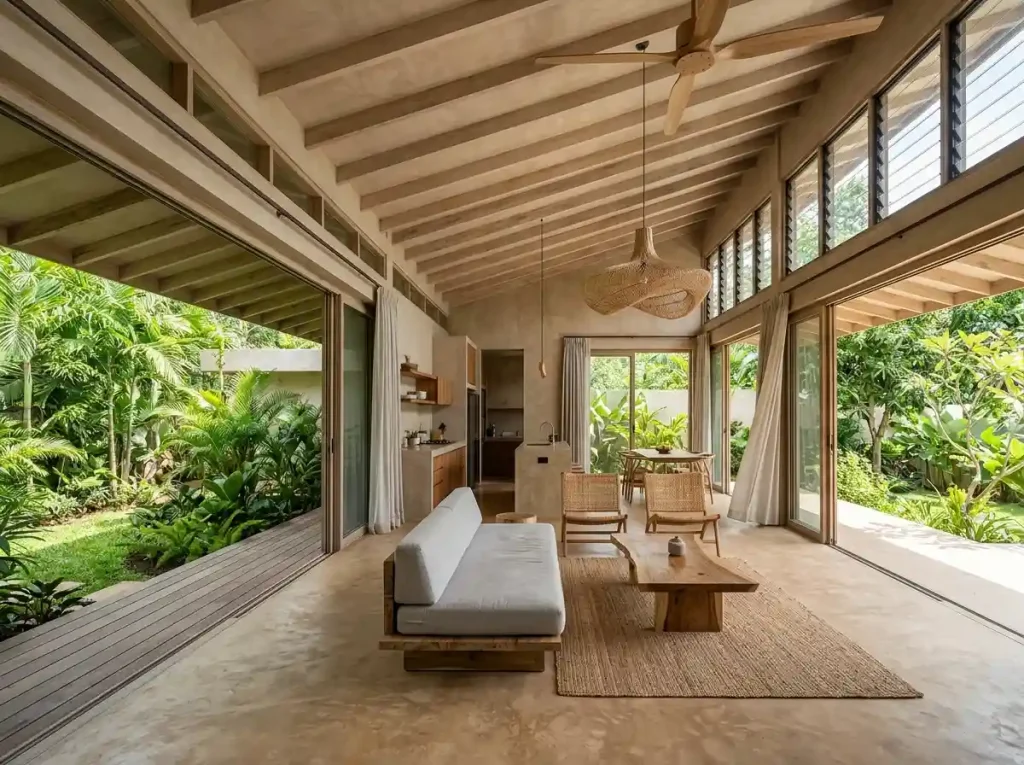
Material choice controls what survives the humidity. Airflow controls how much humidity the interior has to deal with in the first place, and it is the most under-used tool in tropical design. Cross-ventilation, moving air through a space via openings on opposite sides, carries moisture and heat out before they settle into surfaces. High ceilings let hot air rise away from where people sit. Deep roof overhangs and shaded openings keep direct sun and driving rain off the walls.
Traditional Balinese architecture solved this long before air conditioning existed, which is why open pavilions and generous eaves recur across the island. A modern home does not have to be fully open to borrow the principle. Orienting the main rooms to catch prevailing breezes, adding operable openings on more than one wall, and keeping air moving all reduce the load on both the materials and the cooling system. Good passive airflow will not always remove the need for air conditioning in bedrooms or during the most humid stretch of the wet season, but it reduces how hard and how often the mechanical system has to run.
Salt, Sun, and the Coastal Difference
A home fifty metres from the beach faces a harsher version of the same problem. Salt in the air corrodes metal faster and settles on every surface, so coastal projects push harder toward stainless steel, powder-coated aluminium, and finishes that can be wiped down. Ultraviolet exposure is also intense year-round, fading textiles and degrading some plastics and low-grade timber finishes, so UV-stable fabrics and protected finishes matter more the more sun a room gets. An inland or highland home in the cooler air around Ubud gets an easier ride on both counts, which is why the same material list should not be copied blindly from a beachfront villa to a rice-field one.
Designing With the Climate, Not Against It
Pulling it together, tropical climate interior design in Bali is less about a particular look and more about a sequence of decisions made in the right order: understand the envelope, specify materials that survive it, use airflow to lighten the load, then style within those constraints. Done this way the constraints stop feeling like limits. Natural stone, lime plaster, teak, linen, and good cross-ventilation are not compromises; they are what gives a well-built Bali home its calm, grounded, of-the-place feeling in the first place.
Getting the sequence right takes local experience, because the failure modes only show up months after handover, long after a styling-first approach looks finished. If you are planning a build or renovation and want the material and airflow decisions made for your specific site and its exposure, our interior design services in Bali team can assess your location before any finishes are chosen.
These failure modes show up differently room by room. See how they play out in the kitchen, where humidity meets cabinetry daily, and in the bedroom, where heat and noise matter most at night.
FAQ – Tropical Climate Interior Design Bali
Because humidity is high year-round, often above 80 percent, and the air is warm and, near the coast, salty. That keeps timber, metal, and textiles in constant contact with moisture, so materials that last elsewhere can warp, rust, or mould here. Specification has to account for the climate first.
Naturally durable or properly sealed materials perform best: teak and ironwood, natural stone, terrazzo and porcelain tile, marine-grade stainless steel, lime plaster, and treated rattan or outdoor fabrics. The common thread is that they either resist moisture naturally or are sealed to keep it out.
Standard MDF and particleboard, untreated softwood, cheap laminate flooring, untreated iron hardware, and unsealed grout tend to fail fastest. Untreated natural fibres and dense synthetic textiles also trap damp and grow mould. Treated or marine-grade versions of some of these can still work.
Often, but less of it. Good cross-ventilation, high ceilings, and shading reduce heat and humidity and cut how hard the cooling system has to work. Bedrooms and the most humid stretch of the wet season may still call for air conditioning, so passive airflow reduces the load rather than always replacing it.
Combine three things: keep air moving with cross-ventilation, choose moisture-resistant and sealed materials in wet-prone areas, and avoid trapping damp behind vinyl wallpaper or dense finishes. Good airflow and the right surfaces prevent most mould before it starts, which is easier than treating it after.