Last Updated on September 1, 2026 by Wisnu Arista H.
Bali Dining Room Design Ideas: The 2026 Tropical Blueprint
Most dining rooms in Bali fail within two years. The imported table warps from humidity, the sideboard mildews behind, mosquitoes invade the open layout, and the acoustics turn dinner conversation into shouting. If you’re searching for Bali dining room design ideas that survive long-term island living, the difference between Pinterest aesthetics and real-world livability comes down to climate engineering — not styling.
This guide is the master blueprint we use at Bali Best Design for expats, investors, and villa owners building permanent residences on the island. Every recommendation here is drawn from actual project execution, not stock-photo inspiration.
What Makes Great Bali Dining Room Design Ideas for Permanent Homes?
A well-executed Bali dining room design engineers indoor comfort against three tropical constants: 65–85% year-round humidity, monsoon rain acoustics, and indoor-outdoor living as the default. The non-negotiables are strategic cross-ventilation, kiln-dried teak furniture, acoustic dampening, weather-rated lighting, concealed climate control, and seamless flooring transitions.
Skip any one of these and the room fails within two wet seasons. Here’s how each principle works in practice.
- Strategic cross-ventilation to naturally cool the space and circulate humid air
- Kiln-dried teak that resists warping, termites, and humidity-driven joint failure
- Acoustic management to dampen echoes from hard concrete floors and glass panels
- Weather-rated lighting with marine-grade wiring for humid, salty air
- Concealed micro-climate control (hidden VRF systems) for comfort without ruining aesthetic
- Seamless flooring transitions between indoor dining and outdoor deck
These are the non-negotiables that distinguish successful Bali dining room design ideas from expensive failures. If you’re planning a renovation or new build, our Bali interior design team handles the design that you envisioned.
Engineering the Semi-Outdoor Dining Layout
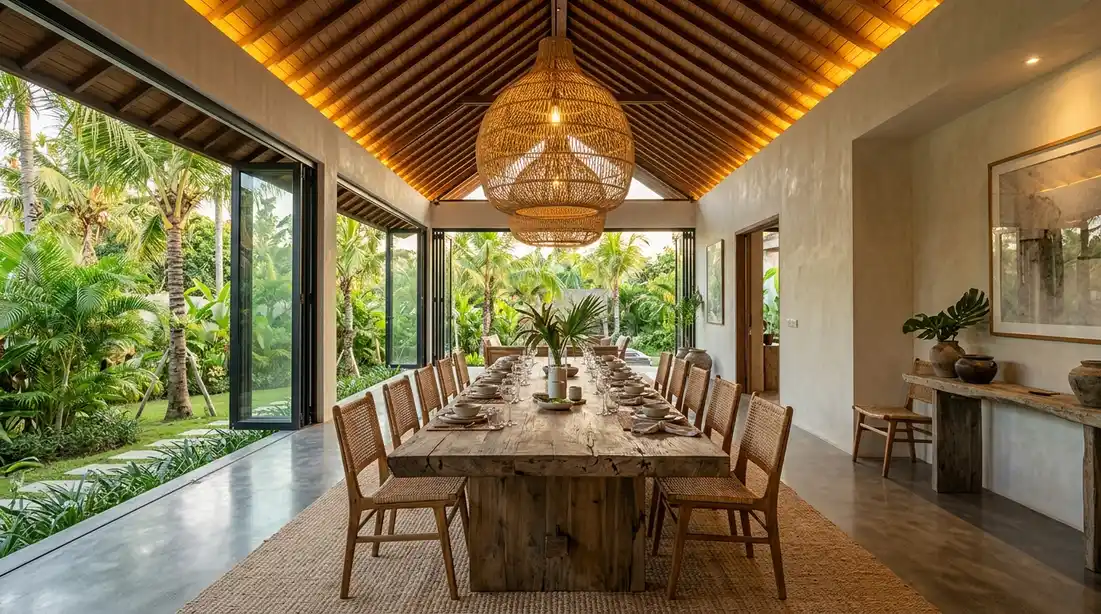
Among all Bali dining room design ideas, the layout decision is the one with the longest-lasting consequences. We rarely design fully enclosed “drywall boxes” for island clients. Instead, we engineer spaces that breathe and adapt to the time of day. Heavy-duty bi-fold glass doors or open-pavilion (Joglo) architectural styles invite natural cross-breezes directly into the dining core.
Here’s what most guides skip: this layout drastically reduces daily energy costs while keeping the space naturally cool, fresh, and free of musty odors.
When the wet season hits or when local farmers burn their fields, industrial-grade glass partitions seal completely in seconds. This protects your custom furniture from sideways rain and ash without blocking the lush garden views. We also calculate exact sun trajectory when planning the layout, ensuring the dining table is shielded from blinding morning or late afternoon glare.
Taming the Echo: Acoustic Solutions for Open Spaces
A common mistake in tropical architecture is ignoring acoustics. Bali dining rooms typically feature polished concrete floors, solid wood tables, and expansive glass doors. While visually striking, these hard surfaces bounce sound waves aggressively — making dinner conversation deafeningly loud.
To solve this, we engineer passive sound-dampening directly into the room.
Thick, hand-loomed natural fiber rugs (sisal or jute) beneath the dining table absorb ambient noise instantly. Instead of flat ceilings, we incorporate slatted timber ceiling designs backed with acoustic fabric. This single architectural decision breaks up sound waves and reduces room echo significantly, keeping dinner parties intimate and conversation-friendly.
The Core Investment: Custom Teak Dining Tables
At the center of every successful Bali dining room design ideas project is the table itself. Importing mass-produced MDF tables from Europe or buying flat-pack engineered wood locally is a guaranteed, expensive mistake. Extreme island humidity will warp engineered wood within months, and salty air rapidly degrades weak metal joints.
This is exactly where local bespoke manufacturing becomes essential. A dining table is the clearest case for custom furniture built in our own workshop.
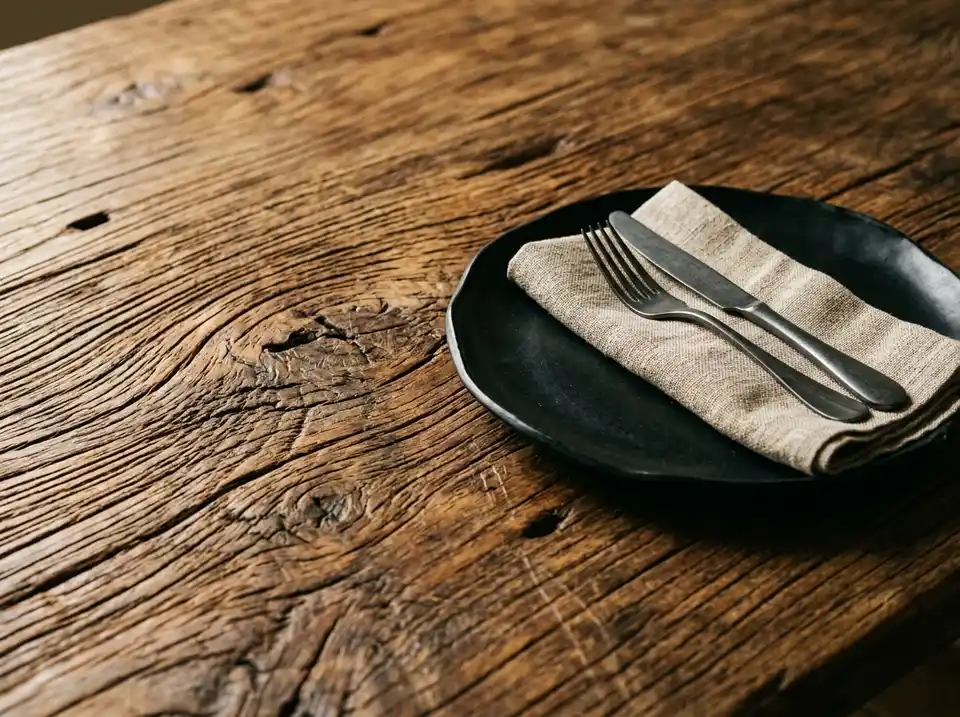
We engineer our dining tables exclusively from solid, kiln-dried reclaimed Indonesian teak. The remarkably high natural oil content in mature teak acts as an organic shield against wood-boring pests, rot, and moisture.
Dining Table Material Ranking for Bali Climate
The truth is, not every wood survives Bali. Based on actual project performance:
- Kiln-dried reclaimed teak — gold standard. Already weathered, dimensionally stable, beautiful patina
- Suar wood (locally sourced) — strong, characterful, handles humidity well when finished properly
- Solid Indonesian mahogany — good performer when kiln-dried; avoid air-dried versions
- New teak — works, but moves significantly during its first 2 years
- Imported European oak or walnut — fails reliably; avoid
- MDF or veneered tables — guaranteed mistake. Will delaminate within a wet season
Bali Dining Room Layout: How Big and Where to Place It
The right table size depends on seat count and circulation space — minimum 120 cm clearance around the entire table is non-negotiable for guest comfort and serving flow.
| Seats | Rectangular Table | Round Table | Min Room Size |
|---|---|---|---|
| 4 | 120 × 80 cm | 110 cm Ø | 2.6 × 2.4 m |
| 6 | 160 × 90 cm | 140 cm Ø | 3.4 × 2.7 m |
| 8 | 220 × 100 cm | 160 cm Ø | 4.0 × 2.8 m |
| 10 | 280 × 110 cm | — | 4.6 × 2.9 m |
For placement, orient the long axis of the dining table perpendicular to your primary breeze direction. In most of South Bali, that’s east-west tables to catch the prevailing southeast wind. This single decision changes how comfortable your dining room feels in dry season.
Custom Seating: Beyond the Standard Bench
Seating is the element most often treated as an afterthought in Bali dining room design ideas — and the one guests notice most within an hour. We often move away from rigid wooden benches and instead design bespoke dining chairs that combine a solid teak frame with tightly woven, breathable natural rattan backs.
This provides essential airflow to your guests’ backs, preventing the uncomfortable “sticky” feeling common in tropical climates. High-density, outdoor-rated foam cushions provide hours of seating comfort without absorbing humidity.
Integrating Invisible Climate Control
While natural ventilation is the goal, air conditioning remains mandatory for humid, windless nights in Bali. However, staring at a bulky yellowing plastic AC unit mounted on a beautiful feature wall completely ruins the carefully curated organic aesthetic.
Our solution is absolute concealment.
We use hidden ducted VRF (Variable Refrigerant Flow) systems or conceal heavy-duty split units within custom teak slatted bulkheads above the dining area. This advanced climate strategy delivers powerful, whisper-quiet cooling that cascades evenly over the dining table — rather than blowing directly onto guests’ food or faces.
Strategic Lighting & Breathable Textures
Lighting a semi-outdoor dining space requires a specialized, technical approach. Standard indoor pendants from retail stores will corrode or short-circuit within 18 months in the humid, salty island air — especially in coastal areas like Canggu or Uluwatu.
We source oversized rattan chandeliers and ensure all internal wiring is marine-grade or explicitly rated for outdoor use.
To soften the heavy architectural elements of concrete and teak, we layer the space with organic, breathable textures. Instead of flat chemical paints that blister in the heat, we apply natural limewash or clay plasters to dining room walls. These finishes are naturally antimicrobial, allow walls to “breathe” out trapped moisture, and provide a soft matte texture that absorbs evening candlelight beautifully.
The Sideboard Problem: Why Imported Buffets Fail in Bali
One of the most overlooked Bali dining room design ideas involves what sits against the wall, not what sits in the center. Imported buffets and sideboards fail in Bali for one reason: they’re built in dry climates with materials that swell, warp, and grow mold in tropical humidity. Drawers stop closing within a year. Back panels — usually thin MDF — start delaminating from the inside out.
A properly engineered Bali sideboard requires three things: solid wood construction (not veneered), ventilated back panels to prevent mold buildup against the wall, and brass or stainless hardware instead of plated steel that corrodes within months.
Our production team at BaliBestBuy designs and manufactures custom sideboards and buffets directly — every piece built for Bali’s humidity from day one.
Space Planning & Ergonomic Flow
A well-executed collection of Bali dining room design ideas becomes more valuable over time. In a villa setting, the dining room often serves as the high-traffic bridge between the kitchen, living room, and pool deck.
We strictly enforce minimum 120 cm clearance around the entire dining table. This ensures guests can push chairs back comfortably and staff or hosts can serve food seamlessly without squeezing past seated guests. These ergonomic micro-measurements separate a house that photographs well from a home that’s effortless to live in.
FAQ — Bali Dining Room Design Ideas
Kiln-dried reclaimed teak is the best dining table material for Bali. It’s dimensionally stable because it’s already survived decades of tropical exposure, won’t warp like new teak in its first years, and develops a beautiful natural patina. Avoid MDF, veneered tables, and imported European hardwoods, which fail within 1–2 wet seasons. This is the material foundation every set of Bali dining room design ideas should start from.
For most Bali homes, an indoor-outdoor configuration outperforms either extreme. Full-width sliding or bifold doors give you the open-air experience 80% of the year and complete enclosure during heavy rain or mosquito-heavy evenings. Fully outdoor dining works for ceremonial use, but daily dining benefits from the flexibility of a transitional space.
Effective insect management is architectural, not chemical. High-powered silent ceiling fans directly above the dining table create consistent downward airflow that physically prevents mosquitoes from landing. Subtle retractable insect screens on louvered windows, plus natural repellents like lemongrass and citronella planted around the perimeter, provide a strong organic line of defense.
The best protection starts with selecting kiln-dried teak as the core material. For ongoing maintenance, avoid prolonged direct afternoon sunlight to prevent bleaching. Apply high-quality natural wood oils or specialized protective sealants every 6–8 months to keep timber hydrated and prevent micro-cracking on the surface.
Ready to Bring Your Bali Dining Room Design Ideas to Life?
A masterfully designed tropical dining room is more than a place to eat — it’s the social heart of your climate-controlled sanctuary. Smart acoustic planning, uncompromising bespoke teak craftsmanship, and engineered weather protection compound over decades of daily use.
If you’re planning a renovation or new build, our Bali interior design studio handles dining room design as part of integrated home interior design Bali projects, from concept through production. Contact us to start drafting the blueprint for your permanent island home.